Steve Goble

Choose life. (Deuteronomy 30:19)

(2,500 words)
The familiar iconic TV theme echoed up the stairs, and Lee and I looked at each other in Pavlovian excitement.

"Star Trek!" we both chanted!

Well, that was that. We rushed down the stairs and were in front of his television set for the duration.

That's my first memory of Star Trek.

How old were we? Pfft. Single figures.

I mean we weren't even that into the series, but everyone at school in the UK, heck everyone in the whole wide world, knew who Dr. Spock was. And his Space Ship Enterprize. Not to mention Captain Slog's famous catchphrase that he said every single week: "Beam me up Scottie!" "Ye cannae change the laws o'physics!" Oh no, that's right, that came later with that song. Och, everything was so straightforward back then. We were like mini Trekkies.

(which sounds like a chocolate bar)

However it wasn't until roughly 18:40 on Tuesday 26th June 1984 - when I was 13 - that I would really get into the series properly, albeit in black and white.

BBC1 began to run what Radio Times was trumpeting would be "the entire series again". I was quite into Doctor Who at the time, and while that was off the air between seasons, it seemed like I really ought to be absorbing other science-fiction shows too.

This screening also looked to be a once-in-a-lifetime opportunity. In London in 1984, we had just the four TV channels. Star Trek was a 20-year-old import, which was not available to ever be watched again by any means other than BBC1 deigning to repeat it. It was not available on VHS, apart from anything else because every sell-through VHS tape cost in the region of £30.00 each, so releasing all 80 episodes was plainly impractical. Frankly, if the BBC were about to rerun all three series again, and in the 'right' (NBC) order, then this would probably be my last chance to follow the entire run for the rest of my life.

Because we had no video recorder (in fact only a black and white telly at that point), the coming years would see me saving my pocket money to buy quite a few blank audio tapes to record almost all the show's soundtracks on. Bizarrely, two WH Smith 60-minute tapes worked out much cheaper then one TDK 120. However to avoid missing the middle of each show while turning the cassette over, right from the start I would record the programme onto one side of the C120, and then during the week dub it via a DIN lead onto both sides of its own C60, making sure that the end of side one and the start of side two overlapped each other. (upon later getting a VCR, because videotapes were several times more expensive, I sometimes used the E180 instead of the C120) It took me ages to realise that I could save time by having two tape recorders running for the first half hour. Today I still have a big tin containing all those audio cassettes, and on occasion, BBC continuity announcements, including a few over the final scene!

Copying out the castlists from Radio Times onto the inlay cards, I quickly found that new words were entering my lexicon, as I had to figure out who people like "Uhura", "Shatner", and "De Forrest Kelley" (sic) were.

Attempting to begin watching Star Trek through the lens of my Doctor Who experience, the series struck me as inherently weaker, for several reasons:

1. Until I could get up to the movies, there could be no continuity to Star Trek. The 78 self-contained episodes were even aired in a different order to how they had been made, which exacerbated this. Try as I might to get involved, I knew that no event could affect the universe, or even the characters' memories, for any longer than 45 minutes.

2. Unlike in Doctor Who where the characters' feelings were usually implied, here they sometimes got verbalised. This was always done badly. Sometimes they would even kiss, reducing the show from a science fiction, to just a very ordinary one. I would just have to sit these scenes out until when the imagination came back on again.

3. The music was only orchestral, and therefore sounded historical, rather than electronic and futuristic.

4. The characters couldn't travel outside of their own time, much.

Nonetheless, I quickly came up to speed, as like so many viewers before me, the exciting world of Star Trek took a firm hold of my imagination.

I bought the third TV novelisation by James Blish, but quickly decided that these 15-20 page abridgements of each episode couldn't really compare with the one book to one story methodology of Target's Doctor Who range. I started buying the all-original Star Trek DC Comic series, despite UK distributor Comag regularly pasting a "35p" sticker over the preprinted "30p" label as though they thought we collectors wouldn't peel them off and notice. On occasion I would even make up my own Star Trek stories, and record them onto the blank spaces at the end of my audio tapes, with full music and sound effects of course.

I had dreams about living on the USS Enterprise. That transporter was a thing of fascination for me. On the show the characters would freeze as they dematerialised, so did that mean that they were temporarily paralysed, or no longer conscious? Were their bodies reformed using the same molecules, or were they locally-sourced copies, and what implications did this have for their souls? What the heck did that warning notice on the transporter's wall in the movies say, let alone mean that they were in danger of?

In fact, the disparity in technology between the TV episodes and the concurrent movies had my muse working overtime.

That same year I went to London to see the new movie Star Trek III: The Search For Spock (or, according to the reliably-informed BBC continuity announcer, Star Trek III: In Search Of Spock). I discovered that the Enterprise's many different warp options had by now been reduced to just the one "Warp speed", which sounded inferior. This now left a colourful rainbow-like trail behind the ship too, which on 70mm film sounded ear-splitting, like Concorde was going overhead. At another point I could swear that there was a tannoy announcement being made outside the back of the cinema, but only during the one scene. Hm. I don't know, with all the 'advances' in technology, movies just never seem to work that unforgettable magic on me today.

Back on BBC1 though, I was about to learn a harsh lesson about how well the BBC's word could be trusted, or maybe just the personal opinions of its controller in those days. Today it's hard to believe that BBC1 used to broadcast any science-fiction at all from America at prime time, as after only nine episodes the BBC rescheduled the show - for the first time ever - to within children's programming at 17:10 on Tuesday afternoon.


There was an enormous outcry of course - how were those adults who had been following the series now supposed to keep up with it while on their way home from work? The BBC's solution was that they should simply miss it, but presumably continue to pay their licence fee.

A few months later the BBC1 channel controller would cancel Doctor Who and a while after that the promised third series of the SF book-trilogy The Tripods. Thanks Michael Grade, who years later in 2002 would admit "I actually hate sci-fi." (he was appearing on Room 101, to argue again for the banishment of Doctor Who, three years after the end of its final episode)

It was the worst time to be a young science fiction fan in Britain, but at least these reruns of Star Trek continued to offer a refuge when they were on, despite their slightly haphazard presentation.

In the US, and indeed in Britain today, Star Trek always begins with a prologue scene, followed by the opening credits, followed by the first act, over which the episode title, names of guest stars and other sub-credits are superimposed. However for many years in Britain the opening credits were chopped out and spliced onto the very start instead. Why, I can only guess. Week after week this resulted in two things:

1. Upon the final fade-out of the opening credits, the sense that I was now on the brink of three quarters-of-an-hour of pure unadulterated Star Trek. The Americans never got that feeling, and it's missing from all British reruns today, including the DVD versions. To experience that moment, you had to be there each week.

2. The story's interruption by a second series of credits several minutes adrift from first lot.

For some reason this was standard practice in the UK for all US programmes.

Today most TV companies transmit shows from a computer file, but in the mid-1980s, the BBC was still airing Star Trek off of high-definition film. What I mean is that while I was watching it at home, someone in BBC Television Centre would be simultaneously running an actual reel of film of the episode past a white light in a machine to broadcast it. Of course they were - that's how they'd been transmitting the show since the 1960s.

However with repeated transmissions over the years, the film prints had also suffered damage. Bits and pieces would have to get cut out, sometimes resulting in a significantly depleted running-time. When this particular airing got up to the episode The Return Of The Archons, the splice holding the end of the prologue to the start of the first act memorably broke live on air:

(these days the digital picture just freezes and pixelates as standard)

By now the series had been restored back to a later 6:55pm slot again (barring the above episode at 7pm), which held for five whole episodes until Who Mourns For Adonais?, when it was taken off the air completely for several months. Responding to complaints from cheated viewers, Radio Times slimily clarified that "… although the re-run of Star Trek was announced as being 'complete', it was never planned to be continuous…"

Okay. So that's how you want to run your station. The viewers who fund you have to watch what you want to show, not the other way around. Okay. Welcome to the BBC's definition of 'public service broadcasting'.

But you know what? Star Trek did indeed periodically return.

We got our first colour telly, and BBC2 took over the series' airing, on occasion tarting up the black background of their big knobbly orange logo with the show's opening starfield, and then very slowly dissolving out while the theme started.

(as it happened, such programme-specific idents were the shape of things to come) Eventually, after a brief detour for the Leonard Nimoy: Star Trek Memories clips show on 29th August 1985 at 18:40 (bumped back 25 minutes from 18:15 by the cricket), the BBC even make it all the way through to reshowing the final episode Turnabout Intruder. Well, most of the way. For as it turned out, this re-run would be neither 'complete' nor 'continuous'. Because the BBC missed out four episodes altogether.

Miri had been banned due to unsuitable content after its first transmission back in 1970, following which Plato's Stepchildren, The Empath and Whom Gods Destroy had been preemptively removed from the BBC's schedules. Seriously, we never got those episodes at all until the next complete run-through, which began on BBC2 in the 6-7pm slot in August 1992, interrupting the Beeb's first run of The Next Generation, straight after part two of The Best Of Both Worlds. Yep, they took the new episodes off the air for 18 months to rerun the originals yet again!

This time the BBC had also acquired brand new copies of the whole series on videotape. On the one hand, these were full-length versions with the opening credits in the right place after the prologue etc. On the other hand, they were 625-line UK videotape transfers from inferior 525-line US videotapes. Garish colours, awkward movements, muffled sound, but what are you gonna do? Well, if you're like me, now with a job and an income, you carefully record them all over again on VHS in production order, and hang onto those old audio cassettes just in case the BBC have again tinkered with them anyway…

But no, I didn't watch them all a second time, even despite the opportunity to resee the early ones in colour. I did however watch the very first episode.

Rather beautifully, BBC2 kicked off this latest repeat series with yet another hitherto missing episode - the first ever full-length UK screening of Star Trek's original hour-long pilot The Cage. The full colour version of this had only just been rediscovered, and was a delight to see, even despite its non-synoptic status with regards to the rest of the run. Jeffrey Hunter as Captain Christopher Pike… wow, I could watch a whole series with that cast…

As I say, further down the line all four banned episodes did get shown this time, maybe due to changed attitudes, but it seemed to me more likely because no-one at the BBC now knew that they had been banned. They were, after all, no longer in the same film cans, being on tape.

When each of the last three of those 'new' shows went out though, somehow I was doing other things. I caught bits of each of them, but was secretly pleased that within my VHS archives I now had what to me were three fresh instalments of such a great show to look forward to one day watching fresh.

Time passed, along with the rest of The Next Generation, further movies, Deep Space Nine, Voyager and Enterprise. I even managed to rediscover the old cartoon series.

This year - 2013 - I finally dug out those old tapes of the three episodes that I had never seen, and we watched them, in production order, and with the few intervening episodes between each of them, at a rate of one a week (mostly).

Enthralling, and so worth the wait.

In this article, I haven't spoken much about Star Trek's merits as a series, because it seems to me that enough commentators before me have already got that more than covered. However returning to view these later episodes in my forties, I am honestly bowled over by just how good the old show was (usually). It really is very serious indeed, there's a lot of subtlety to the writing and performances, fantastic ideas (Wink Of An Eye!) and enough time and exploration to really get your teeth into a story. I've also found it to be surprisingly musical. Somehow, no other incarnation of Star Trek has ever quite managed to reproduce these things. Well, maybe apart from Deep Space Nine, but in a different way.

So, this lunchtime, aged 42, I watched my final 'new' episode of Star Trek entitled Whom Gods Destroy, which turned out to be reminiscent of Plato's Stepchildren.

After four seasons of Star Trek: Enterprise, it's sparkling to see other alien races like the Andorians through such a deeper, broader context. It's refreshing how Kirk and Spock manage to take a back seat to events and become passive enough to let the Rigellian Marta perform her whole dance, secure in the knowledge that their viewers are as much interested in the place where they've landed as they are. Today lead actor William Shatner would be expected by all to sing a song himself, or at least narrate it.

Yes, here in 2013 William Shatner is now a TV icon for sending himself up, and in this episode he plays a dual role! As Fleet Captain Garth pretending to be Kirk, he screams, runs, waves his arms in the air, sinks to his knees and pummels the ground in his defeat! Is he just trying to make his other role look good?

Well, after almost thirty years, I guess that's what we now refer to as Star Trek: The Original Series complete for me. I always thought it was a mistake to stop making movies with this cast - get as much new Trek out of them while we could I reckoned - but it's encouraging to look back at my 13-year-old self and see that I made a good decision there that Tuesday night in 1984.

A five-year mission? Well, I admit I might not have started if Radio Times had told me that it would be a 29-year one!

(available, without the above sketch, here)

Labels: ,

It is with a heavy heart that I have to tonight report the sad news that:

a. Steven Moffat is dead, and

b. the BBC have mounted a cover-up.

Well, maybe he's not dead. Maybe he just has what communist Russia might term "a slight cold".

I suppose the BBC are concerned about such news potentially damaging international sales in this, Doctor Who's fiftieth anniversary year. Accordingly they seem to have hired a ghost-writer to 'do a Moffat' to keep on churning out his distinctive style of script so that the public, and overseas buyers, don't notice his absence. A bit like Max Headroom standing in for Edison Carter.

I just have no other plausable explanation for the extensive recycling of his previous scripts in tonight's episode, plus its delay in transmission by six months. This featured such dutifully reproduced Moffatisms as the Doctor becoming a recluse, the TARDIS' external telephone impossibly working, children, automatons disguised as humans, a bit of innuendo, and a lippy girl whose identity holds the key to the mystery.

(less well-trodden recycling would include leaving said girl in danger to go get coffees, storing people on computer, the motorbike sequence and the TARDIS materialising on an aeroplane, but I'll let them have those)

Even the real villain pulling the strings here turns out to be only the boring old Great Intelligence again, unseen in the series since… oh, the preceding episode, which was also written 'by Steven Moffat'. That time the GI had been plotting to take over the world using snowmen, so we can hardly be expected to find any awe at all in the lightweight entity's 'return' here.

Hmm, or is there? Might we be going to see said entity retconned into being the villainous computer WOTAN in 1966's The War Machines, to explain why the Doctor was actually called 'Doctor Who' in that one? Perhaps similar villainous computer BOSS in 1973's The Green Death also? Let's see, there are 33 Saturdays between now and the fiftieth anniversary on Saturday 23rd November 2013, 20 episodes in hand to screen leaving 13 unaccounted for. A story from each of the 10 earlier Doctors leaves three Saturdays still outstanding, which would be negligible… Wouldn't it be great if we actually got a new second-unit story for each of the surviving Doctors this year, plus minisodes and traditional team-up at the end? Well, I'm not holding my breath, but all the same, the joy in Doctor Who has always been its power to fire the imagination, so I'll dream a little longer while I still can.

Anyway, while I'm a bit vague on the GI's plan this time (something to do with storing people / replacing people / needing them to have clicked on a link to do so), there are a lot of good ingredients in this latest crowd-pleasing season-opener. Wi-Fi, the cloud, the Shard, the flagrant use of time-travel, Moffat's trademark use of banter… yes, this is exactly what you would manufacture if you were trying to forge his style.

And yet, the thing about his scripts that has always made me go wow would have to be all his new ideas. And this episode sadly has none.

Confusingly, there are even Russell T Davies-isms littered throughout, including the present-day alien invasion that no-one remembers afterwards, BBC News, and the handy pressing of a button to handily undo everything at the end handily. Consequently, the plot is identical to The Power Of Three, which as you know was only three programmes ago.

Basically, this is a great episode if you have never seen Doctor Who before and so won't recognise these tropes. It's fun, exciting, and not the least bit scary. It's also set in London and refreshingly actually filmed there for a change.

The difference between this and the usual trying to get away with Wales in its place is stunning. I can actually place where in my world many of these events are set. And though he lives 10,000 miles away from London, I know that my friend Rob will enjoy this too, for similar reasons.

And after everything I said last time about the Doctor looking older, in this one he manages to look even younger than in The Eleventh Hour. How does he do it? Well, given how long this one's been waiting to get shown, they've probably been shot years apart and in the wrong order.

All in all, I enjoyed this start to finish. Fuzzy picture in places, quiet audio but mixed well for a change, and some new music and costume design choices, all good. And, having witnessed the same companion's death twice before now, in this one she really did look like she wasn't going to make it. Now that is a tough thing to convince a weekly TV viewer.

But I couldn't watch 14 remakes of this each year.

As I said, Doctor Who's strength has always lain in its imagination, and that requires at least some elements to be fresh.

I hope you're still out there somewhere, Steven Moffat, and not trapped in your own story.

Now, that is the sort of thing we've come to expect of you…

Labels: ,

I guess we'd all like to win at Who Wants To Be A Millionaire?, no matter what the cost.

Well, maybe not at the cost that it looks like Jamal may be about to.

He knows so many of the correct answers, he claims, because they have all been indelibly burnt onto his psyche at key traumatic moments throughout his life.

For example, his very first question turns out to be regarding a nationally famous celebrity who Jamal actually got to meet as a kid. Imagine that - one billion people in India, and Jamal had met him. The second one is about the Hindu god Rama, prompting a flashback of his mother's assumed death during the Bombay Riots of the early '90s, at which he glimpsed someone dressed in this identity. Whose face is on the American $100 bill? Lucky Jamal had just such a conversation when, in a ninemillion-to-one chance (slightly easier odds I concede), he had bumped into an old friend who had been deliberately blinded by a crime lord, and in so doing had enabled him to escape a similar fate. Well, you would remember a conversation like that.

This is how Jamal claims to know these answers anyway. That his life appears to have taught him these exact facts in such painfully unforgettable circumstances is a coincidence that I can agree with the police officer is "bizarrely plausable." But in more or less the same order?

No. He's almost certainly inventing the whole thing. I'm sorry, but all those noughts are becoming too compelling for me.

That aside, this life story that Jamal is making up is also compelling, and is surely the stuff of Hollywood mov… oh. Even the villains are such shallow baddies that one is unlikely to leave this film feeling as though one has learnt much about real villains. Even the callcentre is in India, where people in England seem to think all callcentres are based. This movie certainly plays to its non-Indian market. I'm calling that one of its strengths then.

As such, what modern Hollywood also brings to the party is a jumbled narrative, a fuzzy picture, and camerawork which, sorry to say, is a non-stop unmitigated disaster throughout. Yet as I say, the acting and story overcome this, helped admirably by the use of Who Wants To Be A Millionaire?'s melodramatic music as just that. Boy meets girl, boy loses girl, boy… oh you know the rest.

All this and a bizarre shot in the middle of their being asked to stop filming? What? I rewound that moment (it's the only one I did), and I'm afraid I still didn't get it.

Slumdog Millionaire is a timepasser. The camerawork makes it difficult to connect with the characters or what's (been) happening to them, and it's no fun whatsoever (unlike the similarly educational Africa United). However like the character, I think I learnt a few things here that I'm unlikely to forget either.

Especially how much extra money beggars can make if they are blind.

Now that definitely is too high a price to pay.

(available much more cheaply here)

Labels: ,

The original run of Doctor Who had an insane number of different directors working on it at different times over the course of its 26-year saga, but the work of one man is remembered by fans as standing head and shoulders above the rest.

The late Douglas Camfield.

As a director, he turned in about 50 episodes across its first 13 years, including the first and last UNIT stories of its era. The influence of his own military background in realising that fictitious wing of the army surely cannot be underestimated.

There were many other episodes on which he worked as Production Assistant, including the pilot. At one point he was even trying to get made a script that he'd written for the series.

Some of his earliest Doctor Who episodes are no longer known to exist, including the fourth ever story Marco Polo. Despite its never getting repeated, for the rest of the series' decades-long run it always remained my father's favourite story, bar none.

But this post is not really about those programmes. For me, growing up as a Doctor Who viewer and later fan had the unusual spin that Douglas Camfield also attended my local church.

Well, perhaps that should more accurately read, had attended my local church. I only really learnt of his name after he had sadly died at the ghastly age of just 52.

So did I ever meet him then? Probably not, not least because I rarely even went to services, but I did find myself within its walls on multiple ocassions throughout the year. School events and so on.

However if, rather than a building, a church is rather the group of people, then Douglas' voice still echoes there amongst so many other memories to this day. It seems that he used to be quite active. It's not just that his old friends still remember him, but among the church's records are Douglas' contributions to the community's newsletter of the day Crossroad - the circular which was partly responsible for his coming into the church in the first place. I remember these things getting pushed through all the local letterboxes every other month, or however often they were printed.

I've read so many pieces in books and magazines over the years about his work on my favourite TV show, but I've never got to read about his walk with God.

Well, if you too are interested, then please feel free to click on the pages below to hear a bit more from and about who this guy was, both inside work, and out…


With thanks to Faith Honeysett of St Stephen's Church, East Twickenham.

Labels: , ,

It's hard to believe, but the BBC have just managed to broadcast a Doctor Who sketch that is even worse than all of the others.

Yes, even worse than that Sarah Jane Comic Relief 'special' a few years back. And The Curse Of The Fatal Death. Tonight's The Night? Shakespeare.

Now, admittedly, a lot of this one is lost on me because I've barely heard of One Born Every Minute, and I've only ever seen Call The Midwife and/or Miranda Hart in another pseudo-Doctor Who crossover recently (which I suppose this must be set immediately before), and so I guess I'm just not the right sort of audience member to 'get' any of this.

But then, it is a sketch about childbirth. As I've noted time and again on this blog, babies are almost never funny on TV. (consider their ubiquity in no end of awful movie sequels) And yet, if there is one subject with an even weaker success rate in raising laughs, then it would have to be the sitcom pregnancy. Again, I guess I'm just not the right sort of audience member to 'get' any of this.

Combine that with just how puerile the level of gags in this sketch is, and this is just awful, man, awful. When the eleventh Doctor shows up at the end, thanks to an extensive cutaway, even he has to deliver jokes about his having sex with a nun, complete with Flashheart-esque pelvic thrust.

Am I being a prude? Well, is he a character who appeals to children? Is he a role model? Was this really broadcast before 8pm?

The most positive angle that I can find in here is that the Doctor's pre-Snowman incidental music is, just for once, quiet enough that we can hear his dialogue clearly. What a shame that this was the one time when it might have been better for the show if we couldn't.

But wait, oh no, there's even more. The sketch over, the Doctor appears in person to josh with live presenters Claudia Winkleman (who he calls "Winkle Woman") and Dermot O'Leary.

Now on the one hand it's nice that the Doctor and Dermot seem to remember each other from their mini-adventure just before the 16th National Television Awards in 2011. On that occasion I wrote of my relief that Dermot had at last stopped looking down his nose at all things sci-fi and embraced the genre. But no, here he belittles his co-presenter for being interested in trivia from an old episode of the show, and he's right back down to insulting his own viewers again. Mr O'Leary, you are supposed to encourage your viewers to like watching the programmes that you are announcing. (yes even when they are as unlikable as this one, a challenge I grant you)

Raising money for charity? Are they asking us to ring up and donate some jokes?

All in all, a perfectly dreadful way for the show's fiftieth anniversary year to get started.

However to close on a positive note, I sincerely hope that it really can only get better.

Labels: ,

Movie about a middle aged single guy who travels from Crete to another foreign country, presents a radio show (using humour), falls into simultaneously teaching English as a foreign language (using humour), and consequently finds himself making a lot of friends in a very alien culture.

Oh, and then, at the end, he leaves and goes home again.

Hmm, given this common ground with my own recent bio, it seems like this really should have been my kind of a film. It's even broken up throughout with short home movies of the area/era.

And you know what? I did enjoy this noisy, unassuming, travelogue of another country. Whatever I might make of Robin Williams' career since, in this one they strike the balance between his manic shotgun comedy, and abject disillusionment at man's inhumanity to man perfectly. I mean sure, the usual straw villains are wheeled out at the start just to stop it all going too smoothly for him, but they're never any danger to him, not really.

What emerges then is a really engaging journey to another place, time and political situation, and all with the slightly chilling safety net of knowing that our man is not in much peril really. Throughout Adrian Cronauer observes what he finds going on around him, but rarely does it threaten him.

My own life's parallels with his journey did enable me to connect with the character, although this irritatingly also illuminated some of the production's shortcomings, simply due to my familiarity with some of the elements. For example, I knew that you simply cannot teach English as a second language by babbling as quickly as this guy did. You gotta slow everything right down, which rendered these scenes unbelievable for me. At another moment, if I heard correctly, a character claimed to have received 90 phone calls from listeners that morning, which my years of working in a callcentre told me was highly unlikely, unless they were all very very quick calls indeed. Well, maybe all those soldiers were particularly efficient with their use of words.

I was disappointed at the meanness with which villain Steven Hauk was belittled by all for not being funny on air, when he himself clearly thought he was. Comedy is a subjective thing, and a risky one, so I really couldn't get behind that attitude.

Ultimately though, I got no bad things to say about this one. Good Morning, Vietnam is a straightforward believable story taking place against a backdrop that seems similarly real. When these people laughed, I found myself laughing along with them, for the same reasons. I'm really not sure what else a movie is supposed to offer.

Despite what I'd heard though, there wasn't much improvisation here that I could spot - Williams' non-stop barrage of gags is just so well honed.

(available here)

Labels:

Half-hour Radio 4 show from last year scratching the surface of the recent rise in immersive theatre.

I gotta admit, I realised even back at college that I didn't really 'get' theatre that required me to sit in an audience watching actors pretending to be people who don't exist walking around a room that wasn't really somewhere else. I also had a problem with the unnatural volume of their voices. Most of all I had a problem with the characters' difficulty in exiting that room. In case you're wondering, I was at college to take Theatre Studies. Yes, I'm sure that I probably was a difficult student.

What did used to get my imagination pumping though was whenever I saw a production that stepped over the line and into the real world. My world. Topical references to the banning of the book Spycatcher in Accidental Death Of An Anarchist. In The Rising Generation (performed by the other class) we all got called up onto the stage to help build a spaceship. Even the jokes about what the audience was missing on TV that evening in my school Christmas play when I was seven are the ones that have remained with me to this day. (Tenko or Kessler depending upon which night you attended)

It figures then that, aside from supporting friends' productions, I have spent most of my adult life not going to the theatre very much. And yet last year I saw Punchdrunk's The Crash Of The Elysium, in which the audience got swept up into a full-length bona fide Doctor Who adventure, and suddenly the possibilities of immersive theatre made sense to me. Thanks to the theatre's mailing list, I received notifications about some other productions in Ipswich that could similarly blur the suspension of disbelief. One of them - Avon Calling - would involve an actor posing as someone coming over to your house for the evening.

That idea sounds quite fascinating.

It's encouraging then to listen to this radio doco and hear about so many other productions that likewise seem to hook my desire for a more actual connection with a show, rather than merely a hypothetical one. You Me Bum Bum Train sounds thrilling!

Sounds like these guys actually want fewer bums in seats.

(available here)

Labels:

It's been a long, shaky week, but as you know there's always someone worse off than yourself.

Of course, that's terrible news for them.

It started with my mum becoming unwell. I'm not going to write about that, but it did turn my week into an edgey one, a significant amount of which has been spent visiting her in hospital.

Hospitals. They are amazing places, full of people chuckling their thanks as they leave healed, only to pass very serious strangers on mobile phones outside. In other contexts I sometimes make eye-contact with strangers, smile, and make a light-heated remark. In a hospital I know exactly how to do this - I shut my mouth and look away, blankly.

But there was one stranger who I looked straight at. On Monday night, as I was heading down the huge main corridor to go home, just before the rotating door to the car park, on the right, there was this fellow in a chair. He had a blanket around him. I supposed that he had come out from his ward to sit here for a while to alleviate the boredom. I felt like I should talk to him, but as indicated above, I more appropriately said nothing, and went home.

The following night, he was there again. This time, just as I approached the door, I said something like "Good night mate, all the best." And again left.

The next night he wasn't there. He was outside at the bus stop. Still seated, still with his blanket wrapped around him. I was actually headed past the bus stop, but I had to say something. I still don't know why.

Whatever it was I said, it led to a conversation of approaching two hours' duration.

Now you might think that Carter (as I shall call him) had missed his bus by that time, but he wasn't sitting there to wait for a bus. No, nor was he trying to escape from his ward. Carter was sitting there because he was homeless. I know he was homeless because he showed me his discharge papers from the hospital which stated, and I quote, "Diagnosis: Homelessness".

Yes, it's officially a medical condition now. They really ought to develop a vaccine for that.

And Carter wasn't even sitting on the bus stop's bench - he was in fact seated in one of the hospital's plain metal wheelchairs. But not one of those ones with big wheels that you can propel yourself along in, rather one that required somebody else to give him a push.

Yes, the hospital had discharged him, but he had been unable to leave, so they had solved this conundrum by pushing him outside as far as the bus stop, and then leaving him there.

Feel free to read that sentence a second time if you need to.

Well, naturally I wanted to call an ambulance for him, then he could be taken to hospital and… oh, no, wait, they would just trundle him back out here again. Perhaps a different hospital then? Hm, they were hardly going to drive out to collect him from just outside of this one. The local homeless shelter? I realised I didn't even know where it was.

Without asking me, Carter said that what he really needed was an advocate who would argue on his behalf to get him admitted and seen by a social worker. I decided not to volunteer - they had already made their decision, and life has impressed upon me the conviction that you cannot change the mind of a person who works for a public body. I did offer to get and pay for a mobility cab to another hospital, but Carter couldn't decide on a course of action. You see, the police had already said they'd called for an ambulance for such a purpose, but that had been hours ago. And for reasons unknown to me, a part of Carter appeared to find merit in remaining at the bus stop. I think I could have swayed him, but telling him that I knew what he should do with his life seemed like I would be insulting his intelligence.

You see Carter, I should explain, was not your stereotypical homeless guy. He was not inebriated. He refused my money. He had a spectacular ability to tell what I was thinking before I had verbalised it. It's no wonder that we sat there for as long as we did discussing world travel and the rise of the internet. "I apologise for not meeting you under better circumstances Steve."

As far as I was concerned, he appeared to have all his faculties, so it was up to him what to do.

Presently Carter correctly observed that I was now looking to leave and go home. I told him that there was a long line of people who he was about to meet. I offered him a copy of my mum's new book that I had with me, but then realised that she had already signed it to someone else, so I said I'd be back the following night with another copy, if he was still here.

The following evening, I told my mum about him, and in her hospital bed she accordingly signed a copy for me to give to him, but missing off his name in case I didn't find him. I didn't want to spent the rest of my life looking out for somebody else called Carter to give it to.

In the event, he was still there. Yes, 24 hours on, he was still sitting at the same bus stop. No-one else had pushed him anywhere either. I hurriedly gave him the book, for which he was grateful. It's a children's book, but he seemed to have the time. I couldn't stay and chat that night, or perhaps more accurately I chose not to.

The following night my mum was to be discharged. Big, tentative, relief. I'd powered up my mobile phone, got some credit for it, and come along armed with the number of the homeless shelter for him. Would you believe, after 48 hours, Carter was still sitting there. He'd spent two entire days now just watching traffic and talking to that succession of people, but he still remembered my name.

I know what you're thinking, and I didn't ask him.

This time there had been progress though. After two days the police were back again with an ambulance that had agreed to take him to another hospital, but one which, for legitimate reasons which he explained to them, he did not want to go to. To clarify, they wanted to take him to one hospital, but he wanted to go to a different one a similar distance away. He wasn't being difficult, he had a good reason, which I won't put here.

We managed to get a few minutes' privacy from them. He accepted my offer of the use of my phone to call the shelter for another option, but I wrongly projected that we now didn't have enough time. So we said our goodbyes instead. And I gave him an apple I'd brought along for him. And I asked if he would mind me praying for him later, which he was cool with.

A couple of hours later, as my mum and I came past in the car, Carter was nowhere to be seen.

Looking back, I wish that I had taken him to the hospital of his choice myself on that first night. I can hardly claim not to have had the time, because I instead spent it just sitting there chatting.

It seems like all he really needed was one human being to simply take him somewhere. Anyone can do that. Anyone. Even me. You don't even need to be a driver. And yet, in 48 hours, absolutely no-one did. Lots of us stopped to talk, one couple prayed with him, but none of us would give him what he practically needed.

Jesus' hands and feet? No, I don't think I was that for him at all.

So long Carter. I hope that, in the event that we do meet again, it is indeed under much, much better circumstances.

Labels:

A couple of years ago, my usual brand of shampoo was replaced by a 'new' formula.

Same name, different actual liquid inside the bottle.

The new formula is thinner, requiring more regular purchases of it. The new formula's lather dries up much quicker than the old. The new formula is harsher.

I have no objection to any of this. My only objection is to the company's removal of the original product.

So for the last couple of years I've been keeping my eyes peeled for the odd unsold bottle still to be found in out-of-the-way convenience stores. This week I struck a job lot of them in Poundland. Result!!

So today I walked in and bought 50 bottles of shampoo, for exactly fifty pounds. An incredible bargain. As Poundland is a clearance stockist, I may be wrong, but I don't think any of my fifty squid will be going back to the manufacturer.

In fact, even if the company does bring back the original formula that I was so thoughtlessly committed to, and even if I were to somehow know that this had happened (still the same brand name on the bottles remember), I will hardly be able to buy it again, for several years at least. I have my own much cheaper supply now, thank you.

Well done manufacturers. Which business college taught you to turn away customers who had committed to regularly buying the same product from you, for the rest of their lives, with no advertising? Well, if it makes you happy.

Here's hoping that my bulk purchase today lasts a long time, but not so long that it outlasts my hair.

Labels:

It was that time in my life when I, Steve Goble, realised I ought to return to New Zealand to pick up my stuff and see my old friends.

I spent most of Tuesday packing, which was unfortunate because my plane was scheduled to leave on Monday. Still, I've become something of an expert at packing light and quickly, so somehow I managed to get everything done and catch the first of the three trains that would take me to London Airport.
Fig.1: Leaving home again.

Carrying my rucksack, I boarded the overground train (to Clapham Junction), then two tube trains (Hammersmith & City line to Hove, changing to Central Line for Edinburgh via Dublin), before finally getting the bus the last leg of my journey to Heathrow. Once at Heathrow, it was just a short walk to Gatwick Airport where I could board my plane. I could have used the free monorail that runs between Heathrow and Gatwick as I had on previous occasions, but I couldn't be bothered making a song and dance about it this time.
Fig.1: One Monorail.

I like to be positive about life, but if there is a downside to travelling to New Zealand it is how long the flight takes. I did my best to fill the time wisely, and ended up watching the in-flight movie - an airline cut-down version of Who?.
I think they must have padded out the chase sequence that appears in the movie, as it made the flight seem longer than even I had anticipated.

Almost two hours after boarding my flight I, along with several other fellow travellers, was finally landing back on terra firma at New Zealand International Airport. One thing that always strikes me about New Zealand is how friendly the country is, and how they have a very strong sense of community. To say that the local population welcomed me back with open arms would be an understatement - in fact, the whole population had come to the airport to see me land and, much to my astonishment, all nine of them wore specially made T-Shirts that featured a letter so that, standing together, they spelt out "N-E-W-Z-E-A-L-A-N-D". Because the indigenous population is so small, the mayor showed what a good sport she is by wearing the N of "New" on her chest with the D of "Zealand" on her back, and running from the far left to the far right of the line like Quicksilver in the Avengers* to spell out the country name. I couldn't help but wonder why she hadn't just swapped places with the other N so she could just kind of do the twist in one spot, but it was hard to fault her commitment.

(* Do you know this story? - C.Y.R.I.L.)

One has to admit that trends in New Zealand can be a little behind the rest of the world. It was refreshing to hear the country's number one record was party favourite Trendy Gloves by Jeff "Love" Hunter and Diana Rigg, which played over the tannoy while I queued for New Zealand Customs. New Zealand Customs are very rigorous - a visitor is expected to dress in national costume (as a kiwi [or kiwi fruit if one prefers]), one must always wear a hat while playing golf, and every citizen is expected to ride a red scooter to work on days of the week with a P in them, no matter the weather. A few years ago, the New Zealand government passed a similar law that insisted people wear only odd socks on days of the week with a B in them, but this proved unfeasible to police and so was repealed.

Any visitor to the country must also be sober on entry, and I was asked to perform the usual test for sobriety of singing the theme to Shortland Street while balancing on one leg and touching my nose with alternate fingers. Naturally I refused, which granted me swift entry into the country (only the inebriated would ever willingly agree to such a performance).


Out of the airport, I sat in the bus shelter, smelling the familiar fumes of the traffic and listening to the songs of the local birds, and feeling like I'd come home. Two teenagers were chatting on their Apple Phones while we waited for the bus. Apple Phones are still quite new to New Zealand, who are a little behind us technologically. They work on the same principal as our own - two apples are connected by a piece of string. One person speaks into their apple while the message recipient holds their own, connected apple up to their ear. So long as the string is taut, the message is carried with some degree of clarity. Though I've not used them myself, I understand that some of those strings can go to lengths of seven metres (twenty feet)!
Fig.1: Apple.

The bus arrived and, once I'd boarded, I felt that giddy sense of being almost but not quite in the capital city once more. In the seat behind me, one of the teens was still chatting on her Apple phone, the string trailing through the open window to her friend in another town. Teenagers, eh? What do they talk about all day? (Well, in this case she was talking about upgrading her Apple by looking on Trade-Me.)

Fig.1: The No 1 Bus:

The bus ride into town is about ten minutes which gave me enough time to close my eyes and just unwind. Air travel is exhausting no matter how many times you do it. I knew this bus route so well that I could tell where we were by every turn of the wheel and hiss of the air brakes.

When the time came, I opened my eyes, knowing just what I'd see - the familiar fluttering flag of New Zealand's capital city, Food Town. Food Town's flag design may sound familiar to my overseas readers - it looks like a hamburger with the word KING written between the halves of the bun, where one would expect the "burger" (i.e. meat) to be. Yes, that sounds a lot like the Burger King logo we're used to in the UK and elsewhere, but due to a quirk of international copyright law, that logo can be used freely in New Zealand. Other ventures that use the same design in New Zealand include McDonald's, Wimpy, Wendy's, Burger Queen, Burger Viscount, Burger Yoyo and Carpetland.

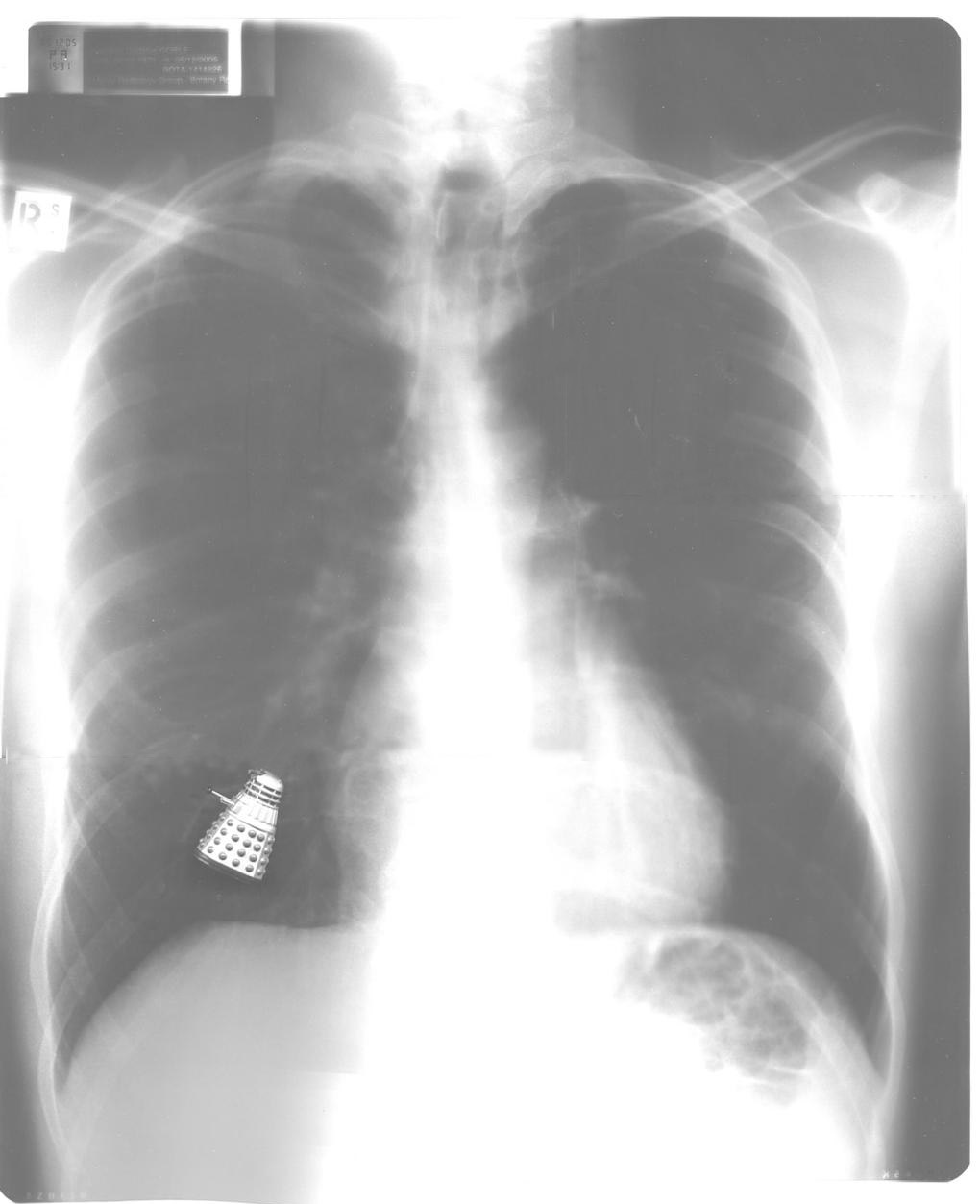
The bus dropped me right outside Flatmate English Dave's Scottish Hostel, The Thistle and Another Thistle (a brilliantly evocative, Scottish name, in my opinion) and I made my way into the lobby to see my old friends. Always hoping that there would be no Daleks appearing at the end of this blog entry!


Fig.1: A Dalek.

(with thanks to Herschel for his contribution to this work)

Labels:

** Click here for preceding post(s) **

** Click here for following post(s) **