Steve Goble

Choose life. (Deuteronomy 30:19)


I'm a Brit, so I might be a bit biased, but I honestly think that BBC Television Centre is the most iconic TV building in the world.

As such, I was exactly the sort of audience that this recent BBC FOUR documentary was aiming for.


A decade after it opened in 1960, I grew up watching programmes that had been made at BBC Television Centre, with the building often appearing as itself. I've attended several programme recordings there as an audience member. Also the odd exhibition. Been past it on the train.

And just occasionally the BBC have even paid me money to do some work for them there, and I've got to spend my lunchhour wandering the concrete doughnut's corridors, realising I had been going around in a circle (same thing), and sitting on a bench out the front of TC1 looking up at both giant channel logos while eating my sandwiches. What's that? Why wasn't I patronising the infamous BBC canteen? Shyeah right, like I could even find it among the mid-1990s proliferation of Tea Bars. I would get lost looking for the back door.

(seriously I once got lost looking for the back door)

Most of my time working for Auntie Beeb was spent at one of the BBC's many other London sites, like… well, like their names will mean anything like as much. Some of them I'm squinting my eyes now to even recall. But my memories of the hallowed TeleCentre have definitely not been junked.

For about that building, my internal phone-directory of colleagues only had words of reverence. Well actually that's not true, there was plenty of angst about the electric lighting, the fountain that was turned into offices rather than fixed, and the long distance between newer departments who had to daily liaise with each other, but those arguably sound more like management problems in a different form.

I remember one day, back at my own site, overhearing two of my colleagues discussing it. One was from Australia, and the other somewhere in the Caribbean I think. They were gushing excitedly about how they had actually got to set foot in BBC Television Centre! "The amount that's gone on in that building…!"

I can't argue at all. Today I can scarcely believe that my own life has occasionally taken place in the Top Of The Pops studio, at Crinkley Bottom, and involved chatting to a helpful Chris Barrie in full costume as Gordon Brittas. (I was looking for East Tower, and was a bit lost) Yes, once I even got to legitimately examine the TARDIS console up close, read the script cues pencilled onto it, and operate the door control, which disappointingly seemed to be the only one that could move.

Oh I very occasionally got to do some admin in the basement (above the sub-basement) as well, but that's just not quite the same. Still, given that I was only there for the odd day at a time, and most of those merely for attachment boards and to help fill up studio audiences, it says a lot that I can remember as much as I can about that giant architectural question-mark.

Looking back, as well as my fondly-remembered colleagues, I'm also glad that I have so many memories of my friends from outside work being there too. Alistair, Rich, my venture scout troop, my mum and dad, Herschel… oh that's right, he spent more time there than I did.

The thing is, I think that most people who I worked with at the BBC despaired of the organisation's management. It was, after all, the 1990s - an era well after the end of BBCTV's golden age. To walk through my own site's reception every day and witness our national licence fee now being spent on churning out endless amounts of cheap daytime filler, when there was so much gold in the archives, was soul-destroying. In pursuing profit to the exclusion of all else, the BBC was slowly dying, and them upstairs seemed determined to make sure that it kept on getting deader.

To paraphrase, as one production colleague at the time agonised to me over the phone, "I think the BBC would be very happy to just stop making programmes all together. Whenever I approach them for more funding, they look at me with this attitude of 'What?! You want… more money to make… programmes?!???'"

As you may know, a while back the BBC actually convinced themselves to sell their world-famous headquarters. True story.

One very good reason why, was the decision to relocate the corporation's base away from the south-east to the more centralised UK location of Salford. I can see that logic, although I thought they were always saying they wanted to make more programmes in the regions too, like in London.

Another very good reason is that the old building's becoming a bit expensive to run. However again, that sounds like more disorganisation, especially considering the amount of money the BBC throw away in other areas, like half-million-pound bonuses for departing Director Generals a mere two months after they've started for example. I have a funny feeling that its new buyers will find a solution. Perhaps it'll even be the ex-DG.

Cold harsh mathematics is one component of entertainment. Another is soul. They need each other. However when the two become so out of balance that the one defeats the other, then success cannot last. And as this documentary proves, Television Centre has long been the soul of BBCtv.

This retrospective about the building then, is packed to bursting with stars of yesteryear recalling anecdotes of how much they loved the old place too. Almost no celebrity declined to be interviewed on the subject (John Birt not really being a celeb), and the affection that they retain for the era that the place facilitated is palpable. That said, I did think the Goodies were conspicuous by their absence.


TVC was never a second home for me, but it was for many of these entertainers, and with such an absolutely stellar collection of clips (eg. Doctor Who meeting Captain Zep in 1982 above), their memories synched wonderfully with my own, partly as an occasional Senior Library Assistant, but mostly as a viewer. After all, despite the subject matter and interviewees, this doco is squarely aimed not at insiders, but viewers like me who usually saw the building from the outside, and on a screen.

Despite internal BBC cynicism, the worldwide effects of all the pleasure that that building helped to generate are incalculable. The world is a very different, and I hope better, place for it.

I could go on and on about that building. Today I still sometimes have dreams about getting lost again among those corridors, escalators and lifts that spoke with the same voice as the BBC1 globe. But now these people have said it all for me, so maybe I should just leave it to them - the BBC's self-appointed witnesses both for itself, and against…

Jools Holland: "It is, without question, the greatest purpose built studios in the world."

Susan Hampshire: "It's an icon. It's like Big Ben. It's like the Houses Of Parliament. It's like St Paul's."

Griff Rhys Jones: "… this will always be the building that is British television at its best."

Maggie Philbin: "I knew all about TV Centre because I used to watch Blue Peter as a child."

David Attenborough: "It was the biggest tailor-made television centre in the world."

Roger Bunce: "The dynamics work. The two ring roads to bring the scenery and the technical equipment, the inner corridor that funnels the artists from the Dressing Rooms through the Assembly Areas into the Studios via Make-Up and Wardrobe - everything arrives at the right place at the right time."

Matt Baker: "Everything here is solid. Y'know with television now, everything's kind of has a life of about five years really, but this place, was built to last."

Maggie Philbin: "I think part of the magic of this building is that you, you saw strange, incongruous and, and weird things every single day."

David Attenborough: "The difference between it and the factory was every bit of output was different. The range of programmes that came out was extraordinary. I mean in TC1 could have full-scale opera going on… and then there would be the daily dramas that were going on… er, comedy shows, audiences coming in… and it really throbbed."

David Attenborough: "Because it was live, and there was always live things going on, it gave the place a fizz."

Biddy Baxter: "The beauty of working at Television Centre was that everything was on tap. Lighting, design, make-up, if you were short of anything during rehearsal, you could whiz round to Small Props and bring something in, or whiz round to Make-Up. It all facilitated getting the shows on the air."

Bobby Warans: "We didn't really have things called budgets, whereas now they nitpick over fifty quid."

Esther Rantzen: "This building embodies the paradox in the BBC of jazz hands and therm [sic], you know, smart suit."

Jonathan Powell: "You would come for the kind of screaming mayhem of studios and the Light Entertainment Department or the Drama Department where basically everybody shouted at each other all the time, and then you'd open up on the sixth floor [management] and there would be a swish and it was silent… You can hear yourself walk, people spoke in whispers, it was like you'd sort of gone to Heaven or something."

Janet Fielding: "Do you know, when we worked here, we used to say, 'You know, they won't be happy - the administrators - until they've closed down all these studios, and this whole complex can just be admin.'"

Biddy Baxter: "I was given a complete brush-off, and I was told 'You're treating this as if it was a place for entertainment!'"

Penelope Keith: "All that's changed, and certainly the inside has changed radically and um, it seems awfully corporate to me now."

Penelope Keith: "Well, the thing that I find rather ironic is the fact that what used to be 'Main Reception' where one arrived, was given one's dressing room with the key, told where to go, and there were always actors buzzing around, now actors are as rare as a snowball on the equator and yet they have changed the name to 'Stage Door'."

Griff Rhys Jones: "It is my guess that, in a very short time, they'll be making a programme in which Penelope Keith will return to restore this building so that the BBC can return in splendour to where they belong."

Ah well. That's Producer Choice for you.

Labels: , ,

Thought I saw a dead leaf on the carpet around the corner at the top of my bed. Crouched down, reached around in the darkness and picked it up. It was a dead spider.

Labels:

Doctor: "What I don't understand is why you haven't just walked into town and killed him."

Never has the word 'showdown' been more appropriate.

This week's Doctor Who movie-riff is Cowboys & Aliens.

The Doctor, Amy and Rory land in the wild wild west, and immediately get mixed-up in a local feud between the people of Mercy, and a troublemaking outsider. Several of the usual western homages are carefully included here, so it ought to go without saying that before long the Doctor is indeed wearing the dead Sheriff's badge, and at high noon facing down the trigger-happy gunslinger, with his sonic.

The real science-fiction twist here is that said challenger is an alien cyborg seeking revenge on his creator - Dr Kahler-Jex - who for years has been holing himself up here as the town's physician.

The moral undertone is to conjure about with the word justice, which is where the script first loses its footing, as throughout the only version of justice under discussion is retribution. As you know, justice can look like deterrence, rehabilitation, restitution, restoration and even forgiveness, but for most of this story it is assumed to just mean retribution.

Doctor: "You committed an atrocity and chose this as your punishment. Don't get me wrong - good choice. Civilised hours, lots of adulation, nice weather, but, BUT… justice doesn't work like that! You don't get to decide when and how your debt is paid!"

Moral concepts can be great things to write stories about, but I do think simplifying them down into just the one facet is not the best way to go in a drama. Here it's particularly unfortunate in light of how last season the same author turned in The God Complex, which similarly sought to make observations about faith, while throughout merely treating it as a synonym for hope. I would encourage either embracing some of the broader subject's depth, or using the correct term.

Worth mentioning too here are the repeated references to belief in a deity throughout both scripts, regarding which this episode comes out better. Faced with the invasion of their town, the people hide en masse in the church where, unusually for any TV series, they actually pray about their predicament.

In your face, Father's Day!

But A Town Called Mercy's script has a lot more unrealised potential that I felt it ought to. The internal functioning of the plot lost me in several places. For example, I'm still none the wiser why the gunslinger wouldn't set foot in the village, or why he kept the villagers prisoner there rather than letting them leave so that he could go in and execute his quarry, or why he was trying to kill them if they left, and giving up so easily, so maybe I should watch it again. (I've just watched it again - no luck I'm afraid)

In one scene, the gunslinger tries to shoot Kahler-Jex, misses, and then, with his target standing literally right in front of him, leaves saying he'll instead come back tomorrow to kill him, and potentially all the other innocent townsfolk too. He can't be racked with guilt over accidentally killing the wrong guy, because he's planning to kill potentially the whole village now. I can't believe they filmed those actors standing right in front of each other saying those sentences. I must be missing something, or this doesn't even appear to be a story.

In the bar at the start, how could the townsfolk, knowing their friend Kahler-Jex to be the alien doctor that the gunslinger was after, mistake the Doctor for him? Serious question.

The gunslinger also has a teleport, which in other scenes he does the old cliché of completely forgetting about.

Matt Smith also gets a few tricky scenes to find motivation for in this. One is justifying the Doctor's now usual high profile aliveness during a period in his life while he is supposed to be pretending to be dead. Another is his very brief decision to become an accessory to murder. An enormous character change like that needs time to both develop and be repented of, but this episode tries to fit it all into the same moment.

Sheriff: "So, we wait here 'til the Doctor comes to pick us up in your ship."
Rory: "Yes. I know. I-I was there when we agreed it."
Sheriff: "Yeah. I said that more for my benefit than yours."

And that is all the dialogue in that scene. Ben Browder you have fallen so far.

Doctor: "This man is a murderer."
Kahler-Jex: "I am a scientist!"

Ha ha, that's a joke, right?

In the end, the whole problem is solved the easy way, by having a guest character conveniently choose to commit suicide. The instances of this in Doctor Who since its revival seven years ago are legion (look no further than the aforementioned God Complex and Father's Day), but A Town Called Mercy tries to get away with it twice. (admittedly though, still not as lazy as Voyage Of The Damned's thrice)

That said, A Town Called Mercy's second suicide is pulled off extremely well.

Kahler-Jex is racked with guilt over the deaths that he has caused. His blowing himself up not only makes him feel as though he is pleading guilty and paying a price, but also prevents his cat-and-mouse games with the gunslinger from causing any further grief to innocents around them. Still think he could have just shot his pursuer though.

The final conclusion, with the gunslinger finding a purpose to his existence as a killing machine by from now on protecting justice, sees the story finally move from justice's retribution component to restoration, but this gets nothing like the same examination, as don't its other qualities.

And as for making the gunslinger the new 'sheriff', when he can't even make up his mind whether or not to try and kill people who are innocent…

Not being a fan of westerns, I haven't watched many of them, but I suspect that they are not generally as drenched in music as this episode was. But maybe they are, how would I know. At least this one featured the dialogue clearly recorded for a change, so that it stood some chance against all the strumming.

And once again, the BBC also saw fit to release a prequel after the episode's transmission, this time by eight days. In retrospect, I actually think that was a good call, but only because it completely gives away the plot.

My many criticisms above might make it sound as though I hated this episode. In actual fact… well, no you're right, it start-to-finish didn't work for me, and this is almost entirely down to my disliking the script.

And yet, even in this B-movie, there is the occassional nugget of solid gold to be found…

PROTECTING THE VILLAIN, THE DOCTOR IS HAVING A SHOWDOWN AGAINST A NERVOUS TEENAGER AND HIS FRIGHTENED MOB.

Doctor: "Please don't do this."
Teen: "Why? Reckon you're quicker'n me?"
Doctor: "Almost certainly not, but this? Lynch mobs? Town turning against itself? This is everything Isaac didn't want!"
THE TEEN DRAWS AND POINTS HIS GUN AT THE DOCTOR.
Doctor: "How old are you?"
Teen: "Nearly nineteen?"
Doctor: "That's eighteen then. Too young to have fought in the war, so I'm guessing you've never shot anyone before, have you?"
Teen: "First time for everything."
Doctor: "But that's how all this started. Jex turned someone into a weapon. Now that same story is gonna make you a killer too. Don't you see, violence doesn't end violence - it extends it. Nah I don't think you wanna do this. I don't think you wanna become that man."
Teen: "There's kids here."
Doctor: "I know, who I can save if you'll let me."
Teen: "He [JEX] really worth the risk?"
Doctor: "Don't know. But you are."

Sorry, but I still prefer The Gunfighters.

Labels: ,

Amy: "Please get me out of here before you press any buttons!"


Another downloadable game from the BBC Doctor Who website, which opens with the Doctor telling Amy about how he once taught Elvis how to play the guitar, which thematically seems to follow on from the preceding City Of The Daleks.

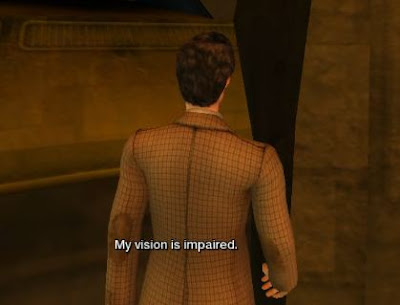
The arctic layout of Blood Of The Diet-Cybermen is a bit of a deathtrap. Apart from Amy rigging up a live electrical cable and neglecting to turn it off again afterwards, Diet-Cybermen, Diet-Cybermats and Diet-Cyberslaves are all over the place, and out to get you. If you're very lucky then you might just avoid them by slipping over on the ice. I assume the characters' uncertain footfalls are intentional, and not a limitation of the graphics. The Doctor and Amy continue to fade in and out of visibility, like last week, although back then it sort of made sense to have impaired vision.

Amy: "Doctor, did you ever see The Thing?"
Doctor: "The Carpenter Kurt Russell Thing or the Howard Hawks Thingy with the walking carrot?"

Well, so long as he hasn't been watching The Waters Of Mars then! (the mind boggles)

One of the early inherent problems in a Doctor Who-themed mission game becomes evident early on, as the Doctor and Amy have to work out how to transport the injured Chisholm back up an icy cliff edge. The TARDIS of course remains right there, unused, throughout. Is the Doctor being eccentric by ignoring it, or just plain finding it hard to think straight in the cold? I'm impressed that the characters have some condensation on their breath, which is the sort of thing that tends to get missed out on telly.

Another difference in style between media might be some of the highly focussed and helpful dialogue, which honestly made me feel as though I was playing Torchwood: Dark Talk again. That game was also written by Phil Ford, so it's nice that he has a style.


Doctor: "Who's in charge here? Could there be other survivors?"
Chisholm: (over intercom) "Elizabeth Meadows, is the senior scientist. Maybe she's not infected. She's pretty resourceful. If anyone has survived, it's her."

Effective bit of audio exposition there with, as you can see above, no lip-syncing from either party, which happens at other points in this game too. I'm still learning this gaming thing, so I guess it must be a convention for much of the dialogue to appear in subtitles without a voice-over. Or is that just to denote what the character is thinking?

Doctor: (subtitle only)"I'll bet the good professor used her daughter's birthday as the code."

That said, the actual audio direction is curious. There's no escaping that Matt Smith and Karen Gillan are just not in character here, and I couldn't help but wonder if this game and last week's City Of The Daleks represent their first time in the roles. At other points their performances are so sotto voce that it's hard to accept that the other characters are close by enough to hear them.

Hardly a major problem though, and it does make the odd comedy flourish well worth it.


Doctor: "Amy! I'll keep his attention, while you think of a way to overpower him!"

Worthy of the sixth Doctor!

Other minor observations: As soon as Elizabeth is seen with a broken arm we know she's been got by the Cybermats. Amy enters a four-digit code by pressing one button. Both of Chisholm's legs appear to break under his own body weight. The synthesise-the-nano-syrum was a good little minigame.

The cards to collect are a lousy bunch, and arguably to be avoided: The seventh Doctor, Donna Noble, Rose Tyler and… Jacqui Tyler? Mind you, we do also get to find the always-popular eighth Doctor. :)

Blood Of The Cybermen is pretty slow, but for a snowy horror story about the lumbering Cybermen (Diet or otherwise), that's probably a good tempo to go for.

Definitely not one to "Delete-delete-delete!"

Labels: , ,

Part 1 of 5: Introduction

How many TV series can you name that have been so successful that they've had a prequel series made?

Okay. And now, how many TV series can you name that have been so successful that they've had a prequel series made featuring none of the same characters?

I'm really not sure that I can name any…

Oh, apart from Star Trek of course.

Amazing. Just what were Paramount thinking? I mean spin-off fiction, like books, is usually all over this sort of idea, because spin-offs are bought by fans, who see the whole thing in much greater detail, including its holes, which they quite rightly want to see filled in and completed. But the general public? What's their interest in tidying up the history of a series that they don't know so deeply? Well, I guess that Star Trek really must be just that popular a series...


In Enterprise Paramount produced a full-length mainstream TV series, set in Star Trek's past, with all the restrictions that come with that. No established character or race could be killed off. No new advanced technology could be introduced that had not also been present in any of the later-set series. Crossover appearances would be right out, or at least highly contrived.

I mean I love the idea. I just never thought that US TV would actually go through with actually making it. Wow.

That said, today the show about the adventures of Earth's very first starship is broadly remembered as a flop. You see, it only ran for four seasons. Yes, only four. Just 98 episodes. I know, what an embarrassing non-starter.

Trouble was, when Enterprise launched, all three of Star Trek's other recent spin-off series (Star Trek: The Next Generation, Star Trek: Deep Space Nine and Star Trek: Voyager) had each run for seven years. So clearly the pressure was on for Enterprise to perform similarly well.

In the event, it arguably ended up making three quite distinctive series over the course of its four-year run.

Part 2 of 5: Seasons 1 & 2

The first two seasons pretty much rested on the name's laurels, and were bog-standard standalone episodes visiting various planets each week, as you'd expect. As the crew of explorers were literally going where no man had gone before at that point, they were somewhat more excitable than their counterparts on those other shows, but broadly speaking their's was the same brief. Shallow human interest stories thinly dressed up as science fiction, with the ongoing background joke of setting up the way that things would one day become.

Eg. In Singularity, Malcolm Reed comes up with what will one day be the familiar 'red alert' klaxon, which Trip suggests they name "Reed Alert". Groan…

There's also a vague recurring plot about a 'temporal cold war', but after seven years of watching Voyager I came with no expectations of this amounting to anything, let alone making much sense.

Detained is worthy of note for reuniting lead actor Scott Bakula with his Quantum Leap co-star Dean Stockwell, in a script packed to bursting with in-jokes about that series. Apart from the rewritten opening scene - Mayweather's role should clearly have been Archer coming to, taking in his surroundings, and muttering to himself "Oh boy!"

On the whole though, more modern-style Star Trek wasn't something that appealed to me. I always thought the worst thing about the original 1960s series of Star Trek was its emotional content. I always liked it for its stories about space, planets, time and ideas, which modern versions always kept to a minimum to focus on feelings, exactly like every single other programme on TV that night.

Consequently the first two seasons of Enterprise just didn't do it for me, although it was better than The Next Generation and Voyager, for which I was grateful. Downer about that constrictive widescreen though - I could make out what was happening, but never with much ease. No wonder the rest of the world was flipping channels.

The end of season two would retrospectively turn out to be the show's halfway mark. There's no avoiding that Enterprise was getting freaked. The final episode of that second season jumped off of the show's regular episodic format with a shameless 9/11 analogy, which would mark a point of no return for the series. In the event, Enterprise would get two further shots at survival.

Part 3 of 5: Season 3

Drawing on the world's real-life bewilderment at the initial total lack of suspects for the September 11th destruction, an unknown and unmanned alien ship materialises without any warning, and silently fires upon Earth, instantly murdering over seven million humans.


The repercussions are inexpressible. Trip's sister is dead, and he wants revenge. Publicly, the USS Enterprise is blamed for attracting attention to our fair planet. Upon being tipped off that the mysterious 'Xindi' are to blame, the Enterprise then spends the whole of season three away in the Delphic Expanse, slowly smoking them out.

And what a series that turned out to be! On some level it was probably an attempt to break away from the restrictions of the Star Trek universe's continuity, forcing the crew to encounter life and civilisations that were as new to the viewers as to the characters. Unfortunately, it also looked like an attempt to emulate the remote setting of Star Trek: Voyager. (eurghhh…) And yet, this time Star Trek really went for it!


Conceding to add the 'Star Trek' prefix to its title, Star Trek: Enterprise now successfully became a distinctive original series in its own right. With only a few standalone episodes (eg. Exile… more eurghhh), the whole series became one long serial, with a mystery to be unlocked, and a whole new menagerie of aliens on a fresh spacescape.

If any word sums up the tone of this season, then I think it would be 'claustrophobic'.


Our heroes spend most of their time banged up in a metal box in space, which due to battles can be a mess of metal wreckage, while in some other dark quarter a race of unknown beings debate the progression of their plans to annihilate the Earth. (that first strike had been a test) Sure, long-term Trek-viewers knew full well that this was going to depend upon help from a string of alien fifth-columnists who would each get murdered in turn requiring the next one to step in and take over, but that didn't matter. The journey that year was well worth it, especially since the serial format now allowed the characters to remember what had happened to them the preceding week.

Perhaps best of all is the gradual descent over to the dark side that Captain Archer goes through. In Anomaly, he tortures an Osaarian for information by throwing him in an airlock and starting to depressurise it. In Damage he needs a warp coil to make an important rendezvous, and upon having his offer of trade for one politely declined, takes it by force, stranding his shocked new friends in space. (he never goes back) In Azati Prime, he orders the destruction of an inhabited moonbase in case they are intending to report Enterprise's position to the enemy. Yes, he murders a group of innocent beings in cold blood. He has to. There are billions of people on Earth depending upon Enterprise's mission to succeed.

What other Star Trek captain could do that?

Archer: "I thought we were here to try and stop a war, not start one."

- The Shipment

I have to admit that developments like these caused that rarest of reactions in me after the episodes: I found myself examining and questioning my own morality. Usually Star Trek's straw arguments are a crowd-pleasing case of preaching to the converted, but some of Archer's dilemmas, and choices, got to me. Now that's engaging television.

Degra: "Aquatics respect boldness and confidence - they view hushed tones with suspicion."
Archer: "I'll make sure I project."
Degra: "Not too loudly - the insectoids interpret raised voices as a sign of hostility."
Hoshi: "When aquatics use the past tense, they switch to sonar."

- The Council

A fantastic season. Well, if I'm honest, actually not that fantastic, but enjoyable. I'm just so well-disposed to it because of the enormous effort I could see them making.

Part 4 of 5: Season 4

Come season four, the show gets yet another facelift.


In one sense, this is a disaster. The CGI takes an absolute nosedive.

In another sense, it's a triumph. Returning from completing last season's creative mission, the Star Trek universe gets firmly re-embraced again, by trading mainly in multi-part stories about different aspects of it.

For example, one three-parter features Brent Spiner as an ancestor of Dr Noonien Soong, and arguably other future roles that he has played. The following trilogy is about politics on Vulcan, featuring a young T'Pau. Still another two-parter shows the Klingon race becoming afflicted with genetic mutations that will make some of them look more like humans for a few generations...

In A Mirror, Darkly is set entirely in the mirror universe. It opens by cribbing footage from the movie Star Trek: First Contact and augmenting it with new shots to change Earth's history. The opening credits are rerealised to portray mankind's warlike conquest of the stars. The alternate ISS Enterprise crew then go on to encounter and board the derelict USS Defiant from just after Star Trek: The Tholian Web, complete with computer voiced by Majel Barrett, and dead redshirts. At one point Captain Archer - wearing a classic 'Kirk' uniform - gets into a bare-knuckle fistfight with a Gorn. The whole story never features 'our' crew, which is likewise impressive.


While on an aesthetic level I loved all these enthralling elements, I found the story uninvolving and the end a disaster. Part two concludes with the various plotlines still in full swing, which left me in no doubt that the following week would bring the concluding episode three. Well, no, that was it apparently.

The final instalment of the whole run These Are The Voyages… is likewise a round disaster, but with the best of intentions. It's always been a part of Star Trek: Enterprise's MO to foreshadow the rest of the Star Trek canon, and be watchable in advance of it. Might have been better cancelled after season three then, so as not to make the original three-year 1960s series look so curtailed! :)

In this episode, people from the future review a holographic simulation of the original starship Enterprise's decommission, establishing its pivotal place in Federation history, and its legacy of further spacefaring vessels bearing the same name. You can see that they really wanted William Shatner to play Admiral Kirk in this role, but obviously they couldn't get him, so they've used their standard fallback… Riker. And Troi. Eurghhh.

I'll admit that the opportunity to feel as though I'm watching authentic brand new Star Trek: The Next Generation scenes again, complete with sets, sound effects and establishing shots, carries something of a nostalgia kick. They've even managed to get Brent Spiner back to reprise Data's voice over the intercom, which belongs since his aforementioned appearance as Dr Soong earlier in the season.

However so much emphasis is placed upon these characters that the finale forgets both the broader Star Trek universe and, much more importantly, the series which I had turned on the telly to bid farewell to. None of the regular Star Trek: Enterprise characters appear in this closing episode. Rather we get computer simulations of them, which cannot possibly represent actual events with any accuracy. Compare this with the final episode of Babylon 5's fourth (and penultimate) season, which trod a similar line, but showed history aloofly rerealising our heroes as bad boys.

The biggest insult must surely be Archer's having to raise a glass in one scene with the words "To the next generation!" Rather, this line really should have been "To Enterprise."

The closing montage of the classic "Space the final frontier" voice-over clips being delivered by Picard, Kirk and Archer was a good ending, surely those were Archer's own inspiring words being embraced down the generations. However I really wanted to see this speech to the Federation. Captain Archer's good at those, and it would have represented the one scene that the future would have retained an accurate recording of.

In short, I never dreamt the series' swansong could turn out to be this unsatisfying.

Part 5 of 5: In Summary

All the same, thanks to the second half of its run, I will always look back upon this fun series with special fondness. It was no classic, but its makers sure deserve an Enterprise 'A' for effort.

I'm still holding out for a series of Trek TV reunion movies within the next decade. The Next Generation, Deep Space Nine and Voyager were all big enough successes to warrant it. Enterprise on the other hand, well, they'll probably get one too, so as to not appear conspicuous by their absence.

Hopefully then this crew, and story, will get a proper send off.

Ships are traditionally launched with a great deal of pomp and celebration. They should go out that way too.

Available here.

Labels:

"Darn you Elliott!"


Absolutely charming Disney live-action/cartoon hybrid, this time about a boy and his sometimes invisible dragon.

I saw this movie about 30 years ago when they screened it at my school, and having just watched it again 24 hours ago, I find it hard to punch a hole in. It's a gorgeous helping of joy, set in a world where everything looks and sounds happy and colourful, and even the bad guys get catchy songs.

Yes, the villains manage to be likable, funny and pathetic in all the right doses, yet still come across as capable of winning easily. Jim Dale as Dr Terminus particularly does well here, with some enormous tounge-twisters to pull off, but y'know what - so does everyone else!

The whole cast is on top form, not least Sean Marshall, who as the Pete of the title absolutely buries himself in the role. His conviction is obviously pivotal to the whole illusion, so it's equally impressive that the artwork of Elliott the dragon is so carefully realised too.

Elliott has shadows. Elliot has a reflection. Elliott even has a vocal actor whose clumsy stumbling around half-words and other noises helps to make the part reminiscent of Mr Bean. I thought I picked up on the odd moment of reused animation, and a lower frame-rate for it, but the way that this whole film came together carried it all off effortlessly.

And what fantastic songs too - It's A Brazzle-Dazzle Day, especially sung by Helen Reddy, must be one of the finest songs ever written for film. I could describe more about it, but there's just no misinterpreting a title like that one.

I Swear I Saw A Dragon and Bill Of Sale stay with me too.

And what a great strong ending. You just don't get those nowadays.

I see now from wikipedia that in watching the TV version I was missing out on maybe as much as another three-quarters of an hour from the original roadshow theatrical release. I don't mind, partly because I'm still in such a good mood from it, and partly because it means that one day I may get to see it again in its entirety, if that version ever gets rereleased. Either or, I'm happy.

Verdict: Ten out of ten. Pete's Dragon is on fire!

"A dragon is just another stranger in search of a friend."

Available, in some form or other, here.
(some scenes may be invisible)

Labels: ,

"DALEKS ARE THE NEW TIME LORDS."

Each year the BBC website produces an enormous amount of non-TV Doctor Who, which is a surprise given that almost every new avenue they discover for it fades away after the first year.


For the 2010 series, the idea was a series of online computer games, entitled Doctor Who: The Adventure Games. Four were duly released that year, after which it seems to have been scaled back to more like one per season.

I'm the first to admit that I'm not a very adept gamer. Inevitably the choice that I found I was facing this evening was not so much whether to play this first one or not, as to whether to play it or watch someone else's walkthrough on YouTube. I have to admit, said YouTube version looked appealing. At roughly 44 minutes, it might feel a lot like watching a regular episode.

Well, in the event I played the game myself, the whole darn thing.


And it only took me six hours. Six! And that includes the time that it took me to, whenever I got stuck, go find out what to do on YouTube anyway!


Not that watching someone else's gameplay is necessarily going to tell quite the same story as driving it myself. I haven't done a direct comparison, but in my version I got a heap of extra material that I dare suppose most YouTube edits missed out on:


For example, my version featured the Doctor repeatedly scratching his head, running on the spot into walls, and entering doorways only to wordlessly turn around and go straight back out again. Admittedly, I found Amy's silent bemusement at such behaviour to be entirely consistent with her opinion of him in the TV series. Also, if you give up in the right places, you can access the odd additional bit of dialogue containing hints.

Amy: "Try using the Sonic to operate that console, Doctor. I'm fading away."

Oh, and in my version the Doctor and Amy both died.

A lot.


A heck of a lot.


Yet, on every single occasion the game copped out and skipped showing either of them going on to accordingly regenerate or decompose afterwards. Rory would be proud.


The story features the Power Ranger Daleks having salvaged a natural phenomenon left behind after their predecessors (the Dapol Daleks) had murdered the Time Lords. They've then returned to Skaro, and used it to devastate the Earth of the past and change history.

Consequently, throughout the game, Amy repeatedly fades in and out of existence as the change to her timeline catches up with her, which towards the end endows her with the serendipitous superpower of random invisibility. (it doesn't seem to affect her shadow) The Doctor seems to display this ability too, which I assume was for the same reason, rather than any shortcomings in our graphics driver.


At another point in my version, while searching for an Ocular Cable (spare Dalek eyestalk) and Beam Distributor (Dalek gun), Amy got trapped behind some boxes, from which there was just no way back out. Ever. No, not even by the same way through which I had squeezed her in. Yep, she had well and truly boxed herself into a corner. This software bug was proving even worse than a plot hole in a TV episode! With no 'select' option, I tried so hard to get Amy exterminated on purpose, y'know, to reboot the scene of course, but you know what Daleks' aims are like.

Speaking of which, the finale is spectacular. The Daleks all have their vision impaired and cannot see, resulting in their constant blind firing creating a 3D maze across the floor for the Doctor to race against time finding his way through. This is in stark contrast to much of the rest of the game, when stealth and taking my time had been my main tactic in avoiding patrols of Daleks, and Varga plants.

It might all have been easier without the distraction of non-diegetic real-life facts and character cards to pick up and collect, but the thing that I would really have liked here was simply a timeline. At any given moment I had no idea how far through the game I was. The subtitle 'episode one' enhanced this ambiguity. After a while this became quite demotivating.

On this PC, I found the maneuverability tricky. Partly this was because I was mainly using the keyboard cursor, but I also found it difficult to get my head around directing the characters from my perspective rather than their's.

Still, a great enjoyable episode, which ties into the show's broader storylines very well.

Released with the 2010 series and featuring the Doctor, Amy and the new Daleks, it's still pretty tough to place. I'd put it straight after Victory Of The Daleks though, simply because Matt Smith just doesn't sound quite in character yet, as indeed he didn't at that early stage in his tenure.

City Of The Daleks may be of debatable canonicity, but it's enough fun that I'm really not too worried. What situation-specific opinion do you have regarding it, Doctor?

"Hmm. No."

Labels: , ,


Classic animated Disney musical about cute talking animals and international stereotypes.

It's one of those movies that has always been just there in the background of my life.

In 1980 (at age 9) without having even seen the film, I found myself collecting its associated Figurine Panini stickers, in an album that I'd received free with the UK's Mickey Mouse comic. Years later I would send off for the remaining umpteen missing numbers, and then spend enjoyable times finally completing the album, before at long last getting to sit down and read the thing.


In 1991 (at age 20) I purchased a copy of the six-minute musical extract Everybody Wants To Be A Cat on Super 8 film, for the purpose of screening with other shorts at a couple of orphanages in the recently-liberated country of Romania.


The kids, many of them terminally ill with HIV and/or hepatitis, had never seen moving pictures before. Most initially turned away from the screen, to where the sound was bizarrely coming from behind them. Some of them ran up to the screen to touch the pictures. Some clapped and, by the end, were actually singing along in English to the chorus. Some cried, and so we had to turn the projector off. Well, of course I will always associate this movie - and that scene in particular - with that fortnight.

In 2004 (at age 33) I think I found myself watching that excerpt again on another life-changing international flight - this time a Cathay Pacific flight to New Zealand. (I don't have a picture of that)

Somewhere along the line I'm pretty sure that I even watched the whole movie from start to finish… on a rerelease at the cinema that I used to work at? The event has faded from my memory now, but I do remember discovering that, on the big screen, some of the characters had different names. In my sticker album, the movie's British geese Abigail and Amelia had instead been named as 'Gwendoline' and 'Adeline'. Hmm. Had there, at some point, been some sort of a UK version of this film, that subsequent rereleases have been ignorant of?

I completed watching it again tonight in 2012 (at age 41) from a VHS recording off of TV, with a logo in the corner and the sound half a second ahead of the pictures. (thanks Channel 5) I found that I was taking particular interest in said geese's similarly British 'Uncle Waldo'. They really couldn't have given that character a name any more American! Again, my sticker album dubs him 'Uncle Reginald'. Alas, I have never solved this mystery. Perhaps Uncle Wally was so tipsy that he got everyone's names wrong, including his own?


Disney films have a bit of a reputation for being timeless, and yet I was equal parts disinterested and relieved to watch this 1970 outing's mellow pace in frantic 2012. It struck me as quite slow, which is two-faced of me given how I often criticise modern productions for their frenzied storytelling.

All the same, this is still one charming movie which I hope continues to orbit back into my life once each new decade.

(available here)

Labels: ,

I have no particular opinion on this book, because it does exactly what it says on the title.

33 short extracts from the Biblical book of Psalms are presented in this pocket-sized hardback booklet, grouped into the headings Introduction, Praise, Petition, Peace, Purity and Provision. (they really should have called that intro Preface)

It occurred to me that there were about the right number of them to read one a day over a month, so I've been using this as my daily-ish Bible reading guide for about the past 40 days. In practice, I have to admit though that I've usually just read each excerpt, and then promptly forgotten all about it. I've tried to address this by reading each passage twice, slowly, and then rerereading it again the following day, but they just haven't consciously sunk in. Still, it does mean that I've got through the book three times! Perhaps I needed to give it more daily time, and/or have some questions to guide me…

The one quotation that did sink in though was also the shortest one: page 31's famous Be still, and know that I am God. I need to be told that one a bit more often in my life.

There are umpteen different translations used for this compilation, which is an attitude that works for me here.

Does this make me a psalmreader?


(available here)

Labels: ,

*** Contains spoilers about life ***


It's not often that I watch a movie because it has a bad reputation, but after what I'd read about CGI fairy tale The Polar Express, I just had to check out these characters' eyes.

Specifically, would they turn out to be as blank and zombie-like as I had heard?

No, they didn't. There are a couple of uncanny mocap moments, but for maybe 99 of these 100 minutes, this movie worked its magic flawlessly.

As our kid sneaks out in the middle of the night to catch the eponymous Polar Express to Santa's home at the North Pole, almost the entire story unfolds in one long unbroken scene, really enabling us to go along with him on the journey too. Despite the minor awkwardness of portraying human beings with animation, the actual world here looks so perfect as to make the whole ride enthralling. The fuzzy picture (digital!) isn't enough of a handicap to dampen things either.

Best of all however, is the film's script, which holds strong throughout the mystery, and often serves up some good observations…

Conductor: "Thing about trains - it doesn't matter where you're going, what matters is deciding to get on."

Boy: "What did he [Santa] look like? Did you see him?"
Conductor: "No Sir, but sometimes seeing is believing, and sometimes the most real things in the world are the things we can't see."

Hobo: "One other thing. Do you believe in ghosts? Interesting."

My only two real problems with this movie were both concerning its attitude.

1. The moral of the story is, on the face of it, that you should believe in Santa. Ultimately, every kid who does right by this film, unless they die first, will one day suffer for it. The only way of restoring their love for it will be for them to eventually become parents themselves, and perpetuate the example by repeating it to their own kids. Here's a thought - how about simply admitting to kids that it's just a game? Y'know, so that no-one has to be defeated each year?

2. Christmas here has nothing whatsoever to do with Christ. Angels get mentioned at one point, and dismissed, which is remarkably un-Christmassy. Whatever your religious beliefs, there's no avoiding just how arbitrary are the pressures on our young protagonist here. At the end of the day, he's on a journey to believing what he's told to believe, which isn't much of a life-lesson either.

Still, I found the whole movie to be an absolutely enthralling piece of magic, and in places a lot like a lucid nightmare.

Ten out of ten. How Christmassy is that?

(available here)

Labels: ,

** Click here for preceding post(s) **

** Click here for following post(s) **