Steve Goble

Choose life. (Deuteronomy 30:19)


I think The Matrix is great. I have done ever since I first saw it at the cinema in 1999.

I was also fairly nonplussed by it, and all its sequels, retreading as they were such well-worn sci-fi ground, but that doesn't mean that I don't like it.

After all, they were retreading it very well.

Over the past decade I've found The Matrix movies to be thought-provoking, intelligent, mindless, visually impressive, exciting, and unashamedly science-fiction. Really – that entire first film, including all that mundane stuff in Neo's original life at the start, looks unequivocally like a science-fiction movie.

As if the title itself wasn't enough of a giveaway.

After all, virtual reality was the 1990s' equivalent of the old revelation that it had all been a dream. "The matrix" had even been the name of the virtual reality landscape that had been a mainstay of Doctor Who's homeworld for the decade following his 1976 story The Deadly Assassin.

So, as I first watched The Matrix in the cinema that 1999 evening, I felt it was somewhat going through the motions. In fact, for my money, they presented the reveal a little early on. How soon was it that Neo was freed – maybe half an hour into the film? Oh well, always leave 'em wanting more.

The rest of the movie unfolded a great tale wrapped up in a truly awesome backstory. This was our future, one in which mankind had ultimately become so dependent upon machines that we were now conceived and grown in ignorance of them. Men and women lived their entire lives in virtual reality, never aware that it was not real.

I only really had two problems with that first instalment –

1. It was broken up with so much mindless violence. Seriously, my mind wandered so much during all the shooting that I believe I actually nodded off. I've never understood the appeal of martial arts. Always leave 'em wanting more.

2. On the way back to my friends' flat afterwards, I had a very long disagreement about its premise, which for me didn't hold together.

The matrix simulated the world of 1999. And it was also old. So when it had first started, the simulated date must have been another year, for sake of argument maybe 1960.

With different people living in the world of 1960, (different to the actual people who'd lived in the actual 1960) it really wouldn't have been very long before matrix-history diverged from the real one. They'd have made different choices. They'd have married different people and had different children. Inventions such as Neo's mobile phone could not have been invented the same way by different people, and accordingly technology could not have developed along similar lines. The matrix's version of "1999" should have been quite a different place to the real one.

But hey, maybe it was, if Neo's ancient computer was anything to go on.

Or, maybe it was, as in maybe the point was that we live in the matrix's alternate version of history, yet what followed seemed to imply otherwise.

Four years later, in 2003, the real world (well all right our world) had duly moved on too.

I found myself over at Herschel's watching The Animatrix - a collection of nine cartoons that tied-into The Matrix and its upcoming cinema-sequels. The one that really impressed me was The Second Renaissance, (strangely in two parts) which fleshed-out the fictional world's backstory admirably.

To the cinema then, and the long-awaited live-action sequel, that had been years in the making, The Matrix Reloaded.

Oh. Dear.

Don't get me wrong – I thoroughly enjoyed the middle of this one too. It's easy to criticise a story that you haven't really followed. I guess what threw me was that this no longer appeared to be set in any world that I recognised. Time had moved on in the story (a device I've always found distancing), and there was a long nightclubish sequence that fairly disinterested me, for similar reasons to why nightclubs do.

But terrific execution though.


Neo's fight in the park against all the Smiths. Dazzling, and captivating as the odds just keep on going up, until eventually he can only run away from them. That whole long chase sequence on the motorway was so intense that it was worth the cost of the ticket alone! Even the trailer for the next one – how on Earth can he beat all those Smiths?

Six months later when The Matrix Revolutions came out, sure enough I missed it. About three months after its release, on 15th January 2004, I hauled myself up to Leicester Square where one of the few cinemas in the country still screening it was.

This one was about all-out war between man and machines. It was… err… kind of slow. Half an hour before the end I was so tired and hungry that I began to laugh at it! When, at the end of the film, one of the characters declares with conviction “It… doesn’t make sense!” my chuckling turned to coughing in a vague attempt to prevent myself from spoiling it for the rest of the audience. The only thing longer than that movie was its own closing credits. Sigh… three out of ten that one, not in Bill and Ted’s league at all… :)

What a come down. Still, at least I would never have to sit through that again.

Leaving the cinema, I passed an advert for visiting New Zealand.

The following month, I got on my very first flight to Kiwiland. It appeared to me to be the longest flight in the world - 24 exciting hours seated in a metal tube, flying to the opposite side of the globe. Any further, and I could have saved time by going the other way. I'd had little sleep beforehand too.

Fortunately they had in-flight movies to make the time go by quicker.

Unfortunately some bonehead had booked The Matrix Revolutions, which had the opposite effect.

Well actually there were lots of other movies available, but 'inevitably' I dipped into the start of this one again. Because it was there. And so it began to wear me down into submission.

It still amazed me that there was no recap of the second film to kick off with. It also began to strike me just how laced with philosophy the script was.

Oracle: "... the real test for any choice is having to make the same choice again, knowing full well what it might cost..."

Prophetic words – the Oracle would have maybe known that just a few months later I would make the same flight again, for the second of five times. (to date)

Anyway after Hong Kong, I changed planes and was put in a seat with only a fuzzy, malfunctioning screen. This time during the film I actually managed to nod off for a little while... (hey – I'd had half a night's sleep and then been up for about 24 hours!)

When my eyes shortly heaved open again, (sleep on flights is never real sleep) something resembling Vision On appeared to be showing. Nope, that was Neo and Smith chasing each other around at high speed. All those glossy high-definition effects reduced to such a tiny, snowy image. Oh the irony.

It had been good to see Smith arguing with the Oracle about predetermination and choice, with as usual no resolution to the paradox. Talking to people in NZ, it began to strike me that there weren't many other films that I had seen that had got to grips with this sort of thing. In fact, I've never seen any film really wrestle with it. That we trust the evidence of our five senses unquestioningly, making every decision a faithful one, and none of them therefore logical, was something I'd long tried to discuss with people without coming across as weird. Were these sort of ideas what seemed to so excite others about these films?

I have a particular keenness to watch things in chronological order. (I once watched Memento like that) If I ever sat through the Matrix films again, I wanted them to be in the right order, with The Animatrix broken-up accordingly.

(Today I'd order them The Second Renaissance Part I, The Second Renaissance Part II, The Matrix, Program, World Record, Matriculated, Detective Story, Kid's Story, Final Flight Of The Osiris, The Matrix Reloaded, The Matrix Revolutions, and Beyond)

Alas, about a month ago, ITV decided to screen the live-action movies over three Monday nights, but without The Animatrix anywhere on the their schedule. Oh well, always leave 'em wanting more. I rewatched them anyway.

A decade hasn't diminished how impressive the first one is. The only thing that seemed ever-so-slightly dated was the use of the phrase "A.I.", which I don't think I've really heard in a while.

What it did suffer from though was a slightly more objective attitude from myself. This time, I could not possibly countenance the notion that anyone, man or machine, would design computer programs that could only carry out their functions through the illusion of being a person or other physical thing. For example, to 'follow' Neo (a ridiculous notion to begin with) the illusion of a tiny insect has to be created and gruesomely inserted into him. Umm, why? Yet this central conceit is copied to enormous degrees throughout the entire series.

Worse, Neo then wakes up and thinks the whole insect-insertion was a dream. Doesn't he notice that the time has moved-on? That he's no longer at work? That he has no memory of having travelled home from work? Even if his clock has been adjusted, he'll pretty soon find it to be out-of-sync with everyone else's.

Maybe he assumes he overslept.

The following week, The Matrix Reloaded still suffered from the jump forward in narrative, but benefited from the last movie still being quite fresh in my mind. At the end, ITV hilariously cut-out the 'next time' trailer. These days, you'd have thought they'd have wanted that.

The week after that, The Matrix Revolutions also benefited from a mere week having passed, especially since, as mentioned earlier, it contains no recap. The whole story made some more sense to me, but still suffered from being built upon such a flawed concept. Outside of the matrix, there is even a simulation of a train station for programs to wait inside!

And yet, how much of this have I just got wrong or failed to understand? If I acknowledge that I don't fully understand it, then I can hardly level criticisms.

Is the matrix really a representation of the whole world, as I assumed, or just one big city? In the first movie, when Neo is taken to meet the Oracle, he is driven down a street that he is familiar with. Highly unlikely if the matrix contains an illusion of the entire planet. When Neo fights Smith at the end, while all the many other Smiths just stand around dumbly watching and not fighting him also, it seems as though everyone in the entire matrix has been turned into a Smith-zombie.

Speaking of Smith, top marks throughout all three films have to go to Hugo Weaving for his performance in the role. Putting so much thought under the surface of such a two-dimensional character makes all his scenes thoroughly watchable.

This morning I rounded-off my second viewing of the series by borrowing The Animatrix off of Herschel once again.

This certainly made more sense this time around.

The first half of Final Flight Of The Osiris still does little for me (fighting... urrr), but the second half is just the sort of stuff that I want to see more of. It's a canon Matrix story, that ties-in and everything. Great.

The same can be said of The Second Renaissance and Kid's Story, which this time I was able to connect to the kid character in Reloaded.

Program I can't even remember now. Umm... nope. Hang on, I'll put the DVD back in. AH! Right, got it. Program does little for me, but is okay, retreading as it does the choice that Cypher made in the original movie. World Record also did little for me, but then I didn't understand what was happening.

By default, Beyond must have been the one about the girl looking for her cat, which as a cat-lover I found fascinating, except that her cat seemed to get forgotten towards the end.

With reference to my earlier point about dates progressing in the Matrix, this also features a fairly clear reference to four years having passed since the first movie:


Unless that's the year 2203.

From here to the end of the disc, The Animatrix kicks butt.

A Detective Story, like Final Flight Of The Osiris, fits very comfortably into the world of the movies. It features Trinity fighting agents, and is told from the point of view of a new detective character who sadly never quite makes it out alive. This was good, exciting stuff.

Also, with reference to my earlier point about technology diverging from our own history within the Matrix, this also features different cars, computer-screens, and has a whole design all of its own.

Finally, the last short, which I have completely forgotten watching in 2003, is now my favourite. Matriculated had a story that lost me towards the end, though I figured out what I must have missed, but also had incredible visuals throughout.

I was similarly impressed by the dialogue. Here Raul is preparing a captured machine to be plugged into its own personal Matrix in order to manipulate it into choosing to help the humans instead of trying to enslave them.

Alexa: "Will it – Do you think it'll convert?"

Raul: "To convert is its choice to make."

Alexa: "Do you think maybe we ought to reprogramme it?"

Raul: "No. We can't make slaves of them."

Alexa: "Because that would be simpler."

Raul: "We won't beat the machines by making them our slaves. Better to let them join us by choice."

Alexa: "Make them believe that the right choice is the one we want them to make."

Raul: "Alright, yes, machines are tools, they're made to be used. It's their nature."

Alexa: "To be slaves."

Raul: "That's why we can show them a better world. Why they convert."

Alexa: "But that world we show them isn't real."

Raul: "It doesn't matter."

Alexa: "Well I'm afraid they'll figure out that we've made-up the thing in our heads."

Raul: "They can’t tell the difference. To an artificial mind, all reality is virtual. How do they know that the real world isn't just another simulation? How do you?"

Alexa: "Well I know I'm not dreaming now, because I know what it's like being in a dream."

Raul: "So dreaming lets you know reality exists."

Alexa: "No, just that my mind exists. I don't know about the rest.

With terrific orchestral music throughout, The Matrix trilogy – all four parts of it – is still great.

(available in digital form here)

Labels:

Having now worked my way through most of the reconstructions of Doctor Who's 108 missing episodes, The Space Pirates represented the very last serial to star the late Patrick Troughton that I had never seen.

In other words, I will never again watch moving images of the second Doctor without any idea what's going to happen next, unless it's a flashback. (until they re-create him using CGI, and knowing Doctor Who they'll probably try to do that a few years before the technology is quite able to)(oh wait, they did that already in Dimensions In Time...)


Sure, they may yet find further missing episodes of his, but having seen all the reconstructions of them, they won't be unknown to me. The same goes for the last televised story of his era - The War Games - which I watched in full some years ago.

This, then, has been officially my last second Doctor story, and it was rubbish! :)

Well, that's obviously not fair. It's six episodes long, only episode two of which is known to exist, joined by reconstructions of the five others using a muddy soundtrack and pitifully few surviving photographs. I know the reconstructors done their best, and I'm very grateful to them, but it's still been an uphill viewing experience.

In fact, I have to confess that I even gave up following the plot quite early on. I never quite got my head around all the different factions chasing across space after the parts of the stolen space station, but then, I do think that some of the responsibility for that still lies with the original script.

In this story, more than any other except The Trial Of A Time Lord, the Doctor and friends seem to get held captive extensively, while a bunch of new characters get to have an adventure without them. In fairness, every so often the Doctor, Jamie and Zoe do escape, but never for very long.

The flip side of this is that the three leads do get quite a lot of time to exchange some good old-fashioned banter, but even then, these scenes seem to be far outweighed in screen-time by everything happening outside.

Towards the end they do escape (once again) and get split-up, and the Doctor gets to take centre-stage for a bit at last, but on the whole I found this to be one of my least-favourite Robert Holmes scripts, taking into account that I couldn't clearly hear a lot of it.

Sadly, this is also, unmistakably, the story during which I have glanced down at the clock the most often, to see how long was left.

The final minutes approached. It was time to bid farewell to one of my favourite Doctors, (probably joint-favourite with the sixth) as I have encountered him on TV.

The bad guys had been defeated (I assume), everything was all right again (I assume), and, for I think the only time in the show's immense 30-season history, the story actually closed on the main cast all laughing together at a joke.

A crass ending? No. That's actually how I'd like to think of them.

Thank you so much Patrick Troughton - I will enjoy remembering, and rewatching, you.

Labels: ,

(sheesh, why do they have to use so many exclamation marks in their titles?)


Writer: Al Milgrom
Pencils: Herb Trimpe (#97-99), Al Milgrom (#100)

Fans of fiction, including myself, tend to like a thing called 'continuity', purely because it makes a fake world operate more like the real one.

After all – that's the intention when making fiction, isn't it, to make everything as believable as possible.

The movie industry even employ people specifically to make sure that actors, often shooting scenes months apart, are consistently wearing the same clothes, for example.

Comicbook artists and inkers must have similar intentions. While the costume from the last issue obviously will never go missing, the artwork containing it might not be available to work from.

Unless of course you're drawing the hero's costume. That's always going to remain identical.

Unless you're drawing Spider-Man in the mid-1980s.

Here's Spidey battling Silvermane in Peter Parker, The Spectacular Spider-Man #96:


And here's Spider-Man's flashback of the same event the following issue:


Well obviously, even Peter Parker's memory is getting a bit confused by his dual-duds.

Anyway, these four issues go on to chronicle a fantastic new villain called The Spot.

Yes, The Spot. Even the webslinger himself has moments when he says he feels as though he's addressing a canine.

While investigating the radiation that had emanated from Cloak's cape in the preceding issues, mild-mannered scientist Dr Jonathon Ohnn enters a jet black portal to another dimension, emerging later to find his body is now covered with similarly inky splodges.

From that day forth he renamed himself... The Ruler Of Darkness! No, no he didn't. He called himself Spot. At least he didn't go for anything including the name 'Polkadot'.

Anyway, as with so many super-types of this genre, I'd be mildly interested to know just what became of his clothes in this whole transformation.


Not to whinge, but two issues later (in #100) he conceals his new appearance for the first time thus:


I conclude that his outer garments took the brunt of the radiation and became all those spots.

Anyhow, though the above is a bit facetious, I actually think The Spot is a great character, purely because of all the cool things those spots that he's covered with can do.

Each one is a movable portal to that other dimension, enabling him to surround Spider-Man with them and strike him with all four limbs simultaneously.


I was looking at the above image trying to work out how the Spot braced himself, and never noticed that he has three arms! In the letters-page of #105, the editor asserted that this "just illustrated the rapidity with which The Spot was delivering the blows", but I ain't convinced!

Anyway, each spot can also be stretched as big or small as he wants, and therefore hidden microscopically in any location that he wants to get to in a hurry.

As a fourteen-year-old when I first read this, this really got my imagination going in exactly the way that comics are meant to. No, I wasn't thinking of hiding one in the girls' locker-room or anything, but I did reflect upon the potential of using them to get to science-fiction and comic shops around London more easily, without having to spend pocket-money on expensive things like a One Day Travelcard. Today of course, I think of nipping back to Auckland. That's just the sort of kid I was and still am. Deal with it.

Finally, these issues also serve to tie-up several ongoing storylines from across the various Spider-titles. #99 sees Joe Robertson come to terms with the stresses of his new job as Editor of the Daily Bugle. The same issue sees the question-mark over the black costume-design's future resolved when the Black Cat knits Spidey a duplicate, so that he can continue to be drawn in both styles, even despite the defeat of the alien original in The Amazing Spider-Man #258.

The manner of Peter and Felicia's break-up in #100 is quite brilliantly plotted too.

The Kingpin reveals to Felicia (the Black Cat) that her bad luck powers will also bring evil tiding to "any who keep steady company" with her. Basically, the more time she spends with Spider-Man, the more that bad luck will befall him until he dies.

This is interesting for several reasons:

1. There's been no hard evidence so far that this is actually true. The Kingpin may well be lying.

2. If true, then if Felicia stays with Peter, he will die. If she leaves him, he will be heartbroken. Either way the Kingpin gets his revenge. Except that Peter escapes much of this lose-lose scenario by breaking-up with Felicia first.

3. Peter unintentionally transforms the comfort that Felicia would have drawn from her intended selfless act into the devastation of a Pyrrhic victory.

4. It's never stated, but Felicia can never have a close relationship with anyone ever again. Even her contact with family and friends must now be dramatically reduced for the rest of her life. And we can only wonder at how much guilt she will put herself through when bad things do just happen to befall her loved ones, for whatever reason.

5. Is she now a victim of her own powers?

Writer / Penciller Al Milgrom gets much of this angst into Felicia's face very well, and the final panel of page 38, in which they actually split, is nicely designed too.

There are also a couple of creepy nightmares being suffered in this last issue too, the creepier of which is the one we don't get to see happening to the Kingpin's wife. Again, the writer / artist knows what he's doing by not putting this one into pictures, but leaving the account as just words spoken in a dimly-lit room.

Vanessa: "I was in a dark place – a dank place!

Rats scurried across my feet – and the smell...

And there was a man. Like you... yet not like you and...

And he touched me. And there were others... touching, chanting: King... King... King!

And I tried to wake but I couldn't! I-IIIIIIIIIIIIIIIIIII!"


Kingpin: (to doctor with syringe) "DOCTOR! A sedative – quickly! It's happening AGAIN!"

Labels:


Remakes.

They're usually made to 'update' a classic movie for a modern audience.

Having seen the original 1963 adaptation of this book at school as a kid (I think my dad came that evening too), this afternoon I sat down to see what the 1993 remake had made of it.

As I watched two dogs and a cat trekking across so much natural landscape, I had to wonder just what had changed so much about these timeless elements since the 1960s...

I guess the most obvious difference is in the filmmakers' apparent perception of their audience. In this one the animals can talk. It's a fairly commonplace convention, and was so in the 1960s too, but all the same, I couldn't help feeling that this somehow made things all a bit too dumbed-down and easy.

Or did it? Actually this had the unintended effect of making the start of the film quite hard to get into. Apart from making the three wisecracking animals appear more similar to each other, in my post-modernist way it took me a while to shake the urge to deconstruct all the dubbing. Much of the dialogue just didn't seem to gel together with the pictures. I kept trying to figure-out which had been recorded first.

Not to mention wondering whether the characters were actually speaking to each other out loud, or communicating via telepathy? The humans can't understand them, so I guess it's the latter, yet several scenes feature their speech reverberating with their changing surroundings. Further muddying the suspension of disbelief, none of the other animals they meet can talk, which is fortunate given that our stars eat a few of them. (shades of Madagascar) A few of the caged pets at the pound yell things out, but I think they're the only exceptions.

Am I overthinking this? Well, any thought on these matters is more than the original 1963 film had had to overcome.

Anyway, for all that, I'm happy to report that, once I had got into this, it managed to work that same Disney charm on me as I recall from my childhood. The story of two dogs and a cat traversing 200 miles to get home won me over in much the same way as before. When they finally were reunited with their human family at the end, I had the intended tear on my cheek. I think Director Duwayne Dunham knew throughout that there is not much that is sadder than a dog's face.

Particular praise must go to Rattler as Chance. With all respect, he has a real blundering to his charging around, which no doubt was material that Michael J Fox could work with in his voicing.

The human scenes break things up without really intruding, and thanks to Airplane!, Robert Hays will always be incapable of doing any wrong in any film ever.

That scene when the cat was drowning though. For a brief moment, I suddenly thought I was watching Sabrina The Teenage Witch.

You know why.


Review of the sequel Homeward Bound II: Lost In San Francisco here.

Labels:

"Creation is a huge and rather splendid accident."

Despite closing the Revelations series by interviewing five high-profile religious thinkers on their views, this is one of the few entries that doesn't brag about having been granted rare access to a hidden world!

The Anglican, the Roman Catholic, the Jew, the Muslim and the Hindu are all very peaceful, respectful, friendly and approachable. However given the show's opening stat about how a whopping one in five Britons believes there is no god, I was disappointed not to find atheism represented. If atheism is Britain's commonest faith, then the question "How do you know God doesn't exist?" would surely have been pertinent.

But then, this doesn't pan-out as being about the differences between faiths, but about how much in agreement the five theistic interviewees are. This is a doco not really about the above listed religions, but more about the larger set of religion itself.

Antony Thomas packs quite a lot into these 48 minutes, and doesn't shy away from asking the big tough questions, apparently arranging them into order so that they become progressively bigger and tougher.

At one point there's a montage of recent news stories – a burning effigy of a banker, victims of knife crime, and Baby P – to load the question "Can people of faith really lead us to a better world?"

Chief Rabbi Jonathan Sacks: "What I think people of faith offer is a sense of accountability."

Good answer. In fact, as the programme progressed, although everyone gave interesting answers, I found that it was this Jewish leader whose responses I increasingly found to be the most illuminating. E.g.:

"Religion is one of the most powerful forces in human life, and all powerful forces can be used for good, or for ill and for harm, and I do believe that God right now is setting us the most serious challenge we have ever been set.

He has given us many faiths, but only one world in which to live together, and unless we as religious individuals can meet that challenge, no shift of perception is even going to be relevant.

We must somehow find a way of seeing the trace of God in the face of a stranger."


Narrator, over clip of aeroplane hitting the World Trade Centre: "And if we fail, are we to expect more and more of this? Nineteen men on a mission of mass-murder in the name of their faith, and in the certainty of their reward in the life to come.


And out of the smoke and dust, a remarkable image: the New York fire brigade chaplain being carried out of the wreckage – dead in a chair."


Archbishop of Westminster Vincent Nichols: "He was this man, he'd gone in this building with the men to whom he was the priest, he was their chaplain, and he'd given his life alongside of them as they fought against this terrible atrocity, committed in the name of religion."

Narrator: "So hard to fathom. Muslim and Christian sacrificing their lives that same morning, some to kill, others to save, and both equally certain that God was on their side, and that has been the pattern of religious conflict throughout history."

I may be quoting him out of context here, but what the Chief Rabbi has to later say about the Bible seems relevant to this extremist aspect of faith too...

"I don't believe that you can have a religion without that sense of interpretation. Fundamentalism is the attempt to move from text to application without interpretation, and that is something Orthodox Judaism regards as heresy. Simply to treat the Bible literally is, the Rabbis say, a form of heresy."

As the film's anchor, Thomas' closing narration is full of positive things too.

"For me, only one thing is certain – our five religious thinkers are among the most engaging, intelligent, honest and compassionate men it has ever been my privilege to meet. Perhaps that was to be expected. The surprise though was to discover how much closer they are to each other than to many of those who claim to share their beliefs. Whether this coming-together is evidence of God's guiding hand, or something we might call the human spirit at its best, remains a matter of faith."

Still available to view until 19th September here.

Review of Revelations: How To Find God here.
Review of Revelations: Muslim School here.
Review of Revelations: Commando Chaplains here.
Review of Revelations: The Exhumer here.
Review of Revelations: Muslim and Looking for Love here.
Review of Revelations: Divorce Jewish Style here.
Review of Revelations: Talking to the Dead here.

Labels:

Because I think this kind of sounds like the Orinoco Flow...


From Seraiah, Meraiah;
from Jeremiah, Hananiah;
from Ezra, Meshullam;
from Amariah, Jehohanan;

- Nehemiah 12:12b-13 (God's Word)

Labels:

Respectfully narrated doco about Spiritualism, somewhat betrayed by the soundtrack's synthesiser and xylophone, which make it feel rather unreal.

I guess the challenge in making this was to overcome the viewer's potential to reject the unfamiliar, yet this show mostly pulls it off. Everyone in this film is pleasant and friendly, and no-one seems to have been portrayed negatively, which is to be applauded.

Though, like so many faiths, Spiritualism means different things to different people (one interviewee says their loved one remains with them, while another says their father is sorry not to see him married), the club-like sense of community makes it easy for new members, and viewers, to feel welcomed.

What I did find a little uninviting, and I guess it's a fairly universal reservation about people of any belief, was the apparent resolve of a few of the subjects.

I guess I think that any faith, by definition, must be partly-subjective. I include my own Christian faith in that, as despite my choice to believe in it, I'm forever challenging it too. This seems to be normal at my church, although evidently not at all of them.

This interviewee, for example, seems to agree with the principle, if not the experience.

Narrator: "Have you been to other churches?"

Interviewee: "Not too much, no. I've, I've read about, erm, different, a few different religions and things... I just don't like the way you've got to take someone else's word for it. 'This what the book says, if you don't believe it, you're not one of us and, you know, you will be, you will be condemned to Hell' sort of thing. I, I don't agree with all that."

Narrator: "You don't feel any of that when you come here?"

Interviewee: "No. No, not at all."

(maybe he's been watching programme one of this series)

A couple of contributors were portrayed as having chosen Spiritualism because they had had experiences that are consistent with many religions, such as healing and knowledge, but which had then been interpreted within a Spiritualist context. There must have been more to those journeys than was possible to fit into one short TV programme.

However there was also a doctor interviewed, who as an objective adherent openly struggled to reconcile his experiences as he searched for truth. His story about being supernaturally told to ask one of his patients about her deceased father would sit quite comfortably within a doco about Christianity, in which context it would probably be interpreted as a story about the Holy Spirit. I'm sure other religions would offer other explanations, but I'm not familiar enough with them to suppose one.

Anyway for me, this doctor's struggle came across as the strongest witness, simply because of his objectivity in determining the truth. I hope I identified with him as a result of the approach that I try to take to my own set of beliefs.

Given that this film seems to set out to promote Spiritualism (there are no challenging questions here except from one of the subjects' friends), the narrator's tone throughout this makes it possible to listen to and respect the participants, despite the potentially unfamiliar, and fairly inoffensive, philosophy that they have arrived at.

Review of Revelations: How To Find God here.
Review of Revelations: Muslim School here.
Review of Revelations: Commando Chaplains here.
Review of Revelations: The Exhumer here.
Review of Revelations: Muslim and Looking for Love here.
Review of Revelations: Divorce Jewish Style here.
Review of Revelations: How Do You Know God Exists? here.

Labels:

What's this?!? The evil Prof. Disaster™ has hijacked a crate of 31 copyright notices and hidden them all in this advert. Can you help Sergeant Liberty™ and Arachnid-Guy™ to find all 31 of them and save the Ovaltine® Universe™? (click to enlarge)


Answers here.

Labels: ,


Writer: Tom DeFalco
Penciler: Ron Frenz


Spider-Man Weekly #633 must surely be the most tweaked British reprinting of a US Spidey-story in Marvel UK's version-shattering history, and as such offers the reader hours of fun in spotting the unprecedented fifty changes.

So – have you found all fifty yet? Really? Okay, then look away now if you don't want to know the answers...

1-21. Subtly removed page numbers:


Pages 2, 3, 4, 5, 6, 7, 8, 9, 10, 11, 12, 13, 14, 15, 16, 17, 18, 19, 20, 21 and 22.
(page 1 didn't have a page number in the original)

22-31. Colour pages printed in black and white:

Pages 3, 4, 7, 8, 11, 12, 13, 16, 19 and 22.

32-34. Footnote boxes rewritten: (which is fair enough)

Page 2 panel 2
Page 13 panel 5
Page 22 panel 7 (the 'next issue' box)

35-37. Footnote boxes removed:


Page 5 panel 1
Page 7 panel 5 (in fairness the US edition referred to the wrong US issue - Pete fell-out with his aunt in #253, not #252, or this box could have been relettered to refer-back a week or so to #631 or #632)
Page 13 panel 4

38-40. Anglicised spellings:

Page 1 panel 4 –
"Colorist" changed to "Colours"
Page 6 panel 3 –
"labor and was" changed to "labour and was"
Page 9 panel 4 –
"labor" changed to "labour"

41-50. Rewritten dialogue:

Page 2 panel 5 –
Spider-Man: "As a super villain, you're a bust!"
changed to
Spider-Man: "As a super villain, you're a no-no!"
(Can't have a bust in a kids' comic. In fact, nearly all of these changes are a bit girly. Hey – the sub-plot is about Liz giving birth!)

Page 5 panel 4 –
The Black Cat: "Let's go back to my place and snuggle for an hour or ten!"
changed to
The Black Cat: "Let's go back to my place and spend the evening together!"

Page 5 panel 6 –
The Black Cat: "If you want to sit in judgment, find another patsy!"
changed to
The Black Cat: "If you want to sit in judgment, find another girl!"

Page 6 panel 6 –
Spider-Man: "She was experiencing a false labor which had been induced by the trauma of her captivity!"
changed to
Spider-Man: "She was suffering complications as a result of what she'd been through!"


Page 9 panel 2 –
Peter Parker: "I see her husband now."
changed to
Peter Parker: "He's over by that drinking fountain."
(And what the heck is that one about? Did they think that Harry was also his wife's doctor? Were they worried that the picture above looked too much like Harry was vomiting into a bin? Did they think the word 'husband' might be too risqué? Did they accidentally spill Tipp-Ex over the line and forget what was written underneath it?)

Page 9 panel 5 –
Hospital doctor: "It's still too early to judge whether this will adversely affect the birthing process!"
changed to
Hospital doctor: "It's still too early to judge whether this will adversely affect the birth!"

Page 12 panel 2 –
Harry Osborn: "Liz is still in labor!"
changed to
Harry Osborn: "Liz is still in there!"

Page 13 panel 6 –
Spider-Man: "... she could easily become the Sergio Valente of the super hero set!"
changed to
Spider-Man: "... she could easily become the top designer of the super hero set!"
(NB. Sergio Valente is an American company that makes women's clothes.)

Page 16 panel 9 –
Surgeon: "I'm afraid we'll have to take the baby from her!"
changed to
Surgeon: "I'm afraid we'll have to operate..."

And finally...

Page 21 panel 5 –
Harry Osborn: "The doctors had to perform a cesarean"
changed to
Harry Osborn: "The doctors had to perform an operation".

However, for me, by far the most surprising editorial decision in this UK imprint has still got to be the actual choice of strip.

A mere two weeks earlier, Spider-Man's cool alien black costume had been unveiled to us in a blaze of glory. It could change appearance at his mental command! It could slide on and off of him automatically! It could stop global hunger! (alright I exaggerate a little with that last claim)

Now, just a fortnight later, we had Peter explaining in a few throwaway lines how it had actually been bad, and had since been replaced by a woolly home-made version, which looked roughly the same, except in the details.

In short, it appears to have been an unintended metaphor for this reprint.

:)

Labels:

on BBC-2
"It's about a young girl who dreams of riding a whale. Everybody laughs at her, until at the end of the film, she does."

I'm sure I'm paraphrasing, but as I recall that's pretty much the description I got when I was first told about this movie back in '04.

For those outside New Zealand, Whale Rider is a New Zealand / Germany film about modern-day Māoris accepting their history. In New Zealand it was so big that it even spawned a stage musical.

12-year-old actress Keisha Castle-Hughes did pretty well out of it too, and deservedly so. She's not just the kid lucky enough to land the lead role, she actually is extremely good in this.

The plot treads such a well-worn Hollywood path that there are just about no surprises at all in here, but then it's not really a film about strategic twists and turns, far more about the journey.

The whole thing sounds great too. As someone who misses New Zealand's people, culture and landscape, I was captivated throughout. There are so many expressions and images that I haven't heard or seen anywhere since my plane departed 18+ months ago, that I found this journey to be quite a welcoming one. There's one scene where everyone is out in a field, and I was delighted to find myself once again listening to the local birdsong.

A lovely hour and a half, though maybe not to everyone's pace.

Labels:

Script & Pencils: Bob Layton

Photo finish?
Shrewd move that, writing "SPECIAL ISSUE" across the top of the front cover, when in fact this one is the polar opposite – it's a filler strip while the intended episode was apparently still being finished.

In fact, this story is so self-contained that it has the look of 21 pages that have been left on a shelf at Marvel and forgotten about for a few years.

Not that the sudden absence of references to developments in the wider Marvel universe makes this a bad story or anything, just a slightly pointless one. As a stand-alone tale, it cannot affect anything beyond the end of page 21.

Evil photographer "Dirty Jake" Jones takes a clear photo of Peter Parker half-dressed as Spider-Man, and sets about exposing his secret in the most profitable way he can.

Narration: The car is at top speed when Spider-Man sights his quarry. Both men throw caution to the wind realizing that the outcome of this race will change forever... their very lives!

Hummm.

Though Jones is obviously no match for the human arachnid, what's really surprising is that he's not much of a match for anyone else either. Whenever Jones finds himself haggling over his price for the negs, or even just advertising that he has them, he loses his cool in terror.

It's no big revelation really when, at the end, Spidey plays on that fear to rattle Jones into keeping his identity secret, and returning the roll of film. (I guess Jones never even took copies)

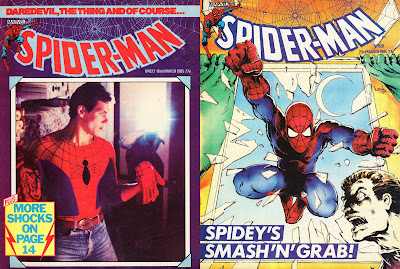
The photographic cover to this issue (above) is a risk, because obviously Scott Leva doesn't look that much like the drawn version of Peter Parker, and breaks the illusion somewhat. Nice that it wasn't the last time he took the role though.

This is not a bad issue, it's just that neat self-contained stories are not what I read Spider-Man for.

However, I don't speak for everyone. There was a group of people at the time who seemed to really love self-contained Spider-Man tales with no continuity at all.

Yes, Marvel UK.

Does the guy in the right image sorta look like a drawing of the version of Peter Parker in the left one to you?
Their reprinting of this tale mere months after the original US publication kinda' sent signals regarding what they were really looking for in a reprint strip.

Aside from the traditional respelling of color and the excising of any page-numbers, this one got represented fairly faithfully. I mean the biggest change was clearly an accident. (and one the coloUrist may not have been too grateful for)

US original on the left, UK reprint on the right:

Put your 3-D glasses on now!
This was, after all, one strip that they clearly didn't want to mess with too much. I say this more than anything else because of what didn't get changed – the final US "NEXT ISSUE" panel.

NEXT ISSUE: At last! Due to absolutely no demand whatsoever, mighty Marvel is
proud moderately pleased to present... THE SPECTACULAR SPIDER-KID! (PLUS! The fate of Harry and Liz's baby! And, a certain web-swinger changes his costume again! Be here in 30 days!)

Yep, Spider-Man Weekly #628 finished-off that issue by also boldly inviting all its readers to buy their next weekly issue in a month's time. I could make some crack about how it was no wonder that sales figures subsequently dropped, but I'd prefer to applaud them for their inspiring honesty.

Y'see, five issues later, in #633, they actually did reprint that strip!

Labels:

I had a very important meeting with my employer in London today, at Westminster Abbey.

Oh yes I did - I'm a Missionary, which means that I'm working for God, and what else is Westminster Abbey for if not for spending some time with the creator?

Well all right, so actually my human employer Phil was using up time sightseeing with me until his flight home this evening, but in fairness, we did have a bit of work to discuss too, and what better opportunity to do that than while strolling around the inside of such an ancient, and apparently still unfinished, London landmark.


After buying our tickets, we discovered that WA boasts a similar electronic commentary system to Milestones Museum, featuring Audioguide handsets that play a relevant clip of Jeremy Irons whenever a number is punched-in from a corresponding map. Irons sounded terribly slow to me, which given our limited timeframe had me chomping at the bit to get a move on.

Phil kept asking me questions. I kept not knowing the answers, so I kept making them up. We both agreed that it was amazing that some of the tombs were so beautifully ornate, given that they were for people who had left this physical world behind.

Eventually we did the really touristy thing and got someone to take a photo of us in the cloisters:

Phil illuminating Westminster Abbey with his innate super-holiness
Then we left the cloisters and went back into the main church, where I kept on taking photos:


Then an Abbey Marshal in a red gown kindly asked me to stop. I'm still not quite clear why, unless it was because, as evidenced above, he could see what rubbish pictures I was taking.

As if to prove my photographic incompetence, once we got back outside into the extremely well-lit and photogenic city that is Olde London Towne, I continued to take no further photos whatsoever.

In fact, despite our subsequent journey down ancient streets, all the people we met, the panoramic overland tube journey and the thriving hustle and bustle of Heathrow Airport, the camera that I had earlier been using remained firmly put away.

Well, I guess Phil and I were just too engrossed in catching-up.

During my time in New Zealand, I saw no less than ten people who I had first known outside Godzone, not to mention all the other kiwis who I'd previously spoken to on the phone or heard on the radio. Most, but not all, of those occasions are recorded on this blog. (I later learnt that one day old friends Rob and Jo had passed within a few minutes' walk of me too)

Conversely, the number of people who I first met in New Zealand and have subsequently seen back here is now up to just two – Chris (in 2006) and Phil (today).

Chatting to Phil over a coffee in Heathrow Terminal One's branch of Costa (a shameless name for any airport outlet) was a completely ordinary situation that just never happens these days.

Meetings like today's give rise to a sense that those years of my life spent down under are still very much in the present, a perception that my work, blogging and even Facebook-reading also contribute to. Not to mention all the phone-calls, emails and IM chats that I have, so many of which still continue to challenge me with the exact words "When are you coming back?"

I like that. No-one ever misses-out the word "when".

Anyway, eventually Phil went through to the duty-free area, and I made my way home, anticipating another coffee at a similar establishment somewhere beneath my feet presently.

When I typed that I guess I was thinking of somewhere like Kreem Café in Penrose, but I guess those freebies I used to enjoy by the luggage carousel at Auckland Airport count too.

Labels:


Writer: Louise Simonson
Penciler: Bret Blevins

Right from the first page, author Louise Simonson has a tone that I'm not used to.

In a good way.

The opening scene features some ordinary members of the public who are in a fairly ordinary late evening situation when something extraordinary and deadly happens. It has the feeling of the opening of an episode of The X Files about it, or something else of that genre.

Cannonball comes across as a great character – one who I found I could really take pity on. Being a New Mutant, he still has trouble with controlling his latent powers. Or put it another way, he can fly, but has hilarious trouble turning.

The overall story of the Incandescent Man's origin was an original one too, I thought.

The other mystery, for the first 20-odd pages at least, is the identity of the masked 'copter pilot.

Page 18 panel two:


Sort of bulky looking guy, isn't he?

Page 20 panel eight:


:)

(available here)

Labels:

Writer: Tom DeFalco
Penciler: Ron Frenz

Harry Osborn!
Before we even start, I have to say how much I admire Marvel UK's subtle recropping of the above two covers...

Harry Who?
I really think that second one looks cooler than the original.

Anyhow, this post isn't here to celebrate the joys of the Anglicised reprinting, but the contents of the strips themselves.

Once more author Tom DeFalco cannot contain his silly streak, as Spidey's opening scrap finds him accidentally webbing-up his own hand!

His recent alien costume has let him lapse into bad habits, you see, so poor Peter Parker has just been forgetting to give his old mechanical web-shooters the same regular maintenance that he always used to. Now that he's wearing them again, of course they gunk up on him. As a result we get to see him carrying-on battling goons one-handed (similar to fighting with a sling back in #257), and realising almost too late the difficulties of swinging around New York one-handed.

But don't let that fool you into thinking that this two-parter is just a comedy 44-pages. (although Spidey does later pull the same handy trick on an opponent)

In order to blackmail Harry Osborn, the Hobgoblin kidnaps his pregnant wife Liz, seizing Mary Jane at the same time just in case she gives birth while captive. (none of his henchman are too keen on dealing with that eventuality)

(In the UK publication, as the actual birth-episode had already been reprinted a year earlier, this was therefore Liz and Harry's second child. Sheesh – why were we supposed to be collecting these things again?)

Anyway, all this pressure threatens to push poor Harry over the edge, especially when you factor in that Harry's dad was the original Green Goblin, and Harry only found out this fact while he was coming off of drugs. Given that this had the effect of making him assume the Green Goblin's identity himself for a while – a trauma he's now blanked-out from his memory – his desperation to save his wife, friend and baby are now raking up some extremes in his personality that he didn't know he had. Just look at the madness that penciller Ron Frenz has planted in the poor guy's mind here:

Harry WHO?
In the event though, despite heavy implications earlier to the contrary, Harry just can't bring himself to even fire a gun. Whew.

When the entire warehouse goes up in flames around them all, it pretty much goes without saying that Liz goes into labour. As everyone eventually escapes, no-one really gains anything from the encounter, least of all the Rose who loses a great deal of desirable NY warehouse space.

As I've come to expect from Mr DeFalco, this is all good, fun, exciting stuff.

Labels:


Issue #2 of a quarterly series that tied-into the Questprobe range of computer games, each of which featured a different Marvel hero. Issue #1 for example had been about the crowd-pleasing Hulk. I don't know much about the computer games, although they are all available to be played here.

As a regular Spider-Man comic however, this script (and pencils) by Al Milgrom sits nicely in with the events of Peter Parker's life at the time, while the focus is on Spidey anyway. Pages 3-8 invest time in introducing us to several unfamiliar factions across the universe, including a sentient floating gem, being held captive by a similarly floating egg, which will explode if it tries to escape.

Meanwhile back on Earth, SFX whizz Quentin Beck's escape from prison is quite inventive, but the central conceit that Spider-Man finds himself battling two foes who look similar by coincidence is a tough one to swallow.

By the end I was getting interested in the blurry political situation on Durgan's planet, but alas, not enough to download the zip file of the game while later writing this review.


Available here.
Review of Questprobe #1 Featuring The Hulk here.
Review of Questprobe #3 Featuring The Human Torch And The Thing here.
Review of Marvel Fanfare #33 here.

Labels:

The spectacular Amazing Spider-Man Annual #18
Plot: Tom DeFalco
Script: Stan Lee
Breakdowns: Ron Frenz


I got this for my birthday this year, and it's the best comic I've read in a long time.

In fact, I'd even go so far as to call it a textbook comicbook.

Following straight on from Spider-Man (UK) #607-610, this was Stan Lee's first Spider-script for 12 years, and it's a breeze to read, start to finish.

While the wedding of a main character is generally considered to be a turning-point in a main comicbook character's life, when it's a lesser character getting hitched it can all too easily be a comedy filler.

Well, this is an annual, and the character getting married is Parker's short-tempered employer at the Daily Bugle - J Jonah Jameson. Accordingly, this is just packed with cynical one-liners. It's also impossibly narrated throughout by Peter Parker, (at the sad but valid expense of Stan's usual trademark hard-sell) making full use that great sense of humour that Spidey is known for coming out with.


(the Marvel UK printing offered further, unintentional, comedy as usual - see one very reedited panel of it here)

Yet beneath the endless jibes at poor Jonah's expense ("Imagine waking up in the morning and being J Jonah Jameson. Yeccch!") there is tragedy lurking. JJJ's visit to his mentally ill son at a sanitarium, and subsequent estrangement from him, got me on the old Meldrew's side, although I knew he and Spidey could never end up working together. (except at the Daily Bugle, of course)

Anyway, the Scorpion escapes, as is a villain's wont, and pretty soon several of the other characters find themselves trying to get away from their respective company too. Jonah himself's ploy to evade his own Police protection is so simple it's brilliant.

At one point Spider-Man webs-up the Scorpion's eyes in order to blind him, a fine move, but one which inevitably left me wondering why he doesn't try this very useful tactic on more of his enemies.

Tom DeFalco's plot is fun, and even the final panel contains a superb closing in-joke that I can't believe I never saw coming.

'Nuff said!

Labels:


Writer / Scripter: Cary Burkett
Penciler / Artist: Greg LaRocque

Three team-ups, one villain throughout.

Despite the cover to #146, the first issue is initially a team-up between mild-mannered alter-egos Peter Parker and Jack Monroe.

As strangers thrown-together by circumstance, together they take-on a NY street gang, each one careful not to give-away their super-identity to the other. Afterwards they hit it off as mates and head off to the cinema together to watch John Wayne's Rio Bravo. As the day wears on, the package Monroe is delivering to Marvel Comics for Captain America's alter-ego Steve Rogers gets stolen, so the two split-up to chase the assailant, each secretly planning to change into their super-identities.

The fact that the rest of this issue features Spider-Man and Nomad battling the same villains together but each never realising that the other is the same person who they were earlier fighting alongside, despite their voices, is one of the inherent flaws in the superhero genre. You really just have to roll with that one.

Along the way they, and an impressed kid bystander, face two villains who I don't think I've come across before - the Taskmaster and the Black Abbott.

The Taskmaster is summed-up by Spidey thus:

Spidey: "If I remember right, he's got some talent he calls 'Photogenic Reflexes'-- --which lets him duplicate exactly the abilities of Hawkeye, Captain America, and a zillion other heroes he's watched in action! But as good as he is at copying natural skills, he can't really do anything superhuman – like matching my spider-speed!"

It sure is a subtle distinction, but it brings Spider-Man and Nomad up against a guy who embodies significantly weaker versions of their many other super-buddies, all rolled into one.

This idea really got my attention, however the villain who lasts-out this trilogy turns out to be the Black Abbott.

(all together now –

Black Aaabbott,
Black Aaabbott,
He wears a jet black tweed,
Black Aaabbott,
Black Aaabbott,
He's very bad indeed...


Sorry.)

The Abbott can do all kinds of weird religious-ish stuff to his foes, including humbling Spidey with a psychic bolt, and reducing another character to ashes. In that deathly cloak, it's tempting to hear Arnold Schwarzenegger delivering his lines...

Black Abbott: "Learn now the fruits of your trespass... as you fall in abject penitence at my feeeet!"

Alas, on page 18, he accidentally dissolves his own arm.

#147 finds the now one-armed Abbott, along with a mysterious two-armed double, hypnotising the Human Torch to obey him. It's a spell which Spidey, in time-honoured comic-tradition, realises he can only break by making Torchie lose his temper. Although this is a family comic, the writers pull no punches.


After the trance is broken, we're told that it takes only "several minutes" for Torchie to calm down after that somewhat shocking goad. I guess that means that at least one of them was showing some restraint.

#148 solves the mystery of the Abbott's double (dubbed by Spidey "the Black Costello") when it's revealed that there's a whole gaggle of versions of him around the world, called the Black Apostles. The kid from part one returns to try to help out, along with the Mighty Thor.

Although all three issues are pencilled by Greg LaRocque and inked by Mike Esposito, the third episode really stood out to me as having some good artwork. The close-ups of Thor particularly suggest a lot of mood behind his otherwise often silent countenance.


(with thanks to Herschel)

Labels:

** Click here for preceding post(s) **

** Click here for following post(s) **