Steve Goble

Choose life. (Deuteronomy 30:19)


Writer: Roger Stern
Artists: John Romita Jr. & Bob Wiacek

This a 16-page UK reprint from 1982 of a story that, despite the cover's claim above to have "a complete story inside", was presumably a bit longer in its original US publication.

It's also got a really asking-for-it title:


A title like that is just inviting criticism of course, especially when the same panel even includes a credit for "COLO RIST" (look at the bottom) because someone at Marvel UK only got half-way through anglicising the word. Oh yes, those of us who find joy in poking fun at comics' editorial shortcomings are indeed well catered-for by this issue.

First up, the plot. In this rather post-modern pantomime, a villain calling himself "The Foolkiller" is terrorising New York by, heck no, I'll let him explain it to you.


Alas, we never clearly find out whether the Foolkiller's definition of 'fool' is 'thick' or 'morally deficient'. But his special power? It's that gun he's holding.

I've made much in recent Spider-posts of the way in which Marvel UK used to adapt and change these comic-strips for the British audience. Sometimes they could be quite... err... enthusiastic about it. And yet here, they seem to have become quite lethargic. On page 7, they've even left-in the references to the American back-issue numbers:


Later, the US-spelt words 'colorful' and 'honor' make it through unscathed, as well as a host of verbs ending in 'ize'.

Not that there's anything wrong with that. If it was deliberate then I applaud the decision to expose British kids to a culture outside of their own. However, in other places this story clearly has been pulled-about and adapted.

For instance, when Spidey bursts in on the Foolkiller, his dialogue just doesn't flow from one panel to the next.


Panel(s) missing?

It gets more fun. After the Foolkiller has escaped and Peter Parker has dropped-off his roll of film of the encounter to the Daily Bugle, he exits from the newspaper offices...


"Where..."? Don't they mean "Whu...?"

Parker changes back into his civvies, and for the second time this issue encounters student Greg Sallinger, who seems to have a lot of anger brewing under the surface about the missing paperwork for his scholarship grant. Parker makes fun of the mailroom employees, quipping "If you ever saw the fools that work there, you wouldn't be surprised!"

Well, Sallinger takes great interest in that comment, leaving the reader honestly wondering if the twist at the end will be that the Foolkiller isn't Sallinger.

Only one problem with that theory of course – there just isn't anyone else.

So – on the last page – after Spidey has battled the Foolkiller again and defeated him, even Spidey has joined the dots and come to the same conclusion. It's just too obviously Sallinger, isn't it? I ain't gonna give it away.

But here's my nitpicky jibe – were Marvel UK ironically acting like a bunch of fools when they published this issue? I choose to believe not. I'm not here to whinge and complain about a 26-year-old comic, I'm here to celebrate how fascinating all these little foibles are in retrospect. As a fan, it's great fun over-analysing these old publications and taking them far too seriously. What's the alternative – taking serious things seriously? Boring.

Bearing that in mind then, the centre-pages of this issue are pure foolish joy – a challenge to help Spider-Man find his way through the maze to save Mary Jane:


Only two problems there:

1. That's not Mary Jane, I think it's Betty Brant.

2. That maze is - literally - impossible!

What was the title of the strip again?

(STOP PRESS: After writing this post, I was later given a copy of the original Marvel US issue Amazing Spider-Man #225 which contained the strip in full. Review of that issue here.)

Labels:

I think this is another remake of an audio story, however since I haven't heard the original story in question, I can't say for certain.

The Doctor and Donna land in ancient Rome, back when it was still new, and are mistaken for Celts every time they try to speak Roman.

It looks like a straightforward enough yarn, however there are three disturbing spins on the norm that creep-up on you.

First, some of the chief protagonists in this tale are seers. Fairly straightforward for a Doctor Who story, right down to their (presumably) foreshadowing events later in the series, just like their counterparts in The Unquiet Dead and The Satan Pit. What happens here though is that it breaks the Doctor and Donna's cover. The Doctor is used to hiding behind the smoke of each false identity he makes up, but when his cover as Spartacus is blown, he and Donna look thoroughly guilty, and really lose the upper hand.

Second, there's the galling ending in which, to save the rest of Earth, the Doctor has to deliberately blow-up Pompeii and kill 20,000 people. Argh.

And third, as a result of the above two points, there's a lot of talk about predestination, and why the Doctor has always refused to interfere in Earth's history, but never had any scruples about mucking about with it in our present-day.

Point (3) rather shows-up how uncomfortably points (1) and (2) share this tale together though. The seers can't predict the Doctor's destruction of Pompeii, because he hasn't made that decision yet. Unfortunately the same reasoning prevents them from being able to predict characters' choices later in the series. I can't blame the author for that though, as his original draft couldn't have contained those lines, and therefore would probably have been stronger if left untampered with.

Despite those throwaway carrots though, this episode has a good script going for it, together with some frankly great visual effects. It's a shame that the production lost some of that in the garbled delivery and muddy soundmix.

For example, towards the end, the Doctor babbles the plot so quickly that you get the impression the director was somehow ashamed of it. At one point the Doctor gets through all of "Yeah, okay, fine, so you forced yourself inside a human brain and used the latent talent to bond, I get that, I get that, yeah." ...in just four seconds! Tennant is a fine performer, but the spectacle of his breakneck delivery hardly outweighs the importance of resolving the story clearly. I sure can't take it in at that speed.

Worse, much of the dialogue in this episode is comparatively quiet anyway. That's fine when there's little else in the mix, but here the actors fight a losing battle against the music and effects tracks.

Overall though, it's great to see a story that tries to explain a few of Doctor Who's long-term failings, (the alien language and meddling-with-history questions date right back to the first Doctor) but this is another tale that the 40-minute format just doesn't have enough time to cope with.

I liked this, and I particularly liked the ending whereby they can't save everyone, but they can save just a few of them.

Labels: ,

The simplicity of the Good News (AKA "Today's English Version") translation of the Bible comes in for a lot of flack. One of my friends commented to me recently "An educated man such as yourself should not still be reading the Good News." (Yep, John sure knows how to couch a criticism)

On the other hand, a Bible translator I met at Cession a few years ago told me that "Every established translation is reliable." (I'm probably paraphrasing both parties)


As a teenager, I was given a full-length hardback edition of the Good News Bible, which I set about reading from the start. Years later my parents gave me a pocket one to take on my travels in my twenties.


It travels with me still. Well, what's left of it these days does.
Back in the UK again, and reckoning at 37 to have now completed reading the Good News translation, this morning I returned to my much larger yellow hardback edition, looking at all the additional pictures it contains, just to be thorough in my reading-plan. (I draw the line at having to read all the sub-headings, which are not an expression of the original wording, and therefore not really part of the 'translation'.)

And even these line-drawings demonstrate its honest simplicity. For example, Job features image after image of Job running the full gamut of human emotions. And rarely do these minimalist sketches seem to dare to interpret the verse – what you usually get is a literal depiction of what's taking place, and given all the Bible's spiritual content, that's often quite tough to draw.

For example, Deuteronomy 30:19:


Or Proverbs 15:19:

If you are lazy, you will meet difficulty everywhere, but if you are honest, you will have no trouble.


Whoa – hold on a sec. How on Earth is that verse represented by those squiggles?

In fact, as with a few other images in Proverbs, it actually appears that the illustrator was bizarrely working from a different translation. Here's the same verse in the NIV:

The way of the sluggard is blocked with thorns,
but the path of the upright is a highway.


Oh, okay then.

And then there are all those pictures that just contain unintended comedy value. Who among us does not smile when coming across our old friend the Good News Klingon?

(that's Proverbs again BTW)

I'd have to say that I continue to read the Good News Bible for several reasons:

1. It assumes you know nothing. I like that – it meets me where I am.

2. It’s so easy to read. I've found some other translations to be full of old language (the KJV), very wordy (the God's Word), or overly-punctuated. (the NIV does contain rather a lot of commas, I know, I expect so much)

3. Its unambiguous footnotes-system. No asterisks, arrows or economically reusing a single footnote in place of ten identical ones within the same chapter. A simple letter 'a' in the text leads to 'a' below, meaning that 'a' below easily connects back up to 'a' in the text too. And it utilises the whole alphabet for this system, ensuring that you're always 26 footnotes away from the closest one that you could otherwise get mixed-up with. (still looking at you, NIV)

Granted, the text of the footnotes themselves seems to be an unfinished project, being applied somewhat sporadically, but you can't have everything.

4. Because it's always been there for me.

Sure, I find the Good News a little simplistic in places too, and as I say the footnotes are kind of patchy, but they did set out to make an easily readable translation, and in this I feel they've really succeeded.

(review of CEV Bible here)
(review of God's Word To The Nations Bible here)
(review of The Message Bible here)
(review of NIV Bible here)

Labels: ,

Went to hear the big R.E.M. concert at Twickenham Rugby Ground tonight.

Well all right, actually I just stood across the road outside Tesco getting some money out from a cash machine, while listening to Stipe's nearby amplified voice warbling away This One Goes Out To The One I Love.

Miles away back home, I listened to the rest of the concert while lying on my bed.

When a band plays Twickenham, they literally play Twickenham.

Along with, apparently, eighty-two-thousand other folk...

Labels: , ,

(as represented in Spider-Man And Hulk Weekly #417-418)


Plot: Denny O'Neil, Jim Shooter, Mark Gruenwald
Script: Denny O'Neil, Mark Gruenwald
Layouts: John Romita Jr.
Pencils: Al Milgrom

In Spider-Man And Hulk Weekly #417 and Spider-Man And Hulk Weekly Incorporating... Team-up #418, everyone's favourite friendly neighbourhood webslinger battled Fusion – a villain who, to this commentator, appears to have maybe inspired the Warner Brothers' cartoon Pinky And The Brain.

Well, probably not, but the similarities are rather fun.

Super-intelligent Hubert Fusser works in a laboratory. Right from the outset his dialogue sounds just like the sort of wordy scientific mumbo-jumbo that the Brain regularly narrates his life with. Really – just try reading this opening lab scene, while imagining Brain's emotionless voice saying the words:


And here's the thing – clever old Hubert has a dim-witted brother, who talks in a similar way to Pinky. In fact, guess what his name is? Again, read this imagining the Pinky And The Brain voices.


Yes, not only do they operate out of a lab, posess similar levels of intelligence and relate to each other in a similarly one-sided way, but the lesser one is even named Pinky! In fact, it isn't long before, just as in the theme song, Pinky and Hubert's genes get spliced. Here however, this forges them into a single energy-absorbing baddie, known as... Fusion! (yeah, that cover above was a bit of a givaway)


It's not actually stated anywhere that Hubert is bent on trying to take over the world, but he certainly does appear to be power-mad.


As you can see, while they're merged together into a single body and whipping Spidey's hide, Pinky and the Hube keep on arguing with each other, in a manner that is not inconsistent with the two lab mice to whom I'm comparing them.


and:


Finally, like all good Pinky and The Brain plans, it's the insane one who gets to save the day (although I accept that you might disagree which mouse that is)


And after they're defeated, I have to assume that they both return to the lab to prepare for tomorrow night, which does leave us with the same question that I opened with:

Were Marvel pondering what Warner Brothers were pondering?

I think so, Hube, but won't Spielberg notice that Keira Knightley is made of rutabagas?

"They're Pinky,
They're Pinky and Hubert Fusser, Fusser, Fusser, Fusser, Fusser."
(and Larry!)

Labels:


"The Master piled up my best soldiers in a heap,

- Lamentations 1:15a (Message)

Labels: ,


I first saw the middle of this film back on Christmas Day 2005, and have always meant to find out how it both ended and began.

Straight away I was hooked by its uncompromising production values. It's very well scripted, very well acted, and has a good strong story. If there was incidental music in here, then I didn't notice it, which is how it should be.

And its central theme of finding some life to live no matter how bleak the circumstances is one that resonates quite strongly with me.

This is, quite simply, one of the best films I've seen.

Labels:

Doctor Jude
Here it is in brief: The Master saved a people out of the land of Egypt. Later he destroyed those who defected. And you know the story of the angels who didn't stick to their post, abandoning it for other, darker missions. But they are now chained and jailed in a black hole until the great Judgment Day.

- Jude 5b-6 (Message)

Labels: ,


"... six spellbinding chapters chronicling Batman's transition from novice crimefighter to The Dark Knight."

Well, that's what the blurb on the back of this DVD promised anyway. In fact, these are just six random animated shorts, that I'm told have very little connection with the current Dark Knight movie that it seems to be cashing in on. The Animatrix this ain't.

Still, it counts as a Batman movie, so I watched it where I think it approximately comes.

The first four cartoons did very little for me, and I'm very sorry to say that my mind wandered during the climax of maybe all four of them. I'm just not sure now.

The final two however - Working Through Pain and Deadshot - I found much more involving.

But serious cartoons just aren't my thing.

Available here.
Review of Batman Begins here.
Review of The Dark Knight here.
Review of The Dark Knight Rises here.

Official website here.

Labels: , ,

Someone shut the fence off in the rain...
This is the first "Weird Al" CD I ever bought – in Canada in 1996 – and its appeal hasn't diminished at all.

The opening track - Jurassic Park - is a parody of MacArthur Park. In '96 I smiled even though I hadn't seen the film back then.

Later we get his original composition Frank's 2,000" TV, which is one of my all-time favourites. It's such a feel-good ballad, all about a neighbour who happens to have a gigantic TV set, that it always gives me tremendous optimism for the future. I'm not joking – it's lovely piece of childish madness.

Everybody in the town,
Can hear those 90,000 watts of Dolby sound,
And I'm mighty proud to say,
Now I can watch "The Simpsons" from 30 blocks awayyyyyyyy!


That's followed by the crueller pleasure Achy Breaky Song, which is allowed because Al – God bless 'im – always gets permission from the original artists before he parodies them! Knowing that the original creator gets the joke too really does make a huge difference.

There's also the short TV theme parody Harvey The Wonder Hamster. I could go on, but I've already said about the same amount as the entire lyrics do.

But the very final track on here is the one that changed my life. I remember reading this title in the shop, and scarcely daring to suppose that it could actually be what it threatened. When I got back to the UK and finally played this CD, I'm happy to report that this track delivered exactly what I'd hoped for. It remains to this day one of my all-time favourite "Weird Al" numbers.

It's called "Bohemian Polka," and it delivers just about everything that it's possible to infer into the title.

Joy. Pure joy.

Labels:

You... brought back Donna Noble...

Most TV shows try to start each series with a stronger episode, but not this one. There's nothing actually wrong with this, but bringing back such an unpopular guest-character as Donna to be a regular is... erm... well, very brave.

And I think they know this. Donna's last appearance – in The Runaway Bride – was toe-curling from the second-scene onwards. You see, she shouts. A lot.

That's not actually a bad thing in a light-hearted family show, but Donna started off by shouting at the top of her voice, leaving her nowhere else to go with it for the rest of that specially-extended episode. As a result, she spent pretty well most of the next hour, yelling at the same wearing volume. Or that's the way I remember it, the truth is that I really don't like remembering it. If she'd started-off by furiously whispering, and then gradually built-up to her top volume, then I think that could have been quite funny, but she didn't.

Anyway, all that to say, the Doctor Who writers seem to have taken this on board, and in this – her first return episode – she hardly shouts at all. Breathe-out - ahhhhhhh... :)

In fact, after a long-winded opening twenty-minutes, in which she and the Doctor are both investigating the same company but without discovering each other's presence, they actually bless us with a scene in which she's completely mute.

She and the Doctor are both spying on the baddies, through facing windows on opposite sides of the same room, when they finally spot each other and have an entire silent conversation by miming.

Oh yeah, this writer knows how painful all that shouting was last time...

Bernard Cribbins reprises his role as the street-vendor from Voyage Of The Damned, who now turns-out to also be Donna's grandad. This is a nice touch, except that of course he wasn't at her wedding...

At the end of the episode, when Donna joins the Doctor, things are actually looking quite promising for the series. I'll admit that I'm seriously concerned that this 'new' companion – exactly like the last two – is a young airhead woman from present-day London with a family that includes an overbearing mum. Given that the same author is responsible for introducing all three companions in the same way, that's just... well, there's a great deal of room for creativity.

But on the other hand previous companions Rose and Martha, despite being airheads, were both repeatedly presented to us as being clever, despite the impossibility of demonstrating this in such dumbed-down plots.

However, this is where Donna has the edge. Originally created for a one-off episode, she didn't suffer from that pretentiousness, and was acknowledged by all around her as shallow.

The point I'm making is that Doctor Who has always been a comedy on the surface, and now that it finally has two comic performers playing two larger-than-life characters as its leads, this could be the start of great things.

Finally, as if to prove the contrast, just before the end of this episode Rose makes a return guest-appearance. Donna, not realising who she is, asks her to give her mum a message, before leaving. Rose, true to her stroppy prideful character, says nothing and then just leaves, with no attempt whatsoever to help.

I do hope this doesn't mean that they're going to force Rose into the background of several episodes this season. Foreshadowing is really not this team's strong point, a weakness accentuated by the way they only think to foreshadow the final story of each series.

Labels: ,

I'm pleased to say that I enjoyed the second season of Torchwood.

There's clearly been a big rethink on the show since its first studenty series. Owen's character has lost his sad short temper, while Tosh has become a bit of a loser. Ianto spent the first few episodes as the wisecracking joker of the team, but that hasn't really lasted.

The swearing and sex has thankfully been toned-down too, although I think that's just so that the show can enjoy a pre-watershed repeat each week. As it is, these scripts appear to have been written as clean, and then had post-watershed content wedged into them, in an easily cutable way. You'll be watching a good, story-related scene, and then that scene will finish. Except that then it'll continue, with the conversation subject suddenly changing, and Ianto and Jack kissing open-mouthed suddenly, for example.

Here's my own pretentious contribution – the high percentage of shaky handheld camerawork this season is so shaky and distracting that I don't think it's even real. No-one handles a camera that badly. If it's a computer-driven editing effect, and the shaking is so consistent that that seems likely, then it's not one that works. Please stop adding it, or buy a tripod.

I'm glad that there actually was a storyline for Gray this season, although it didn't amount to much. The idea (in Exit Wounds) that he hired Hart to do his dirty work without realising he could do it himself, is the same sort of non-objective writing that also saw neither Jack nor Helen realising that they might well dissuade Gwen from her investigation by just telling her about Jonah's compulsive screaming. (in Adrift)

Like its parent show Doctor Who though, Torchwood's strength seems to lie with all its guest writers.

Individual Story Reviews:

Kiss Kiss, Bang Bang
Sleeper
To The Last Man
Meat
Adam
Reset
Dead Man Walking
A Day In The Death
Something Borrowed
From Out Of The Rain
Adrift
Dark Talk (game)
Fragments / Exit Wounds

Labels: ,

Torchwood's first two-parter doesn't come off too well.

As soon as the first episode has them finding bombs displaying helpful countdowns and beeping sound-effects, you get a nasty feeling that the rest of this won't have been thought-through from the individual characters' points-of-view either.

And sure enough, the villain of the piece – Jack's long lost brother Gray – spends much of the story operating through a stooge, although as soon as this is revealed, he does everything else himself. In other words, maybe I'm wrong but he didn't seem to have any reason to use a stooge.

Lying amidst the bombs' wreckage, we get flashbacks to the individual team-members' back-stories from prior to the very first episode. This is common practice in shows that are either very good, or the opposite. Average shows never do this.

However, after all the hard work in Utopia to sort out Jack's three contradictory origins, here they actually go and give him a fourth one. In this version he joined Torchwood in the nineteenth century, despite having later been serving in the army in 1909. (in Small Worlds)

Once the new origins are out of the way though, it's back to the present, where there's more time-travel to come. (I knew sorting out the tenses in that sentence would be difficult) Defeated in the present, Jack gets transported back to 27AD, where he's buried alive. Jack then spends 1900 years buried underground, repeatedly dying and coming back to life many millions of times over, and suffering no psychological effects from this at all. Except for, apparently, failing to think of slowly digging himself out.

Catching-up with the present-day, Jack mercy-kills his brother, although later he seems to be hoping to revive him.

No-one seems quite sure how to handle Owen's death, since he's already dead, so we don't get to see it.

On the plus side, the image of Jack, Gwen and Ianto alone in the Hub at the end really conveyed a sense of loss. I thought there were more of them left alive at the end than that.

Labels: ,

Torchwood's run of passable stories takes a break this week, with a tale in which lead character Gwen's understanding of the plot keeps falling behind the viewer's, and three people (Jack, Helen and Jonah himself) forget to tell her a fairly important plot-point. (namely that Jonah spends 20 hours a day screaming)

I can't deny that this tale packs a big emotional wallop, but I found that inevitably lessened by the lack of reinforcement from the story.

Labels: ,

In 1981 Super Spider-Man TV Comic in the UK ran a "Become a Marvel Artist" competition (apparently with a "Become A Marvel Writer" comp too), offering a prize of putting together a special two-page Spider-Man strip for the mag.

So, about six months later in #493, Gary Mountford and Stephen Easterbrook hit us with a rarely-seen rematch between Spidey and the Vulture.

Mountford's script packs-in a ton of story for just two pages, yet never feels rushed. And Easterbrook's artwork is tremendous. There's a spider hidden somewhere in almost every panel, not to mention a few subtle Spider-Men. In fact, I have to say that the more I look, the more stuff I find buried away in there.

Given how little original Spider-Man the UK weekly saw, this is a bit of a treat to come across. I guess when you only have two pages, you pack a lot more into them.

Labels:


***contains spoilers***

This is a real curiosity.

The publicity states that you don't need to have seen the TV show in order to watch this film, which would suggest that this is aimed at the general public, rather than fans.

And yet, The X Files 2 has quite definitely been made for enthusiasts.

For while there are precious few references to the TV storylines, this instalment is a talky character analysis of Mulder and Scully – something that you would likely need to be a fan to have enough interest in.

There's very little action, I only spotted one special effect, and the whole thing is extremely slow. You really have to decide beforehand that you're in for the duration, because it makes little to no effort to hold your attention.

This is not a Hollywood blockbuster, a revival, a reboot, or even a reunion movie. This is one of those spin-off novels you come across in Borders.

And yet, that's the absolute beauty of it. Chris Carter and Frank Spotnitz have made the movie that they wanted to, and the creative team's undiluted vision of what became of Mulder and Scully after the TV show ended is exactly what they should be allowed to show us.

Me – I am an X Files fan. I've seen every episode, and I watched the last movie, both at the cinema, and then again on VHS when the UK TV episodes caught-up with that point in the story. (yet to see the Lone Gunmen spin-off though) As a result, I was hooked by this film from start to finish.

Sure I have my own opinons, in fact horror really isn't my sort of thing, but I wouldn't swap a single frame of this under any circumstances. These people told me a strong, enthralling tale over nine years, so of course I'm agog to see whatever they tell me happened next.

Finally, as the closing credits rolled, everyone else in the cinema left.

Let me let you into a secret – nearly every film these days has a post-credits tag scene. Yep, nearly every one. Don't believe me? Okay, sure.

Just before the end of the closing credits to I Want To Believe, there's a shot of Mulder and Scully in a boat. We're looking down at them from a huge distance above, I assume from the helicopter. Then they actually look up, see us, and wave at us.

Alone in the cinema, I couldn't resist waving back.

It was so nice to see them again.

(available here)

Related Posts:

1. The X Files (TV series)
2. The X Files (1998 film)
3. The Lone Gunmen (TV series)
4. The X Files: I Want To Believe (2008 film)

Labels: ,

Director Chris Nolan just can't resist telling a story in non-chronological order.

So after Following and Memento comes his take on the origin of Batman.


And – this is meant to be a compliment - he is actually too good at it.

Nolan exposes Bruce Wayne's inner motivation and path to donning the pointy-eared suit so well, that when the fancy-dress costume finally does show up, it's actually a disappointment. What I mean is that by that stage, I was really far more interested in the personal journey of this one tortured soul, than in giving it all up to instead start watching a superhero flick.

But suddenly there's the costume, the gadgets, and the menacing voice, none of which quite tally with the mission that poor old Bruce Wayne seems to be on. Maybe, as well as seeking to clean up Gotham, he is also a fan of comicbooks, and coming-up with a persona like Batman is his idea of having some fun along the way? That's the only way I could reconcile it.

This is a terrific version of Gotham too. One thing that always disappoints me about superhero tales is the presence of a super-villain, but this film doesn't really have one, lending the story a rare quality of believability. (obviously you decide that Batman himself is believable before you even sit down to watch the film)

All this, plus Captain Scarlet and an unstoppable monorail.

Not really my sort of film, but absolutely brilliant.

Available here.
Review of Batman: Gotham Knight here.
Review of The Dark Knight here.
Review of The Dark Knight Rises here.

Labels: ,


Plot: Roger Stern
Script: Tom DeFalco
Pencil breakdowns: Ron Frenz

I don't have the preceding issue of this, however as the episode opens with Spider-Man and Hobgoblin lying amidst the flames of a burning building, I found that I didn't really need to have read it. In fact, thanks to the Hobgoblin's helpful exposition, I didn't even need a proper recap-panel.


That's pretty smart scripting there from Tom DeFalco. Clearly he prefers dialogue over narration any day of the week, as the rest of these two super-beings' battle proves.

The Hobgoblin continues:


Well, y'know, I'm not really being fair am I? I mean, an informative paraphrase is just the way in which super-heroes and super-villains always talk, isn't it?


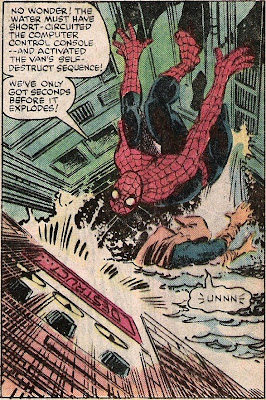
When even something as visual as the van's eventual crash into the Hudson river is being explained out loud by Spidey, you have to just sit back and accept that this is part comic-book, part radio-show – which is something that I can hardly criticise.

Hobgoblin expressing the situation's urgency in French
That's a pretty serious design-flaw that van has. In fact, it brings all the action to a close when we're still only at the centre-staples.

The second half of the issue carries an air of winding continuity down, for reasons I'll touch on in a moment. After the Hobgoblin's defeat, Spidey reports back to his publishing nemesis J Jonah Jameson, has a great argument with him, learns that JJJ has resigned, and watches him hand over editorship of The Bugle to Robbie, who I guess had been waiting for this.

After that there's a second epilogue with Harry Osborn, which leads into a third one with Spidey getting abducted by a giant UFO in Central Park. With a bit of tweaking, this was the only part of the issue to my knowledge that got reprinted here in the UK. (in Spider-Man Weekly #630)

That's because it led into the landmark Marvel Super Heroes Secret Wars series, which took Marvel US an entire year to publish, and introduced his new black costume.

It was an odd time. I first got into collecting US Spider-Man during that very year (I got this as a back-issue) and like so many other readers, found myself reading Parker's adventures on the Beyonder's planet simultaneously with his adventures on Earth set some time afterwards. Despite there apparently being an entire year's disparity between them, it all made good sense and for me demonstrated one of the shared Marvel universe's greatest abilities.

Today I'm still impressed at Marvel's quiet self-assurance back then that its readers would still be following their titles a whole twelve months further down the line to see things tie-up. From the opposite perspective, I'm also pleased that they believed I would remember what I'd read a year ago.

It's probably a big reason why I still expect today's storytellers to treat their audience with the same respect.

(sometimes available here)

Labels:

** Click here for preceding post(s) **

** Click here for following post(s) **