Steve Goble

Choose life. (Deuteronomy 30:19)

I have always wanted to go to Japan.

We did a whole big project on it at infants school, but I think I assumed then that it would never happen. In those days, foreign countries were places that a few lucky adults got to go to.

To prove the point, Japan was also featured in a special summer Blue Peter Flies The World series on TV. Today I can only remember one line from it – about how hot it was and how inviting the residents' private swimming pools looked. It seemed like a very rich and clean place.

In 2004 it actually looked like it was going to happen. The very first time I flew to New Zealand they showed the film Lost In Translation on the flight, but I avoided it, because my plan was to see it properly at a theatrical release down under. (in the end I slowly blinked through The Passion Of The Christ instead – not a smart move on day one of 24-hour jet-lag)

So this morning I finally loaded-up a DVD of Lost In Translation and pressed play.

And it was quite definitely not the film that I had been looking forward to watching for four years.

A clever Hollywood comedy starring hapless Bill Murray in a series of ridiculous situations as he hilariously tries to escape from modern-day Japan?

No, this was much better than that.


No-one ever told me this film was a drama. Bill Murray and Scarlett Johansson play two tortured souls trapped in marriages that have become cages. In a hotel in Tokyo at the same time, they randomly meet and don't have an affair with each other. Or do they?

That's not a question about whether or not they have sex with each other, it's a question about just what sort of a relationship does take place. The DVD billing calls it a friendship (probably because they don't have sex, and there's about 30 years difference between them) but the more simple fun they have together, it's clear that they're both in over their heads. Neither tells their spouse about the other. They're both happier and more open with each other. And at the end of the film they have to say goodbye and return to their lives, suffering the loss of each other, knowing that there was nothing more that it could ever have become.

Lost In Translation is an absolutely charming film, which paints very, very believable people distracting themselves as they somehow shuffle through life from one day to the next. The acting is faultless, and the script so simple that it never has the opportunity to go wrong.

As is usually the case, the DVD's deleted scenes go nowhere and contribute little, but the same is true of almost every scene that was included too. And I mean that in a good way. If you're willing to invest about two hours of your life to see this pondering film anyway, then you may as well watch it all in the right order. Really - it can't get much slower. Alas, this release offers no such extended option.

You can't help but feel sorry for both Bob and Charlotte. You want to tell them to be positive and try to sort their marriages out, but their earlier bad choices are hurting them so much that the film also makes part of you wish they could somehow be free again. Not to be with each other, just free.

The ending is a shame, but it's understandable because it's born out of the secrecy that I mentioned earlier.

As for what they said to each other, I read it as some sort of promise to occassionally still support each other back in the real world, but such an ambiguous ending invites many interpretations.

Lost In Translation makes you feel like you've just spent a very, very real week in Tokyo.

Labels:

This page is in 3 sections, which are hyperlinked here:

1. How I read the Bible in 40 days.
2. Suggestions for reading the Bible in 40 days.
3. My boring stats.

1. How I read the Bible in 40 days

If you read my last entry on reading the Bible in 66 sittings, then the title above should tip you off that lately I've been getting into what Herschel has scornfully termed Competitive Bible Reading.

I've never thought of myself as competitive. And yet, I really don't like leaving anything unfinished.

Here's how I came to read the Bible in 40 days: (see if you can spot a pattern)

About a year ago I had two goals:

1. To have read the whole Bible, and
2. To have read the whole Bible out loud. (I had already been reading it out loud for a while)

So I sat down with all my Bible-notes books from the past few years, and went through logging all the books of the Bible that I had definitely read in full, and all the ones that I had definitely read in full out loud. When it came to the 150 Psalms, I kept a note of each chapter.

Obviously, by default, this produced two 'TO DO' lists.

1. Books I couldn't recall having read in full.
2. Books I couldn't recall having read in full out loud.

At one chapter a day, (plus re-reading the previous day's chapter again to help it sink in) I began going through Genesis in the NIV. I did this, usually, six days a week. I don't read the Bible on Sundays. I'm serious – I knew it would become a chore if I did, and anyway, there was a church I usually heard the Bible at on that day.

The translation was immaterial to me. I didn't want to get that touchy about different versions, lest I later I decide that I needed to have read the whole Bible in each of them.

In the main though, I was reading my battered tiny Good News Bible, the God's Word that Shane gave me, the NIV that Audrey gave me years ago, and the funky Message on Bible.com & latterly Biblegateway.com.

At some stage I noticed that I'd always been perfectly happy to review books on this blog, but for some reason had only the once written my thoughts on a Biblical one. Clearly that had to change, so I began writing my thoughts up upon completing each one.

As I approached the last few books that I had never read, I added another spin to this process. Upon reaching the end of each book, I would re-read it a third time in one sitting. These two things helped, I think, to sort my thoughts out on each one, and maybe actually learn something from them.

On 12th March this year, with chapter 14 of Zechariah, I finished! Or I finished the reading part anyway, there were still plenty of books to re-read out loud.

It was at this point that I decided to kill four birds with one stone. I would re-read each book, out loud if still outstanding, in one sitting, (another reckless thought) and review it. The best part about this was that, if all went as planned, by the end I would even have read the Bible a second time!

Clearly, competitive Bible-reading. I had half a mind to apply for registration to the Olympics, but, y'know, Beijing probably doesn't have the facilities.

The earliest book that I hadn't read out loud was the sixth one – Joshua. So the very next day – 13th March – I sat down, opened my big yellow Good News Bible from years ago, drew breath and read for 2-3 hours.

By now, I also had the benefit of adding my mum's CEV translation into the mix. I like variety. In fact, I was usually defaulting to the NIV, because I wanted to take the opportunity to read each book in a version that I didn't think I had before.

Ruth was fun. I reckoned I had already read that in every mainstream English translation when I had had to read it in public at Cession least year!

A couple of weeks in though, I realised that I just was not attempting enough.

As I was reigned to reading almost the entire Bible a second time, I realised that I had the opportunity to complete it in a very short space of time too. Sure, it would require me to re-read the books that I'd already read out loud in one sitting and reviewed earlier, but there weren't that many of them.

Let's see – 66 books equalled 66 days, plus Sundays, plus days when I was otherwise busy. I didn't need to read them all in strict order, because those "Read The Bible In A Year" plans don't usually do that, and they count. Also, I didn't think that the Bible was supposed to be read in the contents order, or our huge daily Bible-notes industry would be evil and wrong.

So that was okay, and even allowed me to tweak the order to become more chronological. After all, I figured that an overview of human history (give or take a couple of millennia) would be the plan to do that with.

So by simply keeping a note of what I was already doing, plus a little bit of extra work, it seemed that I had a good crack at nailing it all in under three months as well. Yet I realised that if I breezed through all the minor prophets quite quickly too, I could maybe get it down to two months!

In case you're wondering, yes I did question whether whizzing through the Bible quickly was morally a good idea. Some may read this item in horror, protesting that you have to take it all in slowly and meditate on it. But I'd already done that.

While I didn't want to stop and dwell too much, I did make sure that I understood, at least at face value, every verse I was reading. And, fairly, this speed would be helping me to see the Bible from, for me, a new perspective, in addition to my usual one. How could that be wrong again?

When I broke into the New Testament and started on Matthew's gospel, I felt vindicated in my approach. I read the genealogy of Jesus, and was staggered to realise that, for the first time in my life, I actually knew who a lot of those people were!

Two months. One month? Could I do it in one month? No, no way. I'd been too slow and taken too many days off at the start. What about 40 days? "The Bible in 40 days." That sounded nice and Rick Warren-ish. It actually sounded better than "the Bible in a month," which sounded a little throwaway.

Throughout this time, as I mentioned, I was also writing up my thoughts on each book. But now that there was such a tight deadline, I hit a problem: the epistles.

There were 21 of those, and while I was sure I could read them in a few days, I felt less positive about fitting the writing of 21 reviews in. I didn't like to admit it, but I had to throw some weight overboard. I stopped writing the reviews – I would have to come back and do them later. (which I did, taking the opportunity to re-read them again beforehand!)

With Revelation out of the way, it was time to juxtapose the Bible's ending against how it had all started. Straight back to the Torah, beginning with 50 chapters of Genesis. Then Exodus, then Leviticus, Numbers, and finally Deuteronomy.

Done it. Finally. In 44 days.

Dang!

So, still determined to shave 4 days off of my time, I carried straight on. That night I also re-read Joshua again. That would shave a day off by putting the date that I had started back a day. Now I had started with Judges, and finished with Joshua on day 43.

Then the next day I nailed it. I re-read Judges, Ruth and 1 Samuel again.

Having dawdled a bit at my slow start, by taking three days off in the first week, I had now actually started with 2 Samuel on 21st March, and finished before midnight with 1 Samuel on 26th April. Making a grand total, including days off, of... 39 days? Stone me – I'd beaten my target.

I wondered how many other days I'd taken off, such as those Sundays I mentioned, and whether in fact, in actual terms, I might still have done it within a month after all. Considering a day as being from one sleep to the next, (I keep quite irregular hours) it came to 33 days. Still dang.

But what about by considering a day as midnight to midnight? I'd done tons of this in the early hours, might this possibly allow me to massage the figures into a month? Adding up the totals again, it came to 31 days! Yay! Success! Woo-hoo!

But I still thought that 40 days sounded better though.

2. Suggestions for reading the Bible in 40 days.

If you've read down this far, then you might be seriously thinking of reading the Bible yourself in 40 days. If that's why you found this page, then here are a few heads-ups. (you choose to take my advice at your own risk though)

1. Clear your diary, and keep it clear. I actually told my best friend that I wouldn't be seeing him much that month.

2. Take a day off each week – stay sane.

3. Pick an easy-to-read translation, in your first language. In English this might be the Contemporary English Version (CEV). On a related note, if like me you insist upon reading all the footnotes, endnotes and references to other verses, then just pick a translation without any. (maybe the Message) Large text is easier on the eyes, and pictures break things up too.

4. Alternatively, you could mix-up the translations to keep it varied and interesting, and learn the difference between their styles. Maybe you can read it off of the internet some days, such as at bible.com, biblegateway.com or biblos.com.

5. Unless you specifically want to read all the books in the right order, rearrange them as best suits your schedule. This enables you to take advantage of your church's unexpected sermon on 1 Timothy next weekend. Events will still continue to happen in your life, so God might want to speak to you through specific passages on particular days anyway. Only you can make that call.

6. Break books up if you find that easier. The incredibly long Psalms is really five shorter books, which can maybe be added onto days when you're reading another one.

7. Generally, I found disciplining myself to read a book a day to be a good backbone for getting through the longer ones, specifically Genesis, Psalms, Jeremiah, Isaiah and Ezekiel. Nail those five and you're laughing.

8. A quick prayer before each session might well help too, but keep it short, or that'll become maybe 40 long prayers! :)

9. Pick a comfy seat, and stand-up to move around a bit every hour. Varying the location might help too. Go to the park. Use that down-time on the train.

10. Have a soft drink to hand, especially if reading out loud. Sugary snacks give you a quick burn, but can leave you feeling tired again afterwards. Fruit gives energy for longer, and is healthy!

11. Don't be afraid to speed-read, so long as you're taking it all in. The goal for this reading is to get an overview. Reflection on individual verses is for the slower reading-plan that you'll probably follow afterwards.

12. Make a few notes when you find stuff you want to remember. The real goal is to learn. Marking passages on the page itself is generally quickest.

13. Reward yourself at the end, and tell someone who'll affirm you for it! (even if it's only me!)

14. If you go over-schedule, redo the beginning at the end as I did, or nail it in 50 days instead!

It's all up to you now. Go get 'em! :)

3. My boring stats:

12/3 Zechariah
13/3 Joshua
14/3 Judges
15/3 Ruth
17/3 1 Samuel
19/3 Job
21/3 2 Samuel
22/3 1 Chronicles
24/3 Psalms
25/3 1 Kings
26/3 2 Kings
27/3 2 Chronicles
28/3 Ezra
29/3 Esther
31/3 AM: Lamentations
PM: Daniel
1/4 Nehemiah
2/4 Amos
Micah
Hosea
3/4 AM: Jonah
Nahum
Zephaniah
PM: Ecclesiastes
4/4 AM: Song Of Solomon
PM: Habakkuk
5/4 AM: Obadiah
Malachi
Haggai
Joel
PM: Proverbs
7/4 Isaiah
9/4 AM: Jeremiah
10/4 AM: Ezekiel
PM: Zechariah (again)
Mark
11/4 AM: John
PM: Luke
13/4 AM: Matthew
15/4 AM: Acts
16/4 AM: Romans
PM: 1 Corinthians
17/4 2 Corinthians
Galatians
Ephesians
Philippians
Colossians
18/4 1 Thessalonians
2 Thessalonians
1 Timothy
2 Timothy
Titus
Philemon
19/4 AM: Hebrews
James
1 Peter
2 Peter
1 John
2 John
3 John
Jude
PM: Revelation
21/4 Genesis
22/4 Exodus
23/4 Leviticus
24/4 Numbers
25/4 Deuteronomy
26/4 AM: Joshua (again)
Judges (again)
Ruth (again)
1 Samuel (again)

Next month: backwards.

Labels: , ,

Years ago, in my early twenties, one of my friends told me that reading one of the gospels straight-through in a single sitting had blown his mind.

Over a decade later, and on the other side of the world, on 13th January 2006, I finally got around to trying it out.

However the knock-on effect of that was a sense of incompleteness. As well as feeling a sense of accomplishment at having read the whole of John's gospel in a single sitting, it also made me feel like the other 65 Biblical books were now all still outstanding.

Well, as of today, that list is no more. I've finished it. I've now read all 66 of them straight-through in their own individual sittings.

Despite the oddness of the ambition, I've tried to avoid being too silly about it. I haven't taken the definition of "one sitting" to extremes. I've allowed myself breaks, to eat, go to the toilet, answer the phone and generally remain sane. Initially I tried to make these breaks no longer than 15 minutes, but certainly none of them have exceeded an hour.

Undoubtedly the hardest part of the challenge has been this: I'm just not a reader. Despite all the Doctor Whos I digested in my teens, these days I hardly ever read books, simply because I get tired and bored of them quite quickly. Literally, until I started this, I could count the number of full-length books that I'd read in one go on just one of my hands. In fact, here they all are: On The Lemoncurd Trail by Josie Goble, Quantum Leap: Foreknowledge by Christopher DeFilippis, The Prayer Of Jabez by Bruce Wilkinson, Dirk Gently's Holistic Detective Agency by Douglas Adams and The Man In The Rubber Mask by Robert Llewellyn. (and I'm not even that certain about the Quantum Leap one) Maybe there are one or two others I've forgotten, but I doubt it.

So, slow reader that I am, I found that it took me, on average, about an hour to read 10 Biblical chapters.

This is probably the most predictable observation to make, but here goes: It has changed the way I read the Bible.

1. I am going to have trouble returning to reading it in little bits. I now can't understand why anyone might cut it to little pieces like that. Of course, logically I understand, but emotionally it feels a bit like going on a diet.

2. There are over-arcing stories that I've previously failed to appreciate when pondering a particular, much briefer, incident. It is possible to get too close to the detail. For example, the story of David's kingship, when seen from a distance, gives a strong indication of God's long-term teaching and discipline throughout his life, whereas reading just one chapter of it might come across as being just about David's faith in a given situation. In other words, I think one gets to perceive events less from a human being's immediate perspective, but just a little more from God's.

3. Psalms did my head in. Six hours!

I think above all I felt I got a bit of an opportunity to meet many of the Bible's players. In some instances you get to read a person's entire life story, from before conception right up until after their death. People can change over time, like Saul.

I'm not recommending that anyone replace their current reading pattern with this one. But I do recommend that anyone who hasn't tried approaching the scriptures in this way try-out adding it to their program. It didn't 'blow my mind,' but it has certainly offered fresh perspectives onto both familiar and unfamiliar texts.

Labels: , ,

I hate every ape I see...
"Hi – I'm Goble McClure. You may remember me from such Biblical blog-posts as When Gedaliah Went To Get A Lyre and Honey I Blew-Up Gomorrah! But today, I'm here to talk to you about the humble book of Deuteronomy, or to use its syndicated title, The Best Of The Torah. That's right – the book of Deuteronomy is a CLIPS-SHOW.

CLIPS-SHOW. Is there any word more thrilling to the human soul?

Contrary to popular belief, the earliest clips shows were not made due to a lack of money. In fact, in the good old days of live TV, it represented quite an investment to rebuild old sets and hire back old guest-stars to reperform their lines with the exact same inflection and movements a second time.

And today we're so glad they did. Why, if they hadn't, we wouldn't have half of Winston Churchill's speeches.

You can usually tell a clips-show within the first two minutes of the episode. The regular cast will be sitting around on their regular set with nothing to do, when one of them casually utters the phrase "Hey – remember that time when...?"

And when they do, that's your cue and mine to sit back and laugh. Laugh once again at the crazy antics of God's chosen people as, for one night only, they once again trek through the desert, bite the almighty hand that feeds them, and even, ha ha, let all their fears become one great big self-fulfilling prophesy again!

But that's not all – we're also treated to some previously unseen sequences, a prophetic song, and even a special sneak preview of what's in store for the Israelites' future!

And guiding us through it all is our host for the evening Moses – in his own inimitable style of course!

So it's come to this – a Pentateuch clips show."


The book of Deuteronomy is a collection of speeches that Moses made, although having read it straight through, I thought it came across as more like one big long audience with him.

The Israelites are at the end of their 40-year odyssey through the wilderness, and are just on the brink of finally entering the promised land. It's important to recognise that an entire generation has died on the way. While many of those present still remember Egypt from their childhood, the number of surviving adults is in very low single figures. And that's even counting Moses, who knows he's about to die.

It's very much a book of revision. Partly because Moses recounts so much of the lessons learned on their journey, but also because he then repeats so much of it again. Like I said, there are several speeches here, but they come across in the NIV as just one big one.

The end of the book must have been recorded by someone else, presumably Joshua, (Moses' successor) because it drops back into the narrative and covers Moses' death. Unless Moses faked his biblical death by writing it in advance. Smart move that.

Joking aside, I always slow down to read that bit. Moses' death is genuinely sad. This is partly because after so many years he sees the promised land knowing that he won't enter it, but mainly I think because I tend to read Deuteronomy where it comes after Exodus, Leviticus and Numbers, so it feels like he's been around forever.

There's lots of very solid teaching in this book, and without wanting to sound like a cult-leader, I have to say that some of God's harder-to-reconcile actions, such as killing people, are actually starting to make some understandable sense in this.

It's very very evident that God doesn't want anyone to die. But in Revelation it's also clear that everyone who dies will ultimately come back to life again, at least for a short while. So, for God, it's arguable that physical death is not that big a deal to him. What clearly is important to him though is removing from life people who are determined to influence others in a bad way. It's hardly an ideal solution, but certainly driven by the misguided determination of the Israelites to oppose his plan to save their lives in the long run.

Just to be clear, I can understand God exercising his authority in that way, but not us. "Playing God" is something that we frown upon for very good reasons.

There are so many passages I could quote, but I will close on just this one:

Oh, that their hearts would be inclined to fear me and keep all my commands always, so that it might go well with them and their children forever!

- Deuteronomy 5:29 (NIV)


That's not a reward/punishment deal he's striking. He knows that mankind will never live in lasting peace with each other unless someone uncorrupted shows them how.

Labels:

Labels:

I've said it before and I'll probably say it again, but I’ve recently come to suppose that God hasn’t made the future yet, and hadn’t made any future in the past either.

What's that - God is outside of time? Hey, I hear ya. God might flick back and forth through history like the pages of a book, and even write-in changes here and there that affect later chapters requiring him to rewrite them too. Great theory.

However it does depend upon an earlier presumption that God has created a thing called time in the first place.

I mean, outside of science-fiction stories, what is time?

As I type this, I can hear a carriage clock ticking behind me. But it’s not being driven by time. It’s being driven by the chemical changes in a battery together (I think) with the vibration of a piece of lithium. And when I listen to it, and watch the hands slowly move round, it's not really measuring a measuring a tangible thing called 'time', it's really only providing a rough guide to what all the other clocks in the world are doing, each driven by a different power-source.

Every clock in the world is slightly out. But against what? Well, each other. There's nothing else for the world's clocks to be out against.

'Time' is an entirely cultural belief. Just ask the speaking clock, every time they have to add on a second at the end of the year because the Earth wobbled unexpectedly.

There’s a famous story about some atomic clocks that were sent around the world once, and afterwards it was discovered that they were both running fractionally slow. This is often pointed to as evidence that ‘time’ slows down when you move faster, but all it really proves is that the atoms in the clock moved more slowly at speed. Still no ‘time’.

But if God knows everything, then surely he must know everything that will happen in the future? I don’t know the colour of my car, because I haven’t decided whether to buy one yet.

I think there’s a lot that God hasn’t decided yet too. Not everything, (he has a TO DO list in his head like we all do), but plenty. Plenty of holes that he's left in the future for us to fill in with our own plans.

In the book of Numbers, God repeatedly reveals items from his TO DO list to mankind. However upon hearing it, the Israelites repeatedly assume that it's set in stone. I think that God honestly wanted to carry out those promises, but the people's morality was just more important to him.

He's expecting to lead them into the promised land. However when they get there, the people mistrust him, and they expect to get killed instead. So God changes his mind.

That night all the people of the community raised their voices and wept aloud. All the Israelites grumbled against Moses and Aaron, and the whole assembly said to them, "If only we had died in Egypt! Or in this desert! Why is the LORD bringing us to this land only to let us fall by the sword? Our wives and children will be taken as plunder. Wouldn't it be better for us to go back to Egypt?" And they said to each other, "We should choose a leader and go back to Egypt."

- Numbers 14:1-4 (NIV)

The LORD said to Moses and Aaron: "How long will this wicked community grumble against me? I have heard the complaints of these grumbling Israelites. So tell them, 'As surely as I live, declares the LORD, I will do to you the very things I heard you say: In this desert your bodies will fall—every one of you twenty years old or more who was counted in the census and who has grumbled against me. Not one of you will enter the land I swore with uplifted hand to make your home, except Caleb son of Jephunneh and Joshua son of Nun. As for your children that you said would be taken as plunder, I will bring them in to enjoy the land you have rejected. But you—your bodies will fall in this desert.

- Numbers 14:26-32 (NIV)


Then some of them decide to trust in God's promise after all, but that promise is all they believe. They actually leave the camp, the altar and all his laws behind, and expect the promise to stand in isolation, independently of everything else he'd said.

Well, sadly, the future had changed.

When Moses reported this to all the Israelites, they mourned bitterly. Early the next morning they went up toward the high hill country. "We have sinned," they said. "We will go up to the place the LORD promised."

But Moses said, "Why are you disobeying the LORD's command? This will not succeed! Do not go up, because the LORD is not with you. You will be defeated by your enemies, for the Amalekites and Canaanites will face you there. Because you have turned away from the LORD, he will not be with you and you will fall by the sword."
Nevertheless, in their presumption they went up toward the high hill country, though neither Moses nor the ark of the LORD's covenant moved from the camp. Then the Amalekites and Canaanites who lived in that hill country came down and attacked them and beat them down all the way to Hormah.

- Numbers 14:39-45 (NIV)


Of course, you could argue that the future didn't change. You could argue that God doesn't exist. You could argue that the account Moses wrote was simply a rationalisation of a non-existent God's prophesy not coming to pass.

Of course, no Christian would say that. But many Christians do say that when God states the future, it's always set in stone…

Labels:

It's a big challenge to write about the book of Leviticus.

The challenge is to write something positive about 27 chapters that I find so long-winded and unengaging. (sorry, that's just how I honestly feel)

But the BIG challenge is to write something positive about it because, more than any other book of the Bible, this one actually does claim to have been authored by God.

I haven't done the maths, but it seems like about 95% of Leviticus is Moses quoting what God said to him. We can argue over the collaborative God/human authorship of the rest of the Bible, but not so much with Leviticus.

It's mostly laws, about such culturally-specific subjects as animal sacrifices, what to do about mildew, and bodily... no, I'll just stop here.

An intriguing pattern throughout the Bible is one of God teaching mankind to tell right from wrong. Leviticus (the third book in) seems to be the start of God's curriculum in this. And as such at this early stage, he's keeping it simple. I could quote stuff, but if you dip into the book yourself almost anywhere, you'll find just how spelt-out it all is.

Some of it seems to make little sense – chapter 11 on clean and unclean food for example - but I really think that's because, from our perspective, it's over-simplistic.

When we look at unclean food today, we look at details like hygiene, nutrition, bacteria etc. Tough subjects to comprehend in lesson one.

To use an analogy, when we teach young kids about colour, we use toys with very simple colours – red, yellow, green, blue etc. We don't tell them about maroon, indigo, ocean grey and superviolet until later.

(I actually think that brightly coloured toys hold-back a child's development, because they distract them from recognising the subtle gradients in trees, stones, the sky etc., but that's just me)

Anyway, maybe Leviticus is God starting us off with simple stuff.

By the awful time of 2 Kings, people are just not following God's simple instructions, and everything's going the way of madness.

And then come the gospels, which feature Jesus repeatedly trying to make people think, using parables and metaphors to get people's brains slowly grinding away.

It all makes a mockery of our man-made 'law,' and of the popular paradigm that if something is true in one context, then it must always be true in all contexts.

Here, take a read of this:

GOD spoke to Moses: "Tell Aaron, None of your descendants, in any generation to come, who has a defect of any kind may present as an offering the food of his God. That means anyone who is blind or lame, disfigured or deformed, crippled in foot or hand, hunchbacked or dwarfed, who has anything wrong with his eyes, who has running sores or damaged testicles. No descendant of Aaron the priest who has any defect is to offer gifts to GOD; he has a defect and so must not offer the food of his God. He may eat the food of his God, both the most holy and the holy, but because of his defect he must not go near the curtain or approach the Altar. It would desecrate my Sanctuary. I am GOD who makes them holy."

- Leviticus 21:16-23 (Message)


Well, that doesn't sound very nice. Until you remember that Moses himself suffered from a speech impediment. Assuming that he still had it, then how, in light of the above, could he have spent so much time with God – enough to fill most of this book with quoting him?

I'm not telling you what I think, because my point here is precisely that the Bible often doesn't explain itself, precisely in order to make us think. (I think)

Here's what I do think God is constantly pointing us to though:

"Don't pervert justice. Don't show favoritism to either the poor or the great. Judge on the basis of what is right.

- Leviticus 19:15 (Message)


(I can't believe Moses spelt "favouritism" like that)

Finally, chapter 26 is awesome. God spells out the lengths to which he will go to turn someone away from their sins, and back to him. This time, I actually found the whole "hereditary sins" philosophy starting to make some sense to me. Just as kids inherit some disease, characteristics and talent from their folks, it's reasonable to question whether they might get some bad attitudes passed-down too.

Labels:

Why do bad films often seem better on their second viewing?

I think it's because our expectations are lower.

When the murderer is finally revealed, but it's someone who had a golden opportunity to carry out the crime much earlier in the film and didn't, then it's annoying that the 'writer' is getting some of my ticket price.

However, when I later come across the same plot-holed movie on TV, this time I fully expect the murderer to do nothing early on and get caught following a later attempt. As a result, this time when the accelerated credits roll, I feel less disappointment, because this time my lower expectations were fairly accurate.

But imagine what it's like for the writer. Before the film has even been begun shooting, he/she has watched every scene an incalculable number of times in their head already. As far as they're concerned, unless their employers have made tons of changes, their script exactly fulfils their expectations.

Sure, the murderer doesn't kill his intended when he has a golden opportunity to much earlier in the film before his intentions have been revealed to the audience – that's because he just plain didn't.

Sure, the man who's taking his new pants back to the shop to get a refund accidentally slips over and rips the pants he is wearing, which are the very same pants that he was taking back to the shop to return. It doesn't matter that, had he not fallen, he would have had no pants to wear on his way home from the shop later, because you're missing the point - he never got to the shop to return them.

Sure, old Biff Tanner returns the De Lorean to a future that he's averted happening in the past, despite Doc later telling Marty that they can't do that – that's because there'd be no rest of the trilogy if he didn't. (some might say, if only)

It's what I call getting too close to one's story. So close, that one can no longer see it from the audience's fresh perspective. This is why, in my opinion, getting a story proof-read by several objective people is an essential part of writing fiction.

(It's also something that I almost, but not quite completely, fail to put into practice myself, but at least I know my writing is weaker for it)

Non-fiction has it easy though. Non-fiction doesn't follow the same rules as fiction. In non-fiction, nothing has to make sense, because non-fiction is always incomplete.

You can write down any old isolated fact out of context, and it's still non-fiction.

To reiterate: Fiction, unless it's by David Lynch, has to include all the relevant data necessary for the story to work. Non-fiction never includes everything, or you'd have to catalogue the entire history of the world to give events their proper context.

I do not understand why people point at the Bible's contradictions as evidence of its being fiction. To me, they are evidence that it's an account of history. And, as in all history, including the Borgias, this blog and your memory, there are further events and/or facts that have just not been recorded.

Which brings me to the Biblical book of Exodus...

There is simply no way that this can be a work of fiction.

No adult (no, not even a Doctor Who author) would invent and then seriously publish a tale with this many holes in it. To clarify, by a 'hole' I do not mean a 'plot-hole,' which would be an impossible event. I mean a hole where there is an event or a fact missing.

So, in the best tradition of both David Letterman and science-fiction nerds who write episode-guides, (both of whom I look up to, incidentally) here is my top ten (ok, 17, I said I was being nerdy) list of nitpicks in the book of Exodus:

Goble's Top Seventeen List Of Nitpicks In The Book Of Exodus

17. God covers the land of Egypt with frogs, yet the magicians then do the same thing, although there's no land left to cover. (Exodus 8:6-7)

16. When asked when he would like the plague of frogs to be gone, Pharaoh strangely answers "Tomorrow" rather than "Now." (Exodus 8:9-10)

15. God turns all the water in Egypt to blood, yet the magicians still somehow find some more water with which to perform the same trick themselves. (Exodus 7:21-22)

14. Pharaoh "goes to the water", even though all of Egypt's water is still blood. (Exodus 8:20)

13. The Egyptians' livestock are wiped-out by a plague, yet later some of them are left out in the hail, and even later all the first-born animals die again. (Exodus 9:6, 12:29)

12. God says that everyone will die in the hail storm, (9:19) yet both Moses and Aaron (and at least one of Pharaoh's messengers) survive being summoned through it by Pharaoh. (9:27)

11. Pharaoh said to Moses, "Get out of my sight! Make sure you do not appear before me again! The day you see my face you will die."

"Just as you say," Moses replied, "I will never appear before you again."

- Exodus 10:28-29 (NIV)


None of these sentences make sense, as they are all apparently spoken in pitch darkness!

10. Then they made for the tent a covering of ram skins dyed red, and over that a covering of hides of sea cows. [That is, large aquatic mammals]

- Exodus 36:19 (NIV)


Where did they find enough sea cows (or indeed any large aquatic mammals) in the desert?

9. There's a law regarding "If men who are fighting hit a pregnant woman and she gives birth prematurely [Or she has a miscarriage]…" (Exodus 21:22a NIV)

Were people's aims really that bad in those days? How does even a drunk man manage to miss that badly? Does he get confused while fighting another drunk with a beergut wearing a dress?

8. When the Israelites first arrived in Egypt, there were 70 of them, plus wives. (Genesis 46:27) Levi seems to have been about 47 when he moved to Egypt, assuming that he's about eleven years older than Joseph. (Genesis 29:34-30:23-24, 41:46 – I'm assuming Jacob averaged about one kid a year, including a year for each time he was noticed to have stopped) The Israelites live in Egypt for 430 years. (Exodus 12:40) When they leave, there are about 600,000 Israelite males, plus presumably at least that number again in women and children. (Exodus 12:37) That would be over a million people. However for Moses (aged 80 at the exodus) and his family, only about three generations seem to have passed, Moses being apparently Levi's great-grandson, through Kohath and Amram. (Exodus 6:16-20, Numbers 3:17, 26:57-59) How can just three long generations transform just 70 people into over half a million? (I'm not even touching the assertion in Numbers 3:43 that there were only 22,273 firstborn males among the non-Levitical Israelites…)

7. My New International Version (1996 edition) equates the measurement "an omer" (16:16) as "probably about 4 pints (about 2 litres)", yet in the same chapter equates "two omers" (16:22) as "probably about 7½ pints (about 4.5 litres)". Quite apart from the disparity in amounts, why are half-pints expressed in fractions, but half-litres in decimals?

6. God says "… I will completely blot out the memory of Amalek from under heaven." (Exodus 17:14 NIV) Oh no you don't God - not so long as we still have a little thing called the Bible! :)

5. How does Captain Picard's communicator know when he's finished talking and wants it to switch off? Oops, sorry, what's that one doing in here?

4. Why does God repeatedly punish Pharaoh, when Pharaoh's decisions are clearly caused by God hardening his heart?

3. Why does an all-powerful God faff-around leading the Egyptians through the desert? Why doesn't he just snap his fingers and transport them all to Canaan, changing them all into good people at the same time? (something that some people believe God does when we die)

2. God commissions Moses to lead the Israelites out of Egypt, but then tries to kill him. (Exodus 4:24)

And the number one nitpick that I have with the book of Exodus is…

1. God decides to destroy the Israelites... until Moses talks him out of it! (Exodus 32:9-14)

In fiction, the author would have to come up with some additional information to quote in a fan magazine, which would then be debated about by enthusiasts until the last person to care has died.

With non-fiction a similar process takes place, but the existence of further information is always a given. In fact, trying to guess the extra info is quite simply an unremovable part of reading an historical document.

For example, these might also be true:

17. Easy one to start off with: "the frogs came up and covered the land" (NIV) is a generalisation.

16. A powerful man like Pharaoh didn't want to appear too desperate.

15. Again, "Blood was everywhere in Egypt" doesn't literally mean "everywhere". You can also buy newspapers everywhere, but that doesn't literally mean everywhere.

14. Translation convention here, some non-NIV translations say he's going to the river. (which would imply a river of blood)

13. The Egyptians have got themselves some more livestock, very possibly from the Israelites.

12. They weren't out in the hail very long, and they had protective covers.

11. So Moses stretched out his hand toward the sky, and total darkness covered all Egypt for three days. No one could see anyone else or leave his place for three days. Yet all the Israelites had light in the places where they lived.

- Exodus 10:22-23 (NIV)


The implication is that the sky went dark, but indoor oil lamps were unaffected. Moses is surely joking though. And anyway, he's an Israelite, so it could be inferred into the above verse that there was still light wherever Moses happened to be at the time, including throughout his conversation with Pharaoh.

10. They were either given the skins by the Egyptians (12:36) or sent some of their number off to the Gulf of Suez, the Gulf of Aqaba or even the Red Sea to get them.

9. But it could happen, right? In fact, maybe it had happened just recently, hence its inclusion in the law.

8. They lived long and happy lives. (and I'm neither a mathematician nor a statistician, so these figures may well work anyway)

Numbers 26:58 actually says "Kohath was the forefather of Amram", so there may well have been further generations not listed. Again, I'm no expert, I just read.

7. Well obviously there's some rounding going on. Pints and fractions are more old-fashioned measurements anyway, unlike sexy modern litres and decimals.

6. I cheated. The full quote from that verse is:

Then the LORD said to Moses, "Write this on a scroll as something to be remembered and make sure that Joshua hears it, because I will completely blot out the memory of Amalek from under heaven."

- Exodus 17:14 (NIV)


It's written down specifically because it will disappear from human memory. Remember Sammy Jenkiss.

5. Captain Picard's communicator (that badge thing he wears) is actually an alien symbiote that is in constant communication with his mind, without his knowledge, and therefore knows when he wants to end the transmission. It also blocks Picard's awareness of his never telling it when to switch off. And it perpetuates this situation because it's in love with him.

4. God is not punishing Pharaoh. He knows how rebellious the Israelites are, and is using Pharaoh to prove his power, so that they will have 10 reasons to follow God, rather than just one.

Then the LORD said to Moses, "Go to Pharaoh, for I have hardened his heart and the hearts of his officials so that I may perform these miraculous signs of mine among them that you may tell your children and grandchildren how I dealt harshly with the Egyptians and how I performed my signs among them, and that you may know that I am the LORD."

- Exodus 10:1-2 (NIV)


3. Indeed, why bother with creation at all? Why not make everything in a finished state? Why does God do anything that he doesn't need to do? Perhaps because that would leave him with nothing to do.

2. Fascinating that. God makes a promise, and then tries to kill the guy he's made it to. I think it's a test. And maybe it proves that God expects us to make an effort over his promises too.

1. Easy. God does not use logic alone to make his decisions. Feelings like compassion come into it to. God is not a computer, able only to decide on logic.

Labels:

Genesis (aka The First Book Of Moses) holds the dubious distinction of being the most doubted book in the Bible.

They tell us that the first chapter contradicts the second, however all that proves is, consistent with the rest of the Bible, it's not strictly chronological. (this was more common before word-processors)

They tell us that Cain (Adam's son)'s marriage contradicts the assertion that everyone is descended from Adam and Eve, despite how God made Eve from Adam's rib less than two chapters earlier.

They tell us that science has proved evolution, although scientists cannot even prove how the weather will behave tonight.

I have no problem with the creation story, partly because when I first read the big bang theory, afterwards I found I was still waiting for the promised cause.

Let me be very clear about this – the big bang theory contains no explanation of how even one atom of the universe was made.

Even as a kid, I could see that the theory was avoiding the question, rather than answering it.

I remember when I was first told a very simplified version of how Charles Darwin came up with his theory of evolution, too. I had the end of the story sussed well before we got there. The different shell designs proved that each breed of tortoise had been created recently, because, y'know, in millions of years they would have all found each other and interbred.

Boy was I wrong. It turned out the theory stated the exact opposite. In much the same way as new episodes of Doctor Who don't tend to hold together for me, neither did that one.

But you know what? I was a well-behaved kid at school, so I believed what I was told. Because they told me to always do what my teachers said, so I did. For years.

A while back (as in about six years ago) I went to a church talk by a creationist. Here I found myself at the other end of the spectrum. He had a big acetate drawing of a man and a huge Bible with a caption that said something like "The absolute basis of everything we believe." The argument "because the Bible says it" seemed very similar to the argument "because the scientists say it."

Somewhere along the line I realised two things:

1. Broadly speaking, both Christians and scientists have agendas regarding what they hope is true.

2. Nearly everything that I expect to happen today will transpire differently to my calculations. How much more so what happened millennia ago.

Note: I use the word "millennia" in point two, because I think both points apply to both science and Christianity.

However Christianity has an edge over science – it can be checked.

The scientist cannot nip back in time and check whether his rocks actually do take millions of years to form, or thousands, or hundreds, or even less. Science requires another scientist, long deceased, to have also made notes at the earlier time.

You can see where I'm going with this – Christianity has those notes. Somewhere along the line Moses (we think) wrote Genesis.

That still leaves the question of where the author got their information from though.

I was taught at (a Christian) school that the first chapters of Genesis were allegorical, and plagiarised from other religions. I've never heard that theory anywhere else to this day, but I have consequently found it very hard to look at my teacher's words objectively.

If Moses was real, and he actually was the author of Genesis, and his words haven't been changed that much down the years (which they sure don't seem to have been – there are no nice guys in the Bible, and even Jesus is painted as having a temper) then where did Moses get his information from?

He may have pieced it together from written records. (the earliest reference to the existence of writing is in chapter 40, when Pharaoh gives Joseph his signet ring) He may have been recounting spoken history. He may have just made it up.

He may have been told it by the bright light / cloud being that was claiming to be God, who we're told he spoke to regularly. In fact, according to later on in the same document, (now separated into another book) he was.

And God spoke all these words:

For in six days the LORD made the heavens and the earth, the sea, and all that is in them, but he rested on the seventh day.

- Exodus 20:1, 11a (NIV)


If that last suggestion is where he got it all from (and it seems reasonable that he would have asked God those questions at some point, and unlikely that he would then have commited to paper a different version) can we trust what this being who claimed to be God told him?

If only we could go back and check. But then I think that's why we call Christianity a "faith."

It's the same reason why I call the scientific version of history a "faith" as well.

Labels:

Every so often, I realise that I've just watched and enjoyed a chick flick.

Last night, whilst trying to get Battlestar Galactica to start on the DVD player (VCRs are so much quicker) I had the TV on, and spotted the name "Mel Smith" swim past as the director of a film just starting.

Ever since Bean – The Ultimate Disaster Movie I've been converted to Smith's directorial work, so I quickly abandoned the DVD and was in for the duration.

Not the DVD that I didn't watch
High Heels And Low Life - if you just remove the swearing (which even I found mostly funny in context) – is a charmingly old-fashioned comedy about two women getting caught-up in a bank robbery. When I say "old-fashioned" I'm talking about the movie's style. There are no whooshy post-modern pans and zooms, very few special effects, and absolutely no glued-in romantic sub-plot. There is a great split-screen montage at one point, but it's so leisurely, and there to tell the story well.

What we do have, simply, is a series of funny situations in which the stakes keep escalating and the characterisation makes you feel quite safe and at home. And the geography works. When the protagonists get a train to Brighton via Haywards Heath, I knew the exact bridge they were waiting to go over. (although I did pickily think that Haywards Heath station looked more like Lancing)

Why doesn't anyone else make films like this any more?

Maybe they do, and I never watch them.

High comedy and low budget
Shannon: "Guys like that won't take orders from women. They just pulled off a multi-million pound bank robbery and some woman rings them up asking for £300,000? I don't think they're gonna take you seriously."

Frances: "It's the 21st century. Women are doing every kind of job. We can do extortion."

Shannon: "What are you trying to do? Raise their consciousness or get the money?"

Frances: "Ideally, both."

Labels:

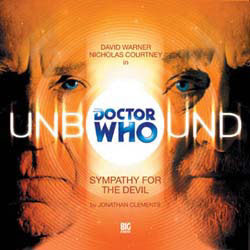
Doctor Who Unbound: Sympathy For The Devil
This is a CD-story made about five years ago by a group of fans, although many fans prefer to describe themselves as "professionals", to compensate for the insecurity of everything the word "fan" implied back when the show was off the air for 16 years.

Doctor Who Unbound is essentially a What If? series, enabling alternate versions of Doctor Who history to be explored without worrying about contradicting the main canon. Some might argue that the canon had already become corrupted by all the contradictory Virgin Books, BBV videos, Marvel comic strips and Big Finish CDs since the show had been cancelled in 1989, but I really wouldn't know.

This story sees David Warner as an alternate third Doctor, running into Lethbridge-Stewart 10-20 years too late. Lethbridge has had to fight all those alien invasions himself, without any help from the Doctor, and while he still managed to save Earth on his own, his solutions were less ideal. For example, there's now a giant prehistoric crater in the centre of London. This Lethbridge's career is in ruins, so when the Doctor shows up, he has, in part, to deal with his messiah-complex – his inability to save everyone.

Despite some fascinating ideas, this is really just an ordinary Doctor Who story dressed up a bit. It's told very well, and sounds great, although it's the older actors who really seem to 'get' audio-work. I guess they have the experience. That said, Warner's Doctor sounds fairly generic, but I think that's what I was expecting of him.

Special mention must go to the actor playing Colonel Brimmicombe-Wood – Lethbridge's replacement. It's David Tennant, at least two years prior to being cast as Doctor Who on television. No, really it is, I checked the inlay card...

Who?
And he absolutely shines in this. I still don't know why he doesn't have the Scottish accent on telly.

Overall, I really enjoyed this. It was refreshing to experience a Who story that was quite unashamed about its heritage.

And does it really happen outside the canon? Nah, he's just half-way through his second regeneration...

Diddley-dum, diddley-dum, diddley-dum, diddley-dum...
Available here.

Labels: , ,

Revelation is the final book of the Bible, and is a detailed account of John's vision of the end of the world.

It is a very good conclusion to the collection, including as it does epistles, prophesy and psalms within the whole. The only thing it lacks in that respect, is some historical writing, which is a shame as the historical writings are my favourite parts of the Bible.

But hey – the book is about the future, which hasn't happened yet.

And that future thing has bugged people for millennia. Is all this literally going to happen, or is it an allegory? If it's allegorical, might it already have happened?

It's certainly tough to land in the literal camp, as the account is quite dream-like.

I watched as he opened the sixth seal. There was a great earthquake. The sun turned black like sackcloth made of goat hair, the whole moon turned blood red, and the stars in the sky fell to earth, as late figs drop from a fig tree when shaken by a strong wind. The sky receded like a scroll, rolling up, and every mountain and island was removed from its place.

- Revelation 6:12-14 (NIV)

The fourth angel sounded his trumpet, and a third of the sun was struck, a third of the moon, and a third of the stars, so that a third of them turned dark. A third of the day was without light, and also a third of the night.

As I watched, I heard an eagle that was flying in midair call out in a loud voice: "Woe! Woe! Woe to the inhabitants of the earth, because of the trumpet blasts about to be sounded by the other three angels!"

The fifth angel sounded his trumpet, and I saw a star that had fallen from the sky to the earth. The star was given the key to the shaft of the Abyss. When he opened the Abyss, smoke rose from it like the smoke from a gigantic furnace. The sun and sky were darkened by the smoke from the Abyss.

- Revelation 8:12-9:2 (NIV)


Yes, like all the best sci-fi shows, The Bible has the sort of final episode that Patrick McGoohan writes...

To take it literally, I've got no problem with stars falling and then going out on earth. No-one knows what stars are, what their size is, or how far away they are, although there's a very popular theory based purely upon what they look like from here. I had intended to debunk this point, but as I've been typing it I've found myself drifting towards that literal camp...

Very dreamy anyway, like the monster with seven heads and ten horns. But back then we think people believed dreams to be from God. (for some reason we take the credit for them ourselves these days) All the same, John never describes his experience as a dream, or as an allegory, and I get the impression that this was a genuine vision, allegory or not.

You want to know how the Bible ends? Everyone comes back from the dead. And here's the twist, so look away now if you don't want to know what it is…

(This sentence is only here to mask the next one from being too obvious.) There's a second death waiting...

This is a long quote, but it's well worth reading:

And I saw the dead, great and small, standing before the throne, and books were opened. Another book was opened, which is the book of life. The dead were judged according to what they had done as recorded in the books. The sea gave up the dead that were in it, and death and Hades gave up the dead that were in them, and each person was judged according to what he had done. Then death and Hades were thrown into the lake of fire. The lake of fire is the second death. If anyone's name was not found written in the book of life, he was thrown into the lake of fire.

Then I saw a new heaven and a new earth, for the first heaven and the first earth had passed away, and there was no longer any sea. I saw the Holy City, the new Jerusalem, coming down out of heaven from God, prepared as a bride beautifully dressed for her husband. And I heard a loud voice from the throne saying, "Now the dwelling of God is with men, and he will live with them. They will be his people, and God himself will be with them and be their God. He will wipe every tear from their eyes. There will be no more death or mourning or crying or pain, for the old order of things has passed away."

He who was seated on the throne said, "I am making everything new!" Then he said, "Write this down, for these words are trustworthy and true."

He said to me: "It is done. I am the Alpha and the Omega, the Beginning and the End. To him who is thirsty I will give to drink without cost from the spring of the water of life. He who overcomes will inherit all this, and I will be his God and he will be my son. But the cowardly, the unbelieving, the vile, the murderers, the sexually immoral, those who practice magic arts, the idolaters and all liars—their place will be in the fiery lake of burning sulfur. This is the second death."

- Revelation 20:12-21:8 (NIV)


I don't think it is about what you've done. I think what you've done is simply evidence of what you're like.

Labels:

Ever since I was young, I seem to have been nobbled to do readings.

At school, at college, at church, I guess it was really my own fault for volunteering.

Even at my dad's funeral, I was the one doing both Bible readings, something that I felt very nervous about. I hadn't rehearsed, and I was scared I might accidentally read the wrong passage. The worry that I might have stood up in front of 100 mourners and boomed "Here are the instructions for the cleaning of lepers" is one that remains with me today.

A little over three years ago I bought a book from the Christian Resources Centre on Queen Street appealingly entitled You Can Predict Your Future.

It was principally about how words shape the future, and how we should therefore discipline ourselves to both speak and think positively.

I can't remember why now, but I read the book a second time, usually in Myers Park, out loud.

Ultimately this led onto reading other books out loud too, such as The Prayer Of Jabez, and doing my daily Bible reading out loud too.

Reading the Bible out loud many days could be a problem though, eg. if I were on the bus. I'd sit there at the back muttering quietly away to myself, in a low tone that I hoped was drowned-out by the engine noise. And obviously, if anyone sat next to me without headphones on, then I just plain didn't.

Ignoring the arguable spiritual benefits, I'd say that I've noticed three tangible effects of this over the past three years.

1. It's become harder to read in my head.

2. I've been asked to read at church more.

3. I think it's helped me to teach English.

A while back I started to keep track of which books of the Bible I knew I had read out loud. With Jude, I've now finished it. It's also helped motivate me to have read the Bible twice. (which I also got to tick-off today)

Now when I read the Bible in my head, three things seem to happen:

1. I whisper it.

2. I put a lot more inflection in, as I imagine how I would read it out loud, if I were reading it to other people.

3. Point 2 requires me to try to get inside the head of the Bible's writers, by which I mean God, the people who wrote it down, and the individuals who are being quoted.

Labels: , ,

It's an age-old question: If you're forgiven for all your sins, then why stop sinning? My uncle asked that question of my mum once, and she replied "Because you don't want to sin any more."

I can find no logic whatsoever in that equation. There lies a purely emotional argument. With which I agree.

Jude's epistle is a warning against precisely this situation.

For certain men whose condemnation was written about[Or men who were marked out for condemnation] long ago have secretly slipped in among you. They are godless men, who change the grace of our God into a license for immorality and deny Jesus Christ our only Sovereign and Lord.

- Jude 4 (NIV)


Much of this letter is taken up with condemning such an opportunistic attitude, and I can't help wondering if Jude wrote the letter partly to blow off some steam.

These are the men who divide you, who follow mere natural instincts and do not have the Spirit.

- Jude 19 (NIV)


Jude's discontent even slips into Biblical fanboy mode at one point:

Woe to them! They have taken the way of Cain; they have rushed for profit into Balaam's error; they have been destroyed in Korah's rebellion.

- Jude 11 (NIV)


Hey Jude - don't make it bad. Take a sad song, and make it better…

Labels:

The elder,

To my dear friend Gaius, whom I love in the truth.

Dear friend, I pray that you may enjoy good health and that all may go well with you, even as your soul is getting along well. It gave me great joy to have some brothers come and tell about your faithfulness to the truth and how you continue to walk in the truth. I have no greater joy than to hear that my children are walking in the truth.

Dear friend, you are faithful in what you are doing for the brothers, even though they are strangers to you. They have told the church about your love. You will do well to send them on their way in a manner worthy of God. It was for the sake of the Name that they went out, receiving no help from the pagans. We ought therefore to show hospitality to such men so that we may work together for the truth.

I wrote to the church, but Diotrephes, who loves to be first, will have nothing to do with us. So if I come, I will call attention to what he is doing, gossiping maliciously about us. Not satisfied with that, he refuses to welcome the brothers. He also stops those who want to do so and puts them out of the church.

Dear friend, do not imitate what is evil but what is good. Anyone who does what is good is from God. Anyone who does what is evil has not seen God. Demetrius is well spoken of by everyone—and even by the truth itself. We also speak well of him, and you know that our testimony is true.

I have much to write you, but I do not want to do so with pen and ink. I hope to see you soon, and we will talk face to face.

Peace to you. The friends here send their greetings. Greet the friends there by name.

- 3 John (NIV)


D'oh!

The only thing I'm getting here is the distinction between written and spoken communication...

Labels:

It's the shortest book of the Bible, so short that I can prove my point by quoting the whole thing here. The Message version translates the opening line as "My dear congregation, I your pastor, love you in very truth." so this appears to again be a letter to a church.

The elder,

To the chosen lady and her children, whom I love in the truth—and not I only, but also all who know the truth - because of the truth, which lives in us and will be with us forever:

Grace, mercy and peace from God the Father and from Jesus Christ, the Father's Son, will be with us in truth and love.

It has given me great joy to find some of your children walking in the truth, just as the Father commanded us. And now, dear lady, I am not writing you a new command but one we have had from the beginning. I ask that we love one another. And this is love: that we walk in obedience to his commands. As you have heard from the beginning, his command is that you walk in love.

Many deceivers, who do not acknowledge Jesus Christ as coming in the flesh, have gone out into the world. Any such person is the deceiver and the antichrist. Watch out that you do not lose what you have worked for, but that you may be rewarded fully. Anyone who runs ahead and does not continue in the teaching of Christ does not have God; whoever continues in the teaching has both the Father and the Son. If anyone comes to you and does not bring this teaching, do not take him into your house or welcome him. Anyone who welcomes him shares in his wicked work.

I have much to write to you, but I do not want to use paper and ink. Instead, I hope to visit you and talk with you face to face, so that our joy may be complete.

The children of your chosen sister send their greetings.

- 2 John (NIV)


Well that's a downer about not writing the rest of his message down isn't it? How valuable would each word have been considered today? Let's hope he doesn't make that mistake again...

Labels:

1 John's USP is the message to not give in to evil.

Fairly basic stuff you might think, and yet on a personal level I find this book very challenging. To coin a phrase, I actually do struggle with that. Why? Precisely because it is so simple. Life, and especially people, seem to be alot more complicated than this.

No one who lives in him keeps on sinning. No one who continues to sin has either seen him or known him.

- 1 John 3:6 (NIV)


I can't really ignore that, actually, all of us who know God still continue to sin. I do, don't you?

John goes on to provide other such tests of reliability, which I also fail.

This is how we know who the children of God are and who the children of the devil are: Anyone who does not do what is right is not a child of God; nor is anyone who does not love his brother.

- 1 John 3:10 (NIV)


We all do things that are not right. We all fail to love our brothers too. Therefore, according to the above verse, we are all children of the devil, and there are no children of God. I think this is a hard interpretation to avoid from such a straightforward statement. Yet paradoxically it's also one which robs John of the encouraging point that I think he was actually trying to make.

Over the past few years I've supposed that what God really looks at in our hearts is our commitment to doing right. (like Adam and Eve before the fall)

The colossal mixed-up evil of the Old Testament seems to go together with the absence of God's spirit to teach us right and wrong.

As for you, the anointing you received from him remains in you, and you do not need anyone to teach you. But as his anointing teaches you about all things and as that anointing is real, not counterfeit—just as it has taught you, remain in him.

- 1 John 2:27 (NIV)

Those who obey his commands live in him, and he in them. And this is how we know that he lives in us: We know it by the Spirit he gave us.

- 1 John 3:24 (NIV)


There are plenty of people of other religions who know inside themselves what is right and what is wrong, and I'd like to think that, just as God came to earth in Jesus in secret, maybe he's come to those people in secret too.

This is how you can recognize the Spirit of God: Every spirit that acknowledges that Jesus Christ has come in the flesh is from God, but every spirit that does not acknowledge Jesus is not from God. This is the spirit of the antichrist, which you have heard is coming and even now is already in the world.

- 1 John 4:2-3 (NIV)


Well, there goes that theory then. Or am I, as above, missing the writer's real point because I'm still struggling with the simpler, more obvious interpretation of the words? (which would also make it very easy for the spirit of the antichrist to pretend to be from God)

1 John 4:16 contains another simplistic phrase that always bugs me when I hear it: "God is love." I believe that love is just one of God's many aspects, another one, for example, being justice.

Another thing that I've noticed whilst going through the Bible over the past month, is the absence of clear references to Christ's deity. Believers are referred to as "sons of Abraham" at one point, so the mantle of "son of God" could equally be metaphorical. Jesus speaks a great deal of listening to God, but I don't think he ever claims to be him.

We know also that the Son of God has come and has given us understanding, so that we may know him who is true. And we are in him who is true—even in his Son Jesus Christ. He is the true God and eternal life.

- 1 John 5:20 (NIV)


Even in the above quote, the phrase "He is the true God" could refer to either Jesus or God.

I find a further challenge in 1 John 4:10 (NIV), which uses the word "atoning" (another concept that I have several problems with), but then gives an alternate version in the footnotes.

Speaking of footnotes, the one to 1 John 5:7-8 (NIV) seems to be only the second place in the (NIV) Bible (after Matthew 28:19) where the trinity gets airtime:

For there are three that testify: 8the[a] Spirit, the water and the blood; and the three are in agreement.

Footnotes:

a. Late manuscripts of the Vulgate testify in heaven: the Father, the Word and the Holy Spirit, and these three are one. 8 And there are three that testify on earth: the (not found in any Greek manuscript before the sixteenth century)


Hmm, the sixteenth century – that'd be around the time the books of today's Bible were agreed upon then.

And finally, 1 John also gives us several references to eternal life, which have also turned-out to be an unexpected rarity in the Bible.

And this is the testimony: God has given us eternal life, and this life is in his Son.

- 1 John 5:11 (NIV)


I sometimes worry that these blog-posts might come across to the reader as hot-headed whinging, yet I'm just trying to be honest about how these texts come across to me. And, just "thinking-out-loud" as I type this, I guess I am making a concentrated effort to try to ask what these books say to me without getting drowned out by all my usual preconceptions, and memories of what I and a million other people have previously told me I should find in there.

That's not to say that I wish to avoid other's opinions, rather that I want to add my own opinions to all those perspectives from others.

With that in mind, I find 1 John a very interesting book, because it helps me to identify some of the parameters of my faith that I may not previously have been aware of, and because I find it challenges me to be a bit more honest with myself about my relationship with God.

Labels:

Is the Bible really the word of God?

When I was a kid, I don't think anyone ever told me what to think there. I guess I perceived that there were three groups of people in the world – those who reckoned it was, those who reckoned it wasn't, and those who didn't know. I was in the third group.

That was when I was a kid. When I got older and spent more time with adults, then it became murkier, because, as I realised much later, alot of adults have agendas to answer the question for them.

When I was 19, a Christian who I was working with said of the Bible "If it's in there, then that's good enough for me!"

His confidence told me that that was the right answer, so I went along with it, but I never had much of a reason.

Over the years, I've discovered that most adult Christians seem to have the same agenda, but no-one's ever given me an origin for the belief. In my early twenties I asked tons of people how the belief that the Bible was written by God had started, but no-one knew. There was the argument that God would never let such a mistake be perpetuated down the centuries, but that didn't hold water because of all the people he allowed to starve in Africa.

It bugged me that the main reason for this belief seemed to be superstition. I supposed that these people would never have believed the Bible to be God's word if it had been written today. Its age muddies its origin, giving us the opportunity to fill-in the blanks with whatever we want to believe.

Recently I learnt that the books we have in the Bible today were only decided upon and declared to have been written by God about 400-500 years ago. I understand that the decision was taken by a group of catholics, who are a church that I don't even belong to, specifically because I disagree with some of their teaching. So how can I follow their stance on the Bible?

Here's the famous quote that you might be thinking of:

All Scripture is God-breathed and is useful for teaching, rebuking, correcting and training in righteousness, so that the man of God may be thoroughly equipped for every good work.

- 2 Timothy 3:16-17 (NIV)


I think that rare word "God-breathed" is fairly inconclusive. God also made us. We sin.

There's also the question of what the word "Scripture" means. And here's the reason why I've mentioned this in a review of 2 Peter:

And we have the word of the prophets made more certain, and you will do well to pay attention to it, as to a light shining in a dark place, until the day dawns and the morning star rises in your hearts. Above all, you must understand that no prophecy of Scripture came about by the prophet's own interpretation. For prophecy never had its origin in the will of man, but men spoke from God as they were carried along by the Holy Spirit.

- 2 Peter 1:19-21 (NIV)


Well, I think he might just be talking about his Bible there, rather than ours.

Peter also uses the word "Scripture" later on in this epistle, but since I'm reading it in English, I won't presume it was necessarily the same word in Greek. Here's the quote anyway:

Bear in mind that our Lord's patience means salvation, just as our dear brother Paul also wrote you with the wisdom that God gave him. He writes the same way in all his letters, speaking in them of these matters. His letters contain some things that are hard to understand, which ignorant and unstable people distort, as they do the other Scriptures, to their own destruction.

- 2 Peter 3:15-16 (NIV)


"the other Scriptures". From Peter's perspective, Paul's letters were not a part of the Bible. He was speaking out against the distortion of Paul's letters. Did he believe that Paul's letters were written by God? Perhaps, but he claims nothing about the authorship of his own.

My point is that if Peter was defending the value of Paul's letters at a time when they were regarded as only letters, then

a) that has implications for Christian letters that we write today, and

b) the uncertainty with which we write Christian letters today has implications for the reliability of Paul's letters.

I don't buy that either Peter or God were referring to the Bible that would ultimately be decided upon 1,500 years later, because that would muddy the Bible's context.

Labels:

The overriding message of 1 Peter is to love other people.

In fact, Peter seems to take positive joy in proclaiming this. He seems to see every setback that life can throw as an opportunity to love. And he's right!

For it is commendable if a man bears up under the pain of unjust suffering because he is conscious of God. But how is it to your credit if you receive a beating for doing wrong and endure it? But if you suffer for doing good and you endure it, this is commendable before God. To this you were called, because Christ suffered for you, leaving you an example, that you should follow in his steps.

"He committed no sin,
and no deceit was found in his mouth."

When they hurled their insults at him, he did not retaliate; when he suffered, he made no threats. Instead, he entrusted himself to him who judges justly. He himself bore our sins in his body on the tree, so that we might die to sins and live for righteousness; by his wounds you have been healed.

- 1 Peter 2:19-24 (NIV)

Your beauty should not come from outward adornment, such as braided hair and the wearing of gold jewelry and fine clothes. Instead, it should be that of your inner self, the unfading beauty of a gentle and quiet spirit, which is of great worth in God's sight.

- 1 Peter 3:3-4 (NIV)

Above all, love each other deeply, because love covers over a multitude of sins. Offer hospitality to one another without grumbling. Each one should use whatever gift he has received to serve others, faithfully administering God's grace in its various forms.

- 1 Peter 4:8-10 (NIV)


The only flaw I can see in this plan is that we all fail at it.

Labels:

** Click here for preceding post(s) **

** Click here for following post(s) **