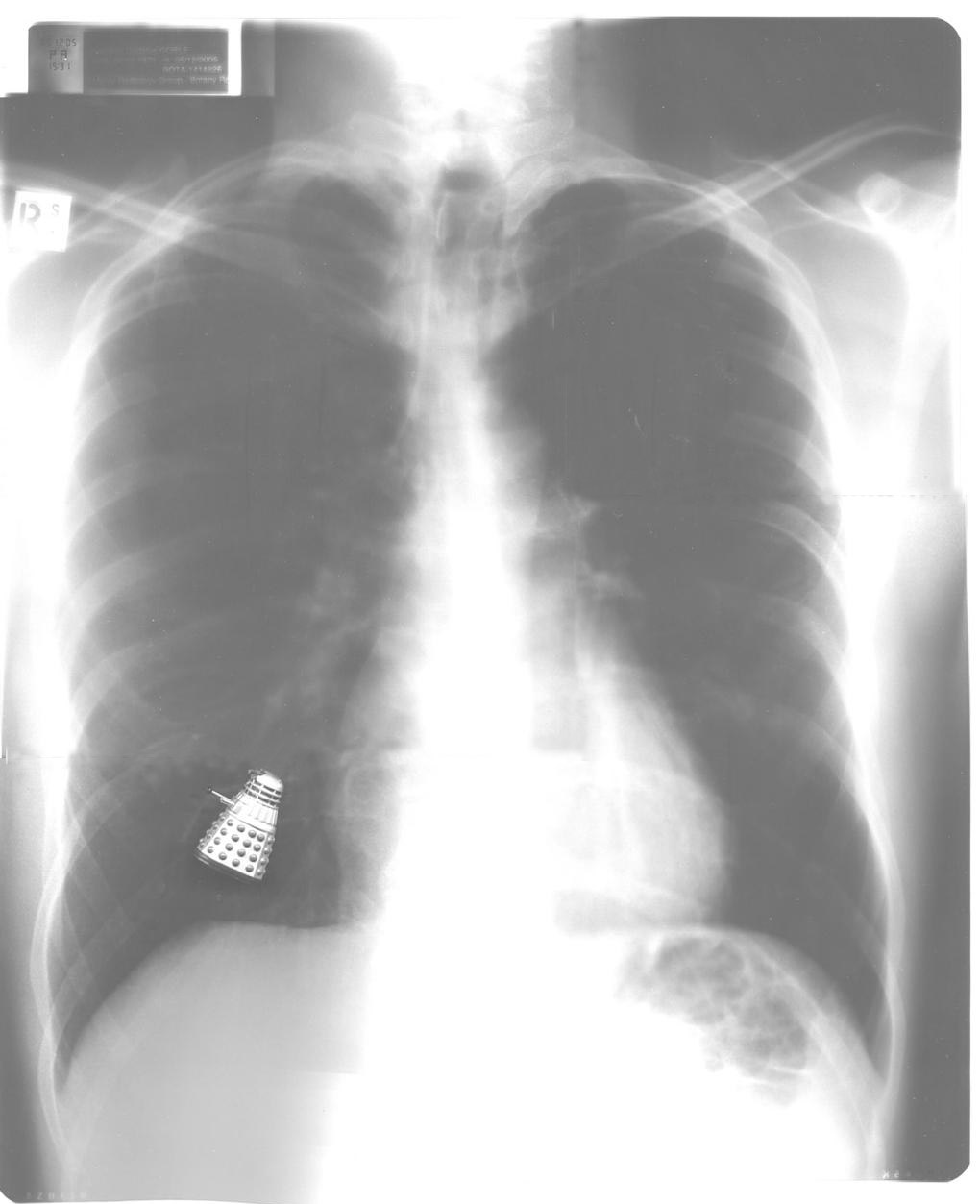
This cartoon VHS, in which Buzz is Buzz the Space Ranger rather than Buzz the toy, is a bit lacklustre and by-the-numbers. It also suffers from the quality of animation, but contains some reliable attractive Disney characterisations, notably Booster.
Top interest would have to be the CGI characters from Toy Story appearing at the start to sit around and watch the video together.
Oh, and William Shatner singing the closing credits of course, although for my money he’s just not putting his heart into it here.
After all these years of Tim Allen playing Buzz as a straight Shatner impression though, it’s nice to see that someone else noticed, even if it was only Shatner himself.

Labels: films, tv

Contrary to popular belief, in each Doctor Who story that they appeared in, the Daleks’ trademark electronic voices sounded slightly different.
Yes, yes I know what a nerd the above sentence makes me.
I only mention this because Evil Of The Daleks is the one in which they sounded utterly petrifying.

Another David Whitaker script, and again some fantastic intelligence behind what our characters get up to.
These are the Daleks as they were when they first appeared on the show – calculating and manipulative. It really jars to see the characters thinking about things so much, straight after the daydream of The Faceless Ones.

Maxtible’s time-travel experiments sound so enthralling that he convinces you that no-one in Doctor Who land has ever travelled in time before.
Alas, again the bigger story just doesn’t make sense by the end though. The initial premise of Waterfield selling brand-new antiques in the present-day is abandoned, and it’s hard to figure-out what on Earth the time-corridor is doing in his house, or why the Daleks need it to lure the Doctor in. And if the Daleks can already travel in time, then what on Earth do they need the TARDIS for?

Still, there are just too many great elements in this story to dwell on the negative. The good Daleks, the Emperor Dalek, and all the sheer politics and manipulation that’s going-on with just about everybody, not least the Doctor as he willingly betrays Jamie.
This is one of the best Doctor Who stories of all time. It’s an epic, and a story in which the odds just keep on getting raised week-to-week. The final cataclysmic end is a satisfying conclusion (if you’ve forgotten the earlier episodes), and shows that Doctor Who really was going from strength to strength in those days.
Just over a year later, straight after repeating the story, the BBC had most of it destroyed.

A little more on that here.Labels: doctor-who, tv
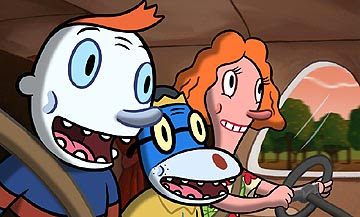
Ahhhhhh - it’s the age-old story – Mother gives dog to boy. Dog wants to become boy. Dog forces the world to accept him as a boy in spite of all social, physical and scientific protests to the contrary.
How can you go wrong with an age-old winning formula like that?

From the very first episode, Teacher’s Pet was a cut above other cartoons. Spot’s weekly (sorry) daily (hey – it’s a modern cartoon don’t forget) longing to become an ordinary boy like his owner were a metaphorical parable for the human condition in post-modern consumerist society. But let’s ignore that – it was funny.
Spot’s first day at school – dressed-up to look like a schoolboy (obviously) – appeared to be in trouble from the off when one kid sniggered “Hey – look at that weird kid running along on all-fours like a dog!”, at which point we saw an actual weird kid running along on all-fours like a dog.
This writing was clever enough to disguise its punchlines, and consequently made me laugh again and again.
No wonder then that Spot (or Scott) and his owner Leonard repeatedly credited their audience with the intelligence to understand patterns of human behaviour – their writers obviously did.
Finally this great show came to an end with Teacher’s Pet – the movie, in which Spot was finally granted his wish to become a human.

Hmm. A tough call that one. While the series had always featured the (obviously ridiculous) characters in believable real-life school situations, the movie needed to facilitate Spot’s transformation into another species – something that had no place in the believable world so far established in the show. Cue a mad scientist with a machine, straight out of a movie:

That said, I can forgive this. The comedy was as intense as ever, with Spot in one scene required to pretend to be his entire made-up family, and songs so complex that they goad you into rewatching the tape again and again and again.
The ending, in which Spot finally accepts that his role in the universe has in fact always been to be a dog, was a little disappointing, from one so determined, but I guess this was the best way.
I’ll miss Spot and Leonard. (and Mr Jolly, and Frank Costanza)
No I won’t, there are tons of reruns I haven’t seen yet.
Labels: films, tv

Still feeling the euphoria of having discovered a 'new' reconned Patrick Troughton scene the other night, (and despite it having originally only been a voice-over) I spliced it onto the start of episode one of The Faceless Ones to create my own deranged pseudo-continuity. In the new scene he is, after all, telling Zoe how an old adventure began with the TARDIS getting stolen, which is also how this one starts. And I know that the ongoing narrative will continue until the Dalek ultimately shows up anyway. I just like to think that he began his account at the beginning, that's all.

That said, The Faceless Ones is a dreadful story, with an awesome start, mainly due to being set on location-saturated present-day Earth.

Yep, you read that right. Setting the story on present-day Earth was a good thing, because in those days it was unusual.
(Granted, it does also feature zombies though…)

The mystery unravels with great spookiness and wonder, and there’s a certain amount of sinister paranoia as the Doctor tries to convince ignorant bureaucrats (like the excellent Colin Gordon as the airport Commandant) that aeroplanes are taking-off from Gatwick Airport and disappearing into space.

But the aliens’ plan – making copies of people’s bodies and then leaving the originals on Earth (in a car park!) where anyone can find them – really lets the whole thing down. So much for being such a super-intelligent race. It’s a real shame that all the great promise of the earlier episodes is not satisfied by the end.
Still, what a tremendous relief that Ben and Polly got an exit scene though.

Labels: doctor-who, tv
 I know very little about Islam. I went to a conference on it a few years and found it to be quite an eye-opener. Reading this book has similarly piqued my interest. I've despaired at some of what I've read, and been encouraged by other bits. As some point I really must read the Quran, but I want to finish the Bible first.
Labels: books
 Episode 1 is a curiosity. Jamie is in nearly every second Doctor story, and yet this a rare occasion when they appear as the regular cast without anyone else in their dynamic. It’s a real chance to see the two of them lazily blunder into a new story together, talking and discussing matters with the rapport that I always remember them having, when perhaps we actually saw it quite rarely.

Zoe’s character is well established before her first appearance too. While they do concentrate on her a bit too much straight after Victoria’s departure from the show (Zoe’s obviously her replacement), the depth they give her does make her joining a much more likable development.
It’s unfortunate that this is the second story in a row featuring a closed-minded commander ignoring the oncoming alien threat, and that the story itself is so thin.
David Whitaker’s surface-plotting has a lot of thought behind it though, and the strength of Doctor Who’s fast characterisation is on show here too. When Gemma dies at the end of episode 5, it feels really senseless.
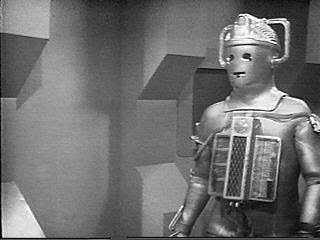
It’s also another story to feature Doctor Who's famous curse of the alien who sounds like Zippy. All this, and we even get Troughton’s famous “Turn on the sexual air supply” fluff. (or did he say “sectional”?)

At the end, Zoe stows away aboard the TARDIS, and to try to change her mind the Doctor puts on a headset and begins to project a memory of an old adventure with the Daleks (from last season) onto the TARDIS’ scanner screen. This was originally to lead into a 7-week repeat of The Evil Of The Daleks while the cast and crew had a holiday. (Doctor Who was literally a weekly series in 1968, all year round)
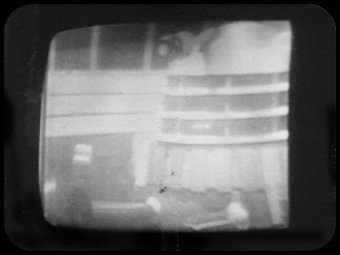

Then, after the closing credits had finished, there was something quite magical on the tape.
I found myself watching some genuine, bona fide, canon Doctor Who material from 1968 that I had never heard of before.
Let me just say that again – I have never ever heard of this extra scene via any book, magazine or website. It was totally new and unknown to me.
The reconstructed scene (still photos with a soundtrack) was from the beginning of the repeated version of Evil of the Daleks episode 1. Apparently this new scene was shot purely to be shown on the start of this first repeated episode, and not to ever be seen again or sold overseas.
It featured Patrick Troughton as the second Doctor and Wendy Padbury as Zoe, continuing their conversation in the TARDIS from the end of the previous week’s episode. I would like to think that Frazer Hines was still there as Jamie too, but since he has no dialogue on the soundtrack, I just don’t know.
Thank God a fan audio-taped this when it was broadcast, as it’s now the world’s only known copy.
Usually when I watch old Doctor Who episodes I have a pretty good idea what’s going to happen.
But just occassionally I don’t, and that’s when I feel like a kid again.Labels: doctor-who, tv
Some years ago, this movie was recommended to me by Tim as a modern classic.
While there’s clearly an intelligence at work behind this film, it totally and utterly made no sense whatsoever to me. I genuinely have absolutely no idea what the story was even about. I respect it, but I don’t understand it.
I’m really sorry.
(available here)
Labels: films
I'm going to lose alot of friends for saying this, but The Office doesn’t impress me.
Partly because it’s rude, but also because there were so many other shows in that style before it. (The Larry Sanders Show, The Day Today and various episodes of The Comic Strip for example)

Best In Show is another one, (albeit a movie) but with the distinction that it has a far more positive feel-good factor.
Sure – the first 15 minutes are solidly jokes about sex, and some of the subtlety fails when the two stereotype lesbians are ‘revealed’ to be just that, but aside from that, this is a film that just oozes fun.
There are no stars either. We get introduced in mockumentary-fashion to several dog-owners, all hoping that their precious pet will win the big upcoming dog-show.

It’s a slow-burner alright, (over the course of the film they barely even meet each other), and it takes time to get to know the individual competitors and their foibles, but this has the advantage that you really can pick your favourite characters and root for them, with no idea at all who will win.
My favourites were the couple who consistently projected all their problems onto their dog, and the scene where the woman lost her temper in a pet shop was funny in such an unpleasant way.
Top marks however have to go to Fred Willard and Jim Piddock as live TV show commentators Buck Laughlin and Trevor Beckwith respectively. Over-excited Willard gets no end of chronic one-liners here, but they’re magnified many times over by the quiet long-suffering Piddock underplaying his public embarrassment so well.

Buck (on the left): "I'd hate to go on a date with Judge Edie Franklin and have her judge me, that'd be no fun."

Buck: "And to think that in some countries these dogs are eaten."

Buck: [after Beatrice the dog jumps up on the show judge] "He went for her like she was made outta ham!"
If there’s a downside, it would be the temptation to dislike these characters for living in their own little worlds, but the film offers far more pleasure if you take a genuine interest, and marvel at the diverse variety of damaged people on this planet.Available
here.

Labels: films
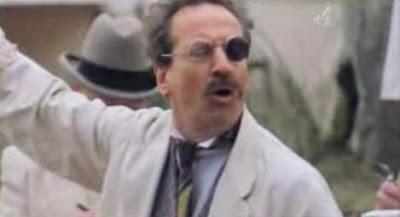
I first came across this film, airing in the middle of the night, a few years ago now, and quickly decided that I didn't like it. The opening sequence was one of those black-and-white newsreel parodies, which almost no-one ever gets right technically.
And then an odd thing happened.
It became colour, established its main characters in next to no time, and I was hooked.
As the main protagonists sat in Teddy's time-machine, quite unaware of whether or not it would work, I settled down in my armchair and unquestioningly allocated the next 85 minutes of my life to coming along too for the ride.
It was fun, it was clever, it was subtle, and despite its bleak location, the whole thing looked and sounded gorgeous.
And then the credits rolled, after just ten minutes.
It was only a short. Oh.
Despite its predictable plot, I think Chrono-Perambulator is worth ten minutes of anyone's time.
Labels: films
 After all the pretentiousness of the recent Doctor Who ‘updating’, comes a tiny ray of hope – a spin-off series aimed squarely at kids.
Hopefully this will follow in the footsteps of the original and ignore such deadening intrusions as flatulence, underage sex, homosexuality, and, I really mean this, love.
Please - get rid of all the love.
Now, fun science-fiction anyone?

This afternoon’s pilot, about ex-companion Sarah and a bunch of kids from her road, kept threatening to throw this opportunity away, and I have to admit this concerns me. But let’s be positive. Although the pilot set the ongoing situation up with a single-parent family, an orphan, and a (groan) love interest, pilots often tend to get the final direction of the series wrong.
It’s also understandable that this opener would mistakenly try to copy the errors of its parent show. I sincerely hope that this will not include draining-out just one burnt-out writer again.
Alarming then, that the very same above writer madly tried to co-write this as well, and no surprises therefore that the plot is almost identical to his first episode Rose.
For example, it’s set on present-day Earth, told from the companion’s point-of-view, who lives with her single parent, encounters the Doctor character fleetingly at first, finds aliens at a nearby company, has her friend captured, is rescued by sonic lipstick instead of a sonic screwdriver, is chased by aliens into a room of alien technology where she learns the backstory… and many more.
Even some of the dialogue is the same. (the exchange when Sarah orders her companion to forget her) It could be a deliberate allusion to the earlier episode, but surrounded by everything else from it too, this seems unlikely.
Oh, and it’s his fifth story about zombies…
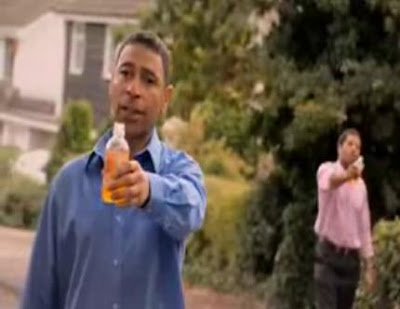
However it also has a co-writer, and I suspect that this is why the script is peppered with characters protesting that things don’t make logical sense, enabling the inherant plot-holes from the original to be solved at their inception this time.
K-9 only gets a cameo appearance, but at least he’s there, and still voiced by John Leeson too. What makes no sense though is why on Earth the rest of his lines are then read by another computer, rather patronisingly called “Mr Smith.” I’m writing this 6 months later, and I still haven’t figured that mistifying change out.

Labels: doctor-who, tv
** Click here for preceding post(s) **
** Click here for following post(s) **


 :)
:)


 Brett
Brett Random Dave
 Scottish Dave
 Frank
Frank Greg
Greg Herschel
 Jacob
Jacob Jean
Jean Joe
Joe Jonathan
 Melissa
 Melva
Melva Paul
Paul The Reynolds
 Rhett
Rhett Sara
Sara Sarah
Sarah Tim
Tim My church