Hey there, and many thanks to the cheery Andrew Leyland for his kind acknowledgement in the latest edition of Back Issue magazine!
If you have indeed arrived here via said article, then I've added links to all my Marvel UK reviews just below this text, for the convenience of anyone who might be interested. (Eg. the history of Spider-Man Weekly is here, and a review of Spidey's big UK adventure is here)
I haven't updated this blog for about 18 months now, but most of the other 1,800 posts are still online, and accessible via the big friendly "Index" button top-right. They cover reviews of other books, comics, films, games, music, stage shows and TV programmes. (not to mention my own hapless attempts at living life)
Cheers for stopping by!
Steve.
(ῧ)
Captain Britain Monthly
Doctor Who Weekly #1-4: The Iron Legion
Doctor Who Monthly #64: The Fires Down Below
Doctor Who Summer Special 1983 (comic)
Doctor Who Summer Special 1984 (magazine)
Doctor Who Magazine #350
Doctor Who Magazine #351
Doctor Who Magazine #371
Fantastic Four Adventures #1
Fantastic Four Adventures #2
Frantic #1
The Knights Of Pendragon #5 (1990)
Marvel Super Heroes Secret Wars II Featuring: Zoids
Secret Wars Featuring: Zoids #25 - Web-Slinger Against Changeling! (UK strip written by Jim Shooter)
Secret Wars II #54
Secret Wars II #55-56
Secret Wars II #58
Secret Wars II #62
Secret Wars II #63
Secret Wars II #65-66
Secret Wars II #67
Spider-Man Weekly
Spider-Man And Hulk Weekly #417-418
Super Spider-Man TV Comic #473
Super Spider-Man #493: The Mistake
Spider-Man #607-610: A Hero's Welcome / Darkness Encroaching / On The Town! / Death Line
Spider-Man #620-622
Spider-Man #627-628
Spider-Man #631-632
Spider-Man #633
The Spider-Man Comic #634-637
Spider-Man Summer Special 1985
Spider-Man And Zoids
Spider-Man And Zoids #10-11
Star Wars: Return Of The Jedi #129-132
The Transformers (G1) #1-8: The Transformers / Power Play! / Prisoner Of War! / The Last Stand
The Transformers (G1): Man Of Iron
The Transformers (G1) #13-17: The Enemy Within
The Transformers (G1) #18-21: Raiders Of The Last Ark
Spot The Difference With Spider-Man
Summary: You cannot celebrate a thing that you are ashamed of.
Part 0 of 11: Trailer (this is a very long review - commentary on the actual episode begins further down in Part 3)
The 11th Doctor: [V/O] "I've been running all my lives, through time and space, every second of every minute of every day for over 900 years. I've fought for peace in a universe of war. Now the time has come to face the choices I've made in the name of the Doctor. Our future depends on one single moment of one impossible day, the day I've been running from all my life. The day of the Doctor."
- somewhat misleading minute-long trailer featuring all 11 Doctors throughout, but no War Doctor. (the episode that it's trailing features only two Doctors throughout, plus the War Doctor)
A 50th anniversary special is supposed to celebrate the past 50 years.
Despite the promises of the trailer above, this one literally doesn't even try to.
The original series of Doctor Who ran for 26 years. The current series has run for 8.
If you wanted to celebrate the last 50 years of Doctor Who tonight, then this story was never intended for you. If you wanted to celebrate just the last 8 years of Doctor Who tonight - i.e. just the new series - then this story was conceived especially for you.
In celebrating a total duration of 50 years, which of these eras should this programme really be celebrating? The answer is BOTH.
The makers invited back both of the past Doctors from the current series (only one of whom said yes), but no Doctors from the original. The makers invited back the actress who played the first companion in the current series, but no companions from the original.
Newcomer John Hurt is never going to be Tom Baker, Peter Davison, Colin Baker, Sylvester McCoy or Paul McGann. However that doesn't stop him spending almost the entire show trying and failing to be Christopher Eccleston.
A story about the two most recent Doctors, plus three brand new ones, revisiting moments from just the last 8 years is not a celebration of the last 50 years by anyone's measure.
The original series' 10th anniversary four-parter in 1973 gave us The Three Doctors. The original series' 20th anniversary special in 1983 gave us The Five Doctors, plus 5-9 returning companions. Even the original series' 30th anniversary minisodes in 1993 gave us five returning Doctors in Dimensions In Time. Whatever shortcomings their plots may have had, these episodes are universally appreciated for at least reuniting us with so many missed old friends.
Doctor Who's decenniel rounding up of past Doctors and companions is the number one thing that fans follow the series for.
Instead of a glorious celebration of the original series, all hope of seeing those characters again was tonight utterly exterminated.
Which is why, after sitting through these 75 minutes this evening, I realised that I could no longer call myself a fan. I no longer hold any hope in this series for the future.
Which is the worst possible viewer-reaction that any so-called 50th anniversary special can prompt.
Part 1 of 11: The Time Muddler
A week ago it had all started out so differently, with a series of complex decisions that had proved just how much I cared about this series.
My first decision was - do I watch Doctor Who's upcoming 50th anniversary special at home on TV with my family as usual, or abandon them to go see the simultaneous projection of it at the local cinema's BIG screen in 3D? (Mum doesn't like cinemas)
I erred on the side of the latter. Doctor Who was off the air for 15 of those 50 years you know, and for all of that time the BBC had repeatedly rattled on about how rubbish it all was, and how similarly rubbish all its fans like me were for liking it. Big public events like this... well, they carry about them a certain sense of reassurance. These days the BBC will tell anyone who will listen how great Doctor Who is. Granted, they usually mean the revived version, but by implication that has to include the original that inspired it.
Also, to watch this celebration of my childhood hero at the same picturehouse where I had grown up enthralled by movies like Star Trek IV - and had also worked for a while as a teenager - was a time-travelling connection that I rather liked the feel of.
However according to the Odeon website, said 7:30pm premiere was already booked out at both screens, barring the odd corner seat, which didn't look to be worth it, especially for the 3D. So I procrastinated again, figuring such strong advance sales surely meant that presently adding a third screen would be a no-brainer.
I was right! The cinema did indeed add a third screening... but one which wouldn't begin until two hours afterwards, at 9:30pm.
Dang, if only I could somehow still get into one of those packed 7:30 premieres. Rarely does the cinema offer the viewer such a sense of immediacy.
There were tickets available for the 7:30 screening at another smaller screen across town, but y'know what? In the end I booked my ticket for the later 9:30pm screening at my cosy local. Sure, I would spend the preceding two hours knowing that I was missing out on 'the moment', but on the other hand, maybe the later performance would also mean that there would be fewer children around to scream spoilers across all present.
But then, on the other other hand, maybe the later screening would instead be full of fans more committed than I, who had already been to the 7:30 showing, and were now loudly bellowing to each other all about its surprise ending before watching it a second time? Or might there instead be giggling non-fan drunks as I had had to put up with last Wednesday at Thor 2?
I found myself daily double-checking the 7:30 showing online, just in case a spare ticket for it were somehow returned or something.
It worked!
Suddenly I found myself snapping up a lone 7:30 seat as well!
So, now I had two prime seats booked at my local, one for 7:30, and then another one for the following screening in the same room but a few rows further back at 9:30. Well, maybe this episode would be worth watching twice? How much of a Doctor Who fan was I?!
So tonight I headed out down the road.
Aside from the minisode publicity of The Night Of The Doctor and The Last Day, I hadn't seen or heard any of the week's ongoing hype of The Ultimate Guide, Strax Field Reports, #savetheday hashtag monologues, ident interruptions, BBC Radio trailers, blippable Radio Times greetings or feature-length docudramas. Sheesh, Matt Smith had a whole 'nother season going on there. I was really just into Doctor Who for the actual episodes, as usual.
In contrast to the trailer, the still that they'd selected for the poster/website had made this episode look rather Tennant / Hurt-heavy, but then I didn't know if there might be more specials on TV after this, maybe featuring earlier Doctors in reverse order, with the super-popular David Tennant's one kicking the whole thing off. After all, Doctor Who's long tradition of decennial specials that prominently featured all the earlier actors has always been one of things that has made following the series so rewarding. Given the staggeringly high number of non-fiction programmes on this week that were merely about Doctor Who, there certainly ought to be a few more new episodes of it coming up than just one.
After all, it was November, and aside from the heavily postponed second half of last year's series, there had been no proper new episodes of Doctor Who at all this year, so far. I had quite reasonably supposed that the BBC must have been banking them up for the 50th.
I should admit here that I was already expecting this episode was going to be rubbish. I was expecting this because I had seen every single episode of the revived series, and they had left me in no doubt about the production team's batting-average. All the same, I also expected there to be some good stuff in there tonight, which I was determined to locate and enjoy, no matter what. I was quietly rooting for it.
As I began approaching the entrance to the cinema, I passed a family of four walking away in the opposite direction looking disappointed. Had they all just rolled up without booking ahead and failed to get in? Oh dear.
I was also wondering whether I ought to have brought along my bow tie? Was the audience going to be packed with kids, or older fans like myself (42), but who had dressed up anyway? I hated the idea of arriving there and finding everyone else dressed in bow ties, but not me. The thing is that, regardless of my allegiance to the series, in some contexts I wear a bow tie anyway, and the opportunity to be with a large group of people who would affirm me for that... well, it would have been cool. Yet with every step I took towards the entrance, I was aware that it would cost me two more steps to go back home for it. I tried not to overthink this. Maybe when I got in there it would be full of nice normal families, who would all be dressed very sensibly in beige woolly jumpers, just like I was.
I stepped into the foyer. Damn there was a kid in a fez. Damn there was another kid wearing a TARDIS t-shirt. Damn there was a tall greying man in his 40s with a long multi-coloured scarf wound several times around his neck.
"Well," I thought, "I'm glad I'm not one of those obsessive fanboys," as I got out my tickets to both screenings and selected the 7:30 one.
Part 2 of 11: The Seats Of Depth
Sitting in seat E13 in my old workplace of Odeon 2, I was going to give this every chance.
I had my comfy slippers on, lunch and pen for taking notes within reach, snacks, a pair of noise cancelling headphones to drown out anyone discussing spoilers beforehand, and 3D glasses at the ready. I was aware that this may still not have been the best way to experience the show's fiftieth anniversary special. Cinemas are increasingly becoming the worst place to watch a film, thanks to how post-modern entertainment has become lately. For example, might the film be preceded by a clip of its author introducing it, and talking about upcoming plot developments, mistakenly safe in the presumption that we would all already know them? These days it's unpleasantly plausible.
Presently, a bit later than billed (so BBC!), the lights dimmed and the adverts came on.
A mute slide advertised Costa coffee. Then, suitably for this feature presentation, there were trailers for Mr Peabody And Sherman, Disney's Frozen and The Secret Life Of Walter Mitty. I am pleased to report that none of the characters in these promos turned to camera to excitedly give away anything that was going to happen in tonight's performance of Doctor Who. As Ron Burgundy swam into view to plug his upcoming Anchorman 2: The Legend Continues sequel, I was starting to relax.
Ron Burgundy (to his earpiece): "Who? Peter Capaldi? Who is his doctor? 'Peter Capaldi is Doctor Who.' Well that's not even a sentence. 'Who is his doctor'. Repeat that? 'Who is Peter Capaldi's doctor.' What do you mean 'Yes'? So 'Doctor Yes'! Which doctor, just say his name! He's gotta have a name! Who? Who!? 'Doctor Who'? You know what buddy? Guess what, you're fired."
Well, he just wasn't going to let any of us get away. Still, we all enjoyed that, and I've never even seen Anchorman 1! (either version) What really impressed me though was the way in which actor Will Ferrell managed to confidently blurt this out to about 140 people without even once breaking character, unlike his successor Martin Freeman.
Freeman: "Welcome to Odeon Cinemas. You are about to watch the trailer for The Hobbit: The Desolation Of Smaug, in cinemas 13th of December. [The] box office is now open so don't forget to pre-book your tickets. We hope you enjoy the film."
There then followed the trailed trailer (which omitted Sylvester McCoy), throughout which I completely and utterly disbelieved every single shot of Bilbo. He's just Arthur Dent in a wig!
Meanwhile, back home on 'BBC one'...
Doctor: "The Moment is here..."
Announcer: "... and the world is watching! This is BBC one, and The Day Of The Doctor - has come."
But not yet in this cinema. If you think this review's taking a while to get started, then remember that I had to sit patiently through all of this too!
Then the Odeon gift card ad finished, and the BBFC's black card replaced it, but even despite this promising sign it would still be several more minutes until the actual episode began, not that this was a bad thing. For unlike 'BBC one' viewers, we were now being treated to a mad Sontaran information film about cinema etiquette.
Unnamed Sontaran: "This feeble specimen proved that while cloning Sontarans is a magnificent duty, attempting to clone a cultural broadcast with recording equipment is the greatest of all war crimes!"
At this line, any nearby phones videoing the screen would have registered a nervous chuckle from Doctor Who's live studio audience in my region. Hey, was there really anyone watching this around the world who wasn't also recording the episode at home? Where as I may have mentioned, it had already been in progress for several minutes now? With this kind of delay, it was far more likely that pirate copies of the TV version were about to start getting hawked around the cinema.
Then this Who-themed sketch was superceded by a third one (no music - yay!) in which the 11th Doctor gave us a warm-up directly from that white void which comes in so handy in the various different series. (in K9 it doubles for just about everywhere)
Doctor: "Hello! Welcome to the 100th anniversary special of Doctor Who, in 12D! [then, echoing Ron Burgundy's earlier altercation with an off-screen prompt] Ay. Three...? No! Really? Oh. Sorry. Oops. It's in 3D. What's good about that. Is there a budget cut? Sorry about that, bit confused, time-travel y'see. I've just watched the hundredth anniversary special. All 57 Doctors! Still, y'know, 3D. That's good too."
Duly flapping his hands about, the Doctor instructed us in how to initialise our facial furniture (use our 3D specs) to identify any very hungry shape-shifting Zygons in the building, which was all great fun, and arguably a bit of a heads-up that if this movie ever eventually did get started tonight, then it might well feature similar shape-shifting Zygons. Thanks for the exposition. You do know that in the original series the Zygons only appeared in the one story, right? And that with this episode they will have appeared in slightly more stories in the revived series?
Then the 10th Doctor took over for a moment with a more confidential safety-check for us:
Doc 10: "As you know, 3D can make things stick out of the screen a bit, and, well, frankly, let's be honest... the chin. So, anyway, here it comes, get ready to duck."
As you might be able to tell, the 10th Doctor's hearts just weren't in this, and I'm sorry, I'm so so sorry, but his trademark enthusiasm didn't improve much over the next 75 minutes. Perhaps this was intentional, given the point in his life that he had come from, somewhere around about his similarly subdued appearance in The Wedding Of Sarah Jane Smith. Oh well. Maybe in 2023. Still, lovely to at least see what he looks like again anyway.
The War Doctor's back (I'm assuming not John Hurt's) also got a brief appearance in this intro, which is nice, given how unlikely that incarnation is to get much further extra-canon work. Or indeed any other sort. Just what was the thinking behind having given him two on-screen 'introducing' credits (in The Night Of The Doctor and The Name Of The Doctor) for just a single appearance in this one-off episode? I still dunno.
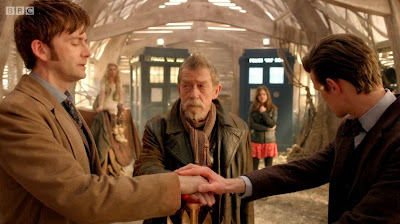
Speaking of which, let's not forget the cliffhanger on which that preceding episode 6-7 months ago had ended, with the Doctor and Clara semi-trapped in a realm surrounded by all 10-11 of the Doctor's previous incarnations...


Clearly this next episode - the fiftieth anniversary special no less - would resolve this, in a part 2 involving several returning Doctors from the past.
No. We never even found out how they survived. Or escaped. Witness author Steven Moffat becoming the butt of his own 'I'll explain later' gag. (though admittedly the trippy trailer above does make more sense here)
But then at last, while those people smart enough to stay at home and watch it on the telly were by now probably turning their TVs off afterwards to begin uploading it via BitTorrent, Doctor Who's advertised fiftieth anniversary special The Day Of The Doctor got underway! (minus the televised "BBC Original British Drama" logo on the start)
What a disappointment that the series' current opening credits, which would have looked beyond awesome in 3D, had been replaced by the original 405-line monochrome ones in plain ol' 2D.
Is there a budget cut?
Part 3 of 11: The 3D Doctors
The ironic words 'waste no more time' sat on Clara's whiteboard, or more accurately floated somewhere above the heads of rows A-D. The 3D here looked psychedelic. For the rest of this film I could pretty well take or leave the third dimension, but that whiteboard lettering... WOW! Gotta feel sorry for Clara's pupils, for whom those letters merely appeared in 2D.
Clara motorbikes herself all the way from her school, across town, and into the TARDIS, where thanks to some sloppy editing she parks twice. Ooh, such carelessness is not a promising sign so early on.
The Doctor is reading an old authorless book entitled Advanced Quantum Mechanics, which oddly displays an image of the TARDIS' police box exterior on both covers. I'm considering this to be a TARDIS manual, the dust jacket of which is slave to the chameleon circuit.
Clara: "Learn anything?
Doctor: "Not a thing."
The way the plot of this episode would play out, you don't say...
The number one thing that I usually consider above all else when evaluating a movie or a TV show (I guess this counts as both) is the story, and this one is, as expected these days, not that well thought through. However even my low expectations upon entering the cinema couldn't have prepared me for just how much worse than that this single episode would get it.
For the production team had found something even more important to me than the story to get wrong, and quite astoundingly, they had done it on purpose.
I think the opening credits summed it up best:
"MATT SMITH / DAVID TENNANT / JENNA COLEMAN / WITH BILLIE PIPER / AND JOHN HURT"
And that's it. It seems that the names billed on that poster above form pretty well the entire cast, rather than just the ones to sell it to today's viewers. Counting Tom Baker's minute-long cameo at the end, this so-called 'fiftieth anniversary special' would huff and puff and manage to bring back a grand total of THREE actors from the show's FIFTY year history, only one of whom would be actually reprising their original role. One! (as opposed to, say, the dozen-odd actors in 1983's 20th anniversary special The Five Doctors)
As such, David Tennant's 10th Doctor is the only character to return in new footage, which cannot really be that big a deal given that he only left 4 years ago.
Whatever way you run these figures, against the three previous anniversary specials, this average is, um, well, rather weak. This was a far cry from the usual reunion of old friends from over the series' history. Sorry Matt Smith, but whatever form the 60th anniversary may take in ten years' time, on the basis of this precedent, you won't be invited.
Despite the extensive return of Tennant's similarly recent co-star Billie Piper (Rose 2005-9), who last appeared in the same episode as he last did, they get no interaction with each other. Also, instead of reprising Rose, Piper portrays the brand new and explicitly different character of 'the Moment'. Even the end credits seem surprised by this casting choice, and she is duly miscredited as the revived series' first companion from 8 years ago.
There is also no justification for the Moment's selection of Rose's form through which to communicate with the War Doctor, and so once again we find ourselves scratching our heads and wondering why mad uncle Tom Baker wasn't more effectively deployed in this guide role.
In fairness, UNIT's Kate Stewart is also back, but for just her second episode, after her first one a mere year ago in The Power Of Three. For reasons I outlined in my review then, I think giving the late Brigadier's role to his own daughter is a bad idea, made worse by her lack of much characterisation of her own. She does less badly in this one, which is impressive given how nearly everything she says makes so little sense. For example right at the start - what possible motivation can she have for assuming the Doctor to not be inside the TARDIS? She might just have been a Zygon replica at this point, but there would be the same problem with the Zygon's reasoning though.
I like that UNIT are based at the Tower of London. I enjoy supposing that in the future they will become the villainous Department of the aforementioned K9 series.
Also, it's always great to see an episode set in London that has actually been filmed here. I could recognise so many places where I have stood recently, and the geography on show actually works.
The series' latest gushing straw fan argument is Osgood, who quietly wears a replica of the fourth Doctor's multi-coloured scarf, hyperventilates over the slightest thing, and twice deals with danger by chanting to herself "The Doctor will save me" over and over and over. I don't know who was being treated with greater disdain here, viewers with breathing difficulties, or all those fans who'd just paid money to watch themselves being ridiculed.
I have no information on how the similarly scarved guy from the foyer felt about this, but I'm guessing he now felt that he looked to everyone like an idiot. I really hope he doesn't carry an inhaler.
However when the current Doctor excitedly put on a fez, I'll bet that kid in the fez felt great.
This fast-developing and disappointing division of attitudes towards old fans and new fans had no place in a programme that was supposed to be celebrating the whole run. If only that scarf had instead been hung on the nearby Tom Baker.
Apparently riffing on Ron Burgundy's earlier 'Doctor Yes' joke, the Doctor thinks Osgood's name is 'Yes'.
The Doctor has a lengthy flashback to the start of the revived series 8 years ago - the Time War on Gallifrey. This, despite having been previously hinted at being all about fighting a war by exploiting time-travel, is here entirely about two races just going through the usual motions of shooting at each other. The 'Moment' - the Doctor's doomsday strategy mentioned in The End Of Time 4 years ago - likewise turns out to merely be a very ordinary big bomb.
Enthrallingly, the effects here are nothing short of stunning, and the Daleks have never looked more real!
In 3D you can really see all the grime on their casings! These are the show's greatest effects of the entire 50-year run, and a massive relief after all the fuzzy CGI in the most recent season.
What a shame however, that in this celebration of the last 50 years, so many Gallifreyan characters from the classic series were missing from this sequence. The weary general of the war council might just as well have been Colin Baker as Commander Maxil. We should have seen Louise Jameson as Leela fighting the Daleks / taking cover from them. With Chris Tranchell as Andred. Not K9 though - he had moved on by this point.
In practice, none of these characters' long-uncertain fates are resolved, as aren't other Gallifreyans such as Romana and the Doctor's granddaughter Susan. We still don't know what became of them I'm afraid.
Even the near-classic Daleks are all voiced by the current artist Nicholas Briggs, instead of legitimately inviting back some of the original and still acting vocal performers, like David Graham and/or Brian Miller.
However weighing-in even heavier on the series' storyline is the episode's second enormous misfire, and like some gigantic anti-matter black hole, its gravitational pull is so strong that not even any future series looks likely to escape it. Ever.
Part 4 of 11: The Armageddon Actor
The Doctor for these events was established 8 years ago - at the start of the modern series - as either the battle-scarred 9th Doctor (Christopher Eccleston) or the 8th (Paul McGann). Assuming that the Doctor's timestream was running more or less in parallel with his home planet of Gallifrey, which it usually does, then those are the only two Doctors who can have been incumbent at the time of its destruction.
Christopher Eccleston (who in his debut episode Rose had explicitly already been the Doctor for some time) had declined to return for this anniversary programme, but blank slate Paul McGann had said yes. McGann had therefore appeared earlier this week in the publicity prequel The Night Of The Doctor, so I was fully expecting his 8th Doctor to appear in further new scenes somewhere in this full-length episode. Because, y'know, that's what the BBC's publicity had shown me.
Well, he didn't. At all. Even though said 'prequel' was filmed at the same time. Yes, Paul McGann was right there in the same studio, in costume, but not to film scenes for the actual anniversary episode.
However if both Eccleston and McGann were unwilling or unavailable to film the main story, and the BBC didn't fancy either doing a page one rewrite or eating the script, then there were still four further acceptable casting possibilities for the role of the 'War Doctor':
1. By default, any of the earlier actors to play the Doctor. He is embroiled in a 'Time War', so for his own appearance or history to be affected, resulting in an earlier incarnation to have survived, would be a logical next option. (ironically a bit like in The Dark Dimension) Tom Baker, Peter Davison, Colin Baker or Sylvester McCoy were the next four actors in the running here, more so in an 'anniversary special'. All of them have publicly expressed their wishes to be in this episode. Viewers tuning in for this 50th anniversary special wanted to see the existing actors reprising their characters again. This is indisputable. That's why Tennant was asked back.
2. Michael Jayston as The Valeyard. He was the original series' incarnation of the Doctor's dark side from his (then) future, still being namechecked and foreshadowed in The Name Of The Doctor this year, and yes, he is still acting.
3. Failing those alternatives, a young actor - a teen I guess - who could have convincingly been going to age into Chistopher Eccleston's ninth Doctor, in much the same way as the younger cast of the recent Star Trek movies are implied to. This could have had the potential to similarly offer the ninth Doctor a whole new lease of life.
4. An older actor who Paul McGann's Doctor could have convincingly aged into.
You know what? They actually did get 73-year-old (same age as some of the actors they turned down) luvvie John Hurt in, and you know also what? His performance as the Doctor is the second best one in this. (he hasn't much competition, admittedly) Given how little characterisation of his own the script offers his incarnation, he fills in the blanks himself very well indeed.
However rather than presenting the War Doctor as an aged and time-ravaged 8th Doctor, as might otherwise have seemed automatically implied had nothing been said about it, they actually went to the trouble of adding a brand new incarnation of the Doctor into the show's history for him to play instead. They even then went to all the hassle and expense of actually getting the 8th Doctor Paul McGann on set to film the aforementioned 7-minute regeneration minisode The Night Of The Doctor to accomplish this.
So inserting this new 'War Doctor' in between Doctors 8 and 9, makes John Hurt the real 9th Doctor instead of Christopher Eccleston, who must now be the 10th Doctor. David Tennant moves from the punning 10th to 11th, and Matt Smith's 11th... well, what a shame that his first story - also by this author - was so carefully entitled The Eleventh Hour.
(sheesh, someone read me that news item about the '2' numbering on that third Ron Burgundy film...)
It's bad enough that since the Doctor's mid-story regeneration in Journey's End he now has no further power left to regenerate a twelfth time at the end of Matt Smith's incarnation, although we still have yet to see him become the Valeyard. (not that this production team appears keen to take advantage of this before actor Michael Jayston's retirement)
It could be argued that the numbering of 'Doctors' is unaffected because the 'War Doctor' rejected the title of 'Doctor'. However this would be wishful thinking for many reasons:
1. The label 'War Doctor' includes within it the letters D, O, C, T, O and R together and in that order.
2. He was explicitly identified on-screen as 'The Doctor' at the end of The Name Of The Doctor.
3. He is explicitly identified as 'The Doctor' on the cover of Radio Times this week, not to mention elsewhere in this episode's publicity.
4. He is explicitly identified on-screen as 'The Doctor' in the closing credits of this episode.
5. He is explicitly identified as 'The Doctor' by several characters, including himself, throughout this episode.
Doctor 11 (12): "He was the Doctor who fought in the Time War, and that was the day he did it."
Dalek: "The Doctor is detected!"
Dalek: "The Doctor is surrounded!"
Dalek: "Inform High Command we have the Doctor!"
Dalek: "The Doctor is escaping!"
Would-be captor: "I would have the Doctor's head."
War Doctor: "Well, this has all the makings of your lucky day!"
Doctor 10 (11): "Pretending you weren't the Doctor, when you were the Doctor more than anybody else."
Doctor 11 (12): "You were the Doctor on the day it wasn't possible to get it right."
War Doctor: "Also the Doctor, standing ready."
War Doctor: "But for now, for this moment, I am the Doctor again."
You can't argue with all that! John Hurt is literally the 9th Doctor.
So then, how best to approach, and maybe fix, such dispassion?
Bear in mind that in The Christmas Invasion the Doctor suggested that a regeneration wasn't really complete until after about a day had passed, so writing-off this Doctor might not be that difficult after all.
The War Doctor does state early on "I've been fighting this war for a long time. I've lost the right to be the Doctor." Aside from the fact that the nature of this war means that his own timeline may have been interfered with, this dialogue and his facial ageing since The Night Of The Doctor are the only indications I am aware of that the War Doctor is the Doctor for any longer than 24 hours.
However, what if what he actually said was "I've been fighting this war for along time"? Then he could have been the Doctor for merely a few hours, until he had completed regenerating.
The facial ageing - including the growth of his beard - would likewise be just the continuation of his regeneration process, culminating in his becoming Christopher Eccleston in a few hours' time.
Alternatively, I would like to suggest that this 24-hour incarnation, unnaturally bestowed upon him by the never-dying Sisterhood of Khan in The Night Of The Doctor, was something akin to a 24-hour Time Lord steroid, and his behaviour the equivalent of (post-regenerative?) delirium. At the end of The Day Of The Doctor, we may actually be witnessing him unregenerating back into his distraught 8th identity of Paul McGann. We could look upon the War Doctor in a similar vein to the Watcher in Logopolis.
Hmm. One to file under the same heading as that universally despaired of American idea about him being half-human then. I really wasn't expecting to see any more of those.
But, would you believe, this whole stubborn disaster actually manages to become even worse, thanks to the lacklustre way in which this terrible idea is then mishandled.
For not only is John Hurt replacing Christopher Eccleston's position as the ninth Doctor, but there is no explanation for the Moment's skipping showing him that incarnation from his future. They even still have Hurt wearing a ringer for Eccleston's coat, which doesn't fit him:
It is no exaggeration to say that in every single one of John Hurt's scenes as the newly retconned 9th Doctor, my attention was constantly drawn to the absence of Christopher Eccleston's head above the collar. Never before have I ever witnessed an actor being so conspicuous by his absence, throughout an entire programme of over an hour's duration. Even his dialogue...
War Doctor: "They're pointing again! They're screwdrivers! What are you going to do - assemble a cabinet at them?"
Remind you of...
Jack: "Who looks at a screwdriver and thinks 'Ooh, this could be a little more sonic'?"
Doc 9 (now 10): "What, you've never been bored? Never had a long night? Never had a lot of cabinets to put up?"
(- The Doctor Dances, also by this author)
Seriously, this Neighbours-ish workaround is their solution to Eccleston's non-availability?
This simply couldn't have been handled any worse.
Impressively, John Hurt does play the Doctor for the first time flawlessly, but in every single scene he incites the wish in the viewer that he was someone else. The fact that one of the film's biggest botches gets so much time given over to it makes the whole production collapse every time we cut back to him, right up until the closing credits. You can enjoy this episode in bits, but never while John Hurt is on screen, which is maybe a third of it. Sorry John, but you really should have baulked at the very suggestion.
By this stage the one and only regular character who does return - Doctor 10 (now 11) - has also shown up, but for the entire episode remains wasted. Yes it is a relief to see that whole Elizabeth I plot hole from 4-5 years ago buried at long last, but that mopping up really is all the much-missed David Tennant gets given to do here.
Once he's met his successor Matt Smith, they pretty much share the Doctor's lines, even completing each other's sentences. They might as well be just a single character. I always thought it was a bad move to make Smith's Doctor so similar to Tennant's when he first took over, and although his portrayal has diverged since then, it's still not enough for any sparks to fly here. Take the 10th (11th) Doctor out of this story, and it actually functions better without him.
Doc 11 (12): (upon meeting Doc 10 (11)) "I'm very skinny. That is proper skinny! I've never seen it from the outside."
Yes he has - in Time Crash, also by this author.
At this stage it all looks like the 8th Doctor will be next to shortly join the gang, presently followed by the 7th, then 6th, 5th and so on. It's a major disappointment that this pattern doesn't continue and follow through.
Still, as this Two And A Half Doctors idea tried to somehow get off the ground with only one official Doctor (the current one) getting to do anything, back home my Mum gave up. She left the room, refusing point blank to watch the rest. I don't know, but I'm guessing that she would have stayed had the story been showing her any of the Doctors who we used to all sit round as a family and watch together with Dad back in the day - Tom (4), Peter (5) or Colin (6).
I can't blame her for that - like so many others, she is one of those people whose viewership the series has depended on for the past 50 years.
Part 5 of 11: CastAsunder
Having started off with peculiar dialogue, Kate Stewart's external monologue continues to make little sense.
Kate: "'70s or '80s depending on the dating protocol."
Do UNIT really have lots of officially misdated files?
For some reason the (by now secretly Zygon) Kate escorts Clara back to the Tower Of London because the Black Archive is now located underneath it, and apparently has been for at least the last ten years.
Zygon Kate (who has access to all of the real Kate's memories) speaking about the guard: "Been here ten years."
Hum, the Tower of London doesn't look like where the Black Archive was located in Enemy Of The Bane. So I guess this episode must be either set in the past, or ten years in the future.
Zygon Kate, justifying the use of an ordinary key to protect the most secret place on the planet: "Can't afford electronic security down here, got to keep the Doctor out."
I think he'd just use his sonic screwdriver. Perhaps you've heard of it.
Zygon Kate: "The whole of the Tower is TARDIS-proofed."
I would like to speculate that this explains why the Doctor never shows up to help stop the Department in K9. I'm disappointed though. Part of the appeal of the TARDIS is that it can travel anywhere in time and space. Lately, between parallel universes, 1930s New York and now the Black Archive, that's becoming disappointingly less wondrous.
Zygon Kate: "We have to screen all his known associates. Can't have information about the Doctor and the TARDIS falling into the wrong hands. The consequences could be disastrous."
You're a long way behind there. Apart from anything else, the Doctor's known associates are already up to speed on the Doctor and the TARDIS, as probably is most of the civilised world by now. I guess Sarah and Rani were wasting their time when they conspired with the Brig to break into the Black Archive in the aforementioned Enemy Of The Bane. Really, couldn't Kate's dad have just asked his own daughter for help?
Speaking of whom just what are those boards of photos of past companions even doing there? Is this supposed to be a substitute for the total lack of any returning companions in this story? Are we meant to go 'Aw, look, just along the bottom edge of the frame - it's the top of Peri's hair! Wow, do you think we'll see her again in the 60th anniversary reunion story?'
When is Sara Kingdom, who only appeared in one story in 1965-6, supposed to have met Mike Yates from the 1970s? How do UNIT have a photograph of Kamelion? Clara examines a picture of Susan Foreman (an ex-pupil of her school), but sadly misses the photos of Ian Chesterton just below, who according to the opening shot is still the chairman of the school's governors, and someone who we can reasonably suppose she knows. And much other laziness.
Trivia holds no interest when it's wrong.
Part 6 of 11: The Twin Zylemma
Suddenly Kate turns out to be a Zygon, although this doesn't really excuse all the nonsense that it's been coming out with, as it has access to all her memories. This revelation is however such a great game-changer that I've no idea when the switch happened. Maybe before The Power Of Three to explain why her appearance has altered since DownTime. ;)
Moment: "It's the same screwdriver. Same software, different case."
No it isn't, it's "a new one" according to the 11th (12th) Doctor in the still inaccurately titled The Eleventh Hour, also written by this author.
In a similar appearance to the throwaway snapshots of companions, the 'round things' (roundels) on the walls of the TARDIS make it back into the series for a whole 16 seconds. (they are very briefly glimpsed later on too) That they are the 2D version of the round things is an interesting choice for a movie in 3D.
Why does the Zygon consider a human appearance (Kate's) to be more 'comfortable' than its natural one?
Real Kate to her doppelgänger: "Somewhere in your memory is a man called Brigadier Alistair Gordon Lethbridge-Stewart. I'm his daughter."
Yes Kate, I think your duplicate will already know that, for several reasons.
Clara: "He's [Doc 11 (12)] always talking about the day he did it. The day he wiped out the Time Lords to stop the war."
Well that sure doesn't sound anything like the introverted 11th (12th) Doctor. Is he a Zygon?
What happened to the Zygons in the end? They're last seen failing to negotiate peace without even knowing who they themselves are, and with no guarantee of them keeping any promises once they do remember. Especially since Zygon Kate said earlier that their memories would get automatically wiped once they leave the building, when all promises will be forgotten. (yes, there's now yet ANOTHER method of amnesia in this series) I think sooner or later one of them is going to change form accidentally though, eg. when they sleep, or go to the toilet.
Part 7 of 11: Re-Dominance Of The Daleks
The two Doctors take the 11th (12th) Doctor's TARDIS back in time to pick up the 10th (11th) Doctor's TARDIS before, for closure I suppose, going after the War Doctor. (they never explain why)
The War Doctor is agonising over whether or not to push the big red button on the Moment that he erroneously believes will wipe out all the Time Lords and Daleks together. Although the Moment can see the future, 'she' seems to have this all wrong too.
Moment: "One big bang. No more Time Lords. No more Daleks."
Wrong! Pushing that button kills all the Time Lords, but seals the rest of the Daleks' victory!
This has been the awful twist of the knife for the Doctor ever since the episode Bad Wolf (8 years ago) when the penny finally dropped that there were other surviving Daleks out there in time and space. They decimated Earth in The Parting Of The Ways (8 years ago, when the Doctor had the same choice to make). They decimated Earth again while fighting the Diet Cybermen in Doomsday (7 years ago). And then they decimated Earth a third time in The Stolen Earth (5 years ago). When he last saw them in Asylum Of The Daleks (1 year ago), their numbers were... uh... doing extremely well:
But just you try reminding either Doctor 10 (11) or Doctor 11 (12) of any of their half a dozen subsequent encounters with the victorious Daleks who they helped to win.
No, they both decide to help their former self to ensure that the Daleks both triumph over their own people, and go on to terrorise the rest of the universe unchecked.
Doc 10 (11): "What we do today, is not out of fear, or hatred. It is done because there is no other way."
Doc 11 (12): "And it is done in the name of the many lives we are failing to save. What? What is it? What?"
Clara: "Nothing."
Doc 11 (12): "No, something. Tell me."
Clara: "You told me you wiped out your own people, I just... I never pictured... you... doing it, that's all."
Indeed Clara, neither could we.
Clara: "These are the people you're gonna burn?"
Doc 10 (11): "There isn't anything we can do."
Doc 11 (12): "[He's] right. There isn't another way, there never was. Either I destroy my own people or let the universe burn."
No Doctors, by detonating the Moment you both know that you will be choosing both.
Fortunately the 11th (12th) Doctor then comes to his senses and changes his mind, and you'll never guess what he quips about it...
Doc 10 (11): "BUT, there's something those billion billion Daleks don't know!"
Doc 11 (12): "'Cause if they did, they'd probably send for reinforcements!"
Indeed, because once again, both Doctors know for certain that those reinforcements are indeed out there, and will be safe from their detonation of the Moment.
Part 7 of 11: The Greatest D'oh In The Galaxy
Doc 10 (11): "The sky trenches [are] holding [not according to The Last Day] but, what if the whole planet, just disappeared?"
Clara: "Tiny bit of an ask."
Doc 10 (11): "The Daleks would be firing on each other - they'd destroy themselves in their own crossfire!"
No that's a tiny bit of an ask. Because if the planet disappeared, then the Daleks would stop firing. Destroy themselves in their own crossfire indeed, who does that.
Fortunately, the Daleks all considerately go on a smoko break for a minute to allow the Doctors to set up their plan.
Part 8 of 11: The Soundbites Of The Doctor
War Doctor: "That is brilliant!"
No, that is the 10th (now 11th) Doctor's catchphrase. He uses it in the very next line:
Doc 10 (now 11): "Oh, oh, oh, I'm getting that too! That is brilliant!"
See. Do you think the War Doctor's line could possibly be a placeholder for the 8th (now 9th) Doctor's catchphrase of "that is fantastic"?
War Doctor: "Bad Wolf girl, I could kiss you!"
Moment: "Yeah that's gonna happen!"
Again, while this line makes narrative sense for the War Doctor, it still sure feels like it should be said by Eccleston...
Then, just as you'd think things can't get any more ill-conceived, for less than half a minute 2D clips from previous episodes of all the previous Doctors (1-9) flash past intended to represent their all showing up to help save Gallifrey.
Now I can understand them substituting old clips in place of actors who have passed away or are otherwise unavailable. However when five of them are just not asked, two of whom are already in the studio anyway, and the other three of whom are on the record as saying they wanted to be there, then, well, that's just rude.
Story-wise, these 30-odd seconds form yet another rushed retcon from an author who these days doesn't seem able to write an episode without one. In his lifetime, the Doctor visits the same event over a dozen times, 11 times forgetting it afterwards.
How do the earlier Doctors know to travel forwards in time to take part in this event? There isn't even one line to explain this.
It's never explicitly mentioned whether the TARDIS has been silently working on these calculations ever since the Doctor's 1st incarnation, or just for the 9th, 9th (10th), 11th (12th) and 12th (13th)'s eras. I'd go with the latter, although this scene would make much more sense if it featured three or four of each of the three Doctors already in this episode. Or just thirteen versions of the 11th (12th) Doctor.
As it is they have TWO 7th Doctors, one with question marks, and another older one without!
Again with the sloppy editing. If you're going to have two versions of the same Doctor, then at least make it the two incarnations portrayed by David Tennant thanks to his mid-story regeneration in The Stolen Earth / Journey's End.
These clips from old episodes, lasting barely three seconds each if that, also feature the odd line of dialogue (eg. "Stand by."), but it seems only for some Doctors. The eighth Doctor seems to say nothing, even despite actor Paul McGann's brief, wasted and counter-productive appearance in the prequel short The Night Of The Doctor. The fourth Doctor seems to say nothing, even despite actor Tom Baker's brief, wasted and counter-productive appearance as a different character in the following short scene. The fifth Doctor seems to say nothing, I think. Even scrutinising it afterwards on BBC iplayer, it's actually hard to be certain. The second Doctor seems to get two soundbites, "Good luck" and "Ready", so maybe one of them was in fact the fifth? I can't even lip-read them because none of this audio is synced to any of the fuzzy pictures.
Coming off only slightly better is the first Doctor, who makes it all the way through ten whole words (ten!) of "Calling the war council of Gallifrey, this is the Doctor!" This is thanks to his being impersonated to perfection by voice actor John Guilor. Alas, the first Doctor spent his entire era on the run from the Time Lords, so can hardly be showing up to help them here. Nice that he got to say the word 'Gallifrey' though.
There is no suggestion of any companions being present with any of them. Probably just as well. This lot would deliberately pair the 1st Doctor with Grace Holloway.
Part 8.5 of 11: The Today Of The Doctor
General: "I didn't know when I was well off. All twelve of them!"
Doc 12 (13): "No Sir - all thirteen!"
Yes, despite what a truly awesome moment this is (and it is a truly awesome moment), the incoming 12th (13th) Doctor's very first words in the series are wrong. There are 14 Doctors. Quit now, while you are only slightly behind. Even Ron Burgundy is doing better.
And that's it. Yes, like most of the other Doctors, they did the absolute bare minimum with him, and then just didn't mention him again. Well, at least that's consistent.
Part 9 of 11: The Empty China
Then there's then a big explosion, and we simply never see what any of the other Doctors do next. For reasons that remain equally unexplored, the following scene features the Doctors all flying to Earth to enjoy a good old celebratory cup of tea together afterwards, but not inviting the 1st, 2nd, 3rd, 4th, 5th, 6th, 7th, 8th, 9th (10th) or 12th (13th).
Too difficult to film? No, it needn't really have been all that difficult if you'd already had most of the actors in the episode anyway...
Which as I might have mentioned, this episode disappointingly didn't. How great would such a scene have been? How clearly would all the Doctors having tea together have depicted the series' 50th anniversary celebration?
Then the War Doctor regenerates (or completes his regeneration), and just as with his entry in The Night Of The Doctor, they again cut away so that we cannot watch it.
But wait, just as it looked like this episode was finishing and couldn't possibly get any worse, they still had one more moment of devastation up their sleeve, and no, I'm not talking about the 11th (12th) Doctor's brief breach of the fourth wall (which I think suits his character).
They're making a 50th anniversary special, they have Tom Baker contracted to appear in it, he's standing right there in front of the cameras, in a scene that the 4th Doctor is already conspicuous by his absence from, they even have a duplicate of his scarf on another character... and they ask him to say eight whole lines as someone other than the 4th Doctor!
Un-be-lievable.
Now, I concede that if you're looking for an actor to cameo as an implied older incarnation of the Doctor then Tom's is a hard name to beat, except that Peter Capaldi does beat him, hands down. (even John Hurt would have been more wisely deployed here)
Without the fourth Doctor's hat, scarf or coat, in his plain drab clothes this guy looked exactly like the actor Tom Baker in the many public appearances that he has made over the years.
The knock on effect of this was to make Matt Smith look just like the actor Matt Smith, in the many public appearances that he has in recent years.
Far from the 11th (12th) Doctor's cheeky addressing of the camera a moment earlier, if any moment has ever destroyed the Doctor Who universe for me, then it was this conversation. I sat in the cinema feeling thoroughly embarrassed through the entire exchange. I could barely watch it.
Am I really expected to be thrilled to see Tom Baker again, in much the same casual way as I bat an eyelid whenever he's on TV these days? I felt so insulted that they thought the actor would impress us, and so briefly, but not the character who makes the actor popular.
But could he really, as suggested, be playing an unknown future Doctor? Sure, it might be fun to suppose so, even despite his no-show to help save Gallifrey in the preceding scene. However the bottom line is that they are never going to make an episode in which the Doctor regenerates back into Tom Baker again and has a series of adventures as an Earth curator, but fails to spot the Zygons when they invade. So no, sorry, but he cannot ever be. (If you're still in any doubt, he's even missing from the tableau in the upcoming final shot)
Just like John Hurt's understandable inability to be Christopher Eccleston, Tom Baker is just as unable to be actual future Doctor Peter Capaldi. Or even actual future Valeyard Michael Jayston for that matter. In context, he makes more sense as one of the Zygons, giving the current Doctor a massive distraction from hanging around on Earth any longer.
Or how about just making this figure the already very similar future-seeing character of the Moment?
Part 10 of 11: Time Hash
So let's recap, they have Tom Baker, but only as a cameo, and not as the 4th Doctor, even though the storyline requires the 4th Doctor to cameo in the same scene.
They have Paul McGann, but only in publicity, and not in the main programme, even though the storyline requires the 8th Doctor to cameo in the same episode.
They have a past Doctor, but not performed by any of the past actors to have played the role, even though five of them wanted to appear, and the storyline requires all five of them to cameo in this very episode.
They have recycled footage of five Doctors to stand in for the five original actors who were all available but never asked.
They have future Doctor Peter Capaldi, but not in the scene when the storyline requires a future Doctor. For that they do use a past actor!
So that's THREE characters in here who are ALL Doctors who we have never seen before, actually outnumbering the massive two who we have seen, one of whom is the present edition anyway.
And this is supposed to somehow celebrate the past 50 years?
Even the closing shot betrays just what a dud the entire thinking behind this episode was.
Some glassy-eyed statues of the Doctors (but not the 12th (13th)) form a tableau (the sixth now with grey hair), still saying nothing, because despite the Doctors' well-documented verbosity, none of them can speak. Most of them can't even move.
No, not even for a fiftieth anniversary special, with a budget huge enough to be made for cinemas all around the globe in 3D.
How much more Doctor Who would this ending have been, if we had faded out on a group of Doctors all arguing with each other?
Part 10 of 11: The Big Fizzle
The credits rolled (sans the Christmas trailer, thankfully). Images of all the Doctors' faces except Capaldi's (huh?) flashed quickly past, which after the preceding 75 minutes without most of them made no sense whatsoever. The audience not only remained in their seats throughout the closing credits (rare in a cinema), but also applauded. They applauded with the enthusiasm of a group collectively declaring 'See? Now that's how you make an anniversary special!'
I tried to applaud as well, honestly I did.
I felt awful about the whole thing, but I was determined to remain positive. There had been good stuff in there too. Many good lines. The effects and acting had all been simply first class, more so in 3D. The Time War and the 10th Doctor's wedding to Elisabeth I were pointless wounds in the series' past that had at last been roughly dressed, if you ignore that the cost had been creating much much bigger ones. The blink-and-you'd-miss-it appearance of the '13th' Doctor was a rare moment of the series embracing its own bigger picture, and at that moment it was encouraging to hear the Doctor's voice once more being intoned with such depth.
So I raised my hands to join in the applause, and...
... and...
... my hands wouldn't clap.
I tried again, mustering all my supposedly 'free' will to make them slap together, join in, and not be such a spoilsport.
Nope. I found I could make my fingertip touch my palm a few times, but not to make any audible noise. I swear, I was completely unable to clap, despite choosing and trying to.
And who can criticise my subconscious for taking the higher ground on this?
The house lights came up. People rose to begin filing out. One kid enthused to his dad about how it had all been "the best Matt Smith story!"
Well, there you have it. It had all been made purely for current viewers, despite all the publicity promising it to be for all viewers.
It's fun to dream, and Doctor Who has always been such an inspiring series. For the past couple of years I have allowed myself the luxury of dreaming about how great the 50th anniversary could be, without ever once believing that it would.
This should have been a multi-part story, not a one-off.
They should have built up to this special within the storyline of the regular series.
They should have made a new full-length two-part story starring each of the available returning Doctors (to give each of them the chance to be the Doctor for a full week again), plus minisodes, culminating in the big reunion show tonight. What's that? Not enough time or money? But the BBC didn't even make a Doctor Who series for this year...
Just what is the point of, in the preceding episode six months ago The Name Of The Doctor, inserting copies of Clara throughout the Doctor's whole life if they're not about to shoot any new 'past Doctor' scenes for her to appear in?
Last Wednesday night the BBC did broadcast the docudrama An Adventure In Space And Time about the original production team's struggles to get the first series made. It was 90 minutes long. In other words, it might as well have instead been 4 new 25-minute episodes starring at least one classic Doctor.
Instead this single new episode was all about this new character, who nobody had ever seen before. Honestly, which did viewers really want to see here? Actors who represent the last 50 years, or somebody who no-one associated with the series?
Just why had so much effort been gone to to avoid the successful creatives who this programme was supposed to be paying tribute to?
Were BBC lawyers afraid of litigation from Big Finish - the holders of the 'past Doctors' audio story license - who are broadly prohibited from using any character who has appeared in the TV revival? (eg. when Davros returned to the main TV series in 2008, they had to cease using him for a few years) (Time Crash and The Night Of The Doctor are only minisodes, and arguably not a part of the main series) Would such a TV programme have proved a conflict of interest with Big Finish's license, making it impossible for them to use any Doctor?
The one and only past Doctor who does get correctly represented here - David Tennant as the 10th Doctor - is similarly only allowed in the audios when he is not playing the Doctor. Much like Tom Baker in this episode. Tennant's lone inclusion here has the opposite of the intended effect, by making the episode look thoroughly ashamed of its heritage.
Or was it because BBC America - the channel who makes the series - banned any reprisal of characters from the original run, fearing that their US viewers might be so shallow as to not watch? That might mean that all these near-misses are in fact subversive workarounds.
Zygon Kate: "Think about it. Americans with the ability to rewrite history? You've seen their movies."
After all, this story sets its sights so low that, divorced from all the hype, it looks like just a regular season-closer, much like 2008's The Stolen Earth / Journey's End, but with lower ambitions. If you were to watch The Day Of The Doctor without being told it was a special, then you would have no way of knowing that it was supposed to be celebrating all the episodes before David Tennant as well.
It's the most plausible explanation that I can come up with. That BBC America felt they couldn't market a 50th anniversary, but could sell the return of David Tennant. Perhaps they thought they were representing the wishes of all the American advertisers who fund the show's production these days more than the UK licence-payer does.
Sheesh, do they any awareness of how long, and successful, the original series was in the US?
Here in the UK, this theory would of course be compounded by 'BBC one' repeatedly promising that this programme would celebrate the original series, when they already knew full well that it didn't.
Though I grant you, now that I think about it, I suppose that trailer I mentioned at the start did only promise us mute statues of the earlier Doctors...
Underpinning the last 50 years of Doctor Who has been the character's conviction of the importance of history. The makers of this episode do not appear to share this.
Doctor Who has been running in some form or other for an incredible 50 years. It seems unfair to celebrate that achievement by ignoring the very contributors, and lifelong viewers, who have enabled it to run for that long.
7-8 years ago the episode School Reunion brought back 1970s companions Sarah and K9, and was so popular that they each got their own spin-off series from it. (totalling over 80 episodes) No such financial opportunities for the BBC from this one.
The main reason why I watch today's version of Doctor Who is because, on some level, I want to see something of the old series again. While that's less likely during the course of a normal series, if the alleged time-traveller cannot even do this in a so-called 50th anniversary special, when three previous such decenniel specials over the years have set this as such a strong precedent, then there is simply no point in my continuing to tune-in.
The series no longer has the potential to interest me. Of course it doesn't - tonight the Doctor(s) himself let me down.
Which is why, after getting my money back for the second screening tonight, I realised that after about 40 years I can no longer call myself a fan of Doctor Who.
Well done BBC. First 1987 and now this.
Part 12 of 11: The Next Time Of The Doctor
For the next 12 months, it will remain Doctor Who's 50th year.
Next November can we please have a proper special to celebrate its first 42 years as well?
Or, failing that, can we have such a programme the following year in 2015 - when the new series will be due a story exactly like this one to celebrate its own 10th anniversary?Labels: doctor-who, tv

Time Lord #1: "Welcome to Arcadia."
Time Lord #2: "Safest place on Gallifrey - [and] that's no lie!"
[And] There you've pretty well got the whole story!
Like The Night Of The Doctor, this minisode is a band-aid on the chasm of not-bothered-with story between the 1996 TV movie and 2005's distant Rose. If you're watching every Doctor Who episode in order, then you can now view the segue from original series to current as follows:
Doctor Who (1996)
The Night Of The Doctor (2013)
The Last Day (2013)
Blue Peter (04/04/2005) (if you've the heart to count such fluff)
Rose (2005)
I mean sure it'll still make no sense, but at least you'll guage that there has been some sort of war between the Time Lords and the Daleks, with maybe an extra incarnation of the Doctor bundled in there somewhere who doesn't get mentioned again for the next 7 seasons. Hey - these brief minisodes have got to be better than not seeing any of it!
The acting here is top-notch, which is just as well in front of such rough CGI Daleks. That the latter side will after this episode go on to win the battle of Arcadia is perhaps a metaphor for the series' own promotion of spectacle over drama these days.
All the same, despite this scene standing as little chance of filling the gap as the soldier who has to stop the entire invasion of Daleks on his own, I am glad that this little entry exists.
More patches still needed though. Really, the Time War has always needed to be a whole series.Labels: doctor-who, tv
Red button minisode in which the eighth Doctor attempts to save a space pilot's life.
Prob... whoa, what the heck did I just type? The eighth Doctor???
Yes it's true. Only 17 years after taking over as the Doctor, Paul McGann returns to at long last clock up just over an hour in the role. (last time, in 1996, I think he only just managed 57 minutes)
I mean all right, so this 7-minute episode does comprise of merely two cut scenes, yet it still leaves one yelling at the TV screen "See, FOX Network, see??? Now how hard would that have been each week?!?"
(please be my guest to substitute FOX Network in 1996 with BBC1 in 2004, or indeed any of the preceding 14 years...)
More seriously, despite just how encouraging it is to see that actor playing that role again at last, and with such compelling dialogue, from a production point of view there is much that leaves this entry into the Doctor Who canon wanting:
1. At the fiftieth anniversary, there's just no escaping that this both could and should have been a full-length episode. Likewise there should have been a new full-length episode for each of the available earlier Doctors. PLUS minisodes. There are enough other brand new Doctor Who related programmes on this week.
2. Before he regenerates, the outgoing eighth Doctor properly gets a valedictory speech, but in using it to list his many unseen companions, this episode manages to plug a hole in the show's history by creating several new ones. Not a smart average. Naming them after his audio story companions, but ignoring his books and comic ones, well, that's just careless.
3. We get the eighth Doctor's closing regeneration scene, but then the director goes and idiotically cuts away, denying us the satisfaction of at long last seeing it. This is not going to look good in future compilations of all the different Doctors' regenerations.
4. As the eighth Doctor regenerates, how many of us were rooting to see Christopher Eccleston's missing launch as the ninth Doctor, and were then disappointed at losing this too? It only needs a still image of him unconscious to be doable.
5. John Hurt. No matter what way you try to spin this, every minute that he is on screen is another one that is subtracted from a different actor who we have a vested interest in seeing in the role. It looks like he's reading Eccleston's lines, but the 'bad' incarnation of the Doctor has always been the Valeyard played by Michael Jayston. Casting a prominent new actor really shouldn't be anywhere on an anniversary special's todo list. Likewise replacing an unavailable actor with another one who is also unlikely to be available for return appearances in the future is also daft. Every time I see him I wish he was someone else. He's going to cripple every scene he's in in the 50th anniversary special...
6. One of the sisterhood of Khan really should have been a Clara. Really, after the hopeless retcon of her across the Doctor's entire life in Name Of The Doctor, it's basic damage limitation. The Doctor is unconscious and in need of saving and everything that she's supposed to be there to do for him.
7. If the Sisterhood of Khan can control who the Doctor regenerates into, then why didn't the tenth Doctor return to them in all that spare time he got at the close of The End Of Time?
For all that though, the mere fact of this edition's existence outweighs all the above missed opportunities.
I tend to sum up each of the Doctor's incarnations in my review of their final story, so I suppose here goes. Paul McGann's TV portrayal has remained consistently generic throughout his 17 years, yet he has never fallen into the trap of becoming predictable. Even in this story, any protest that the Doctor would never be so daft as to remain on a crashing spaceship when he could escape in the TARDIS is bunk, because we just don't know how his Doctor would behave. His prolific spin-off stories, such as the aforementioned audio stories, are just that - spin-offs, and therefore subjective.
Regardless, it's moments like this at which we can all be glad of those audios. The fact that those CD producers have down the years successfully approached, befriended and won over the actor is likely a large reason why he has been willing to now return to the role he played once on TV so long ago. Well done!
Really, we should be getting a whole TV series with this one now.
It's about time.Labels: doctor-who, tv
***Contains spoilers***

Although it has to be said, this is one film that is pretty dark anyway.
Literally, about half of it is set off in Asgard again, much of which is just not terribly well lit. Last time I could blame this on the airline seat in front of me, but my local Odeon cinema has less excuse. When we get to gaze upon the famous rainbow bridge, we have to wonder just how the Asgardian sun managed to come out without the rest of that world noticing.
I'm afraid I found all these scenes to be, in every sense of the word, dull. Even the pseudo 3D barely noticed, although admittedly this made for a much more convincing effect than the exaggerated cardboard cutout look of other movies lately that have lazily been converted from 2D. If you're making a 3D film then please just use 3D cameras already.
As a result, I found myself switching off and tuning out so much of this that when it all suddenly went into slow motion I realised that I must have just missed something important. Hang on, wasn't Thor's mum in this a moment ago? Has she just died or something? Oh, right, she did die, and I missed it, even though I had apparently been looking straight at the screen throughout. I'm sorry for your loss Thor, I for one missed her immediately.
Erik: "Your brother isn't coming, is he?"
Thor: "Loki is dead."
Erik: "Thank God! [BEAT] I'm so sorry."
I have much better things to say about the other half of the film - that's the stuff set on Earth, in daylight!
Early on the story follows Jane Foster investigating a levitating automobile in London, and I admit that at this I was duped into erroneously believing two things:
1. That this film was about to tie into the recent floating phenomenon seen just two episodes earlier in the TV series Agents Of SHIELD, an effect which had even been caused by a virus from one of Loki's aliens in Avengers Assemble.
2. That Jane was turning into good character material.
Nah. On both counts. Jane spends most of the rest of this one in need of being rescued. :( Ah well.
These Earth scenes are realised and played much more for comedy though, and as a result they garnered quite a few laughs from the giggly yobs sitting just behind me annoyingly repeating lines. Being a Hollywood movie set in London, and also being screened in that city, one line that particularly meritted some chuckles was 'Greenwich'. We expect a film by Edgar Wright to set such major global events in such a mundane sounding suburb, but not Marvel. Excellent!
All the same, for all the enjoyment that this one place name caused around our theatre this evening, much funnier surely had to be that commuter informing Thor that he could somehow get to Greenwich by travelling a mere three tube stops from Charing Cross station.
Yes, the Hollywood rule that all references to journeys on the London Underground must be complete nonsense remains intact, as does casting American actors who cannot do British accents, and one rather US-looking apartment.
However lest you get the wrong idea about me, I found this film okay, and indeed amusing for all the right reasons as well. Having played similar comedic roles in The IT Crowd and Frequently Made Mistakes About Time Travel, guest actor Chris O'Dowd now seems happily typecast as a stressed single office worker. Again both his scenes here are funny simply because we are expecting him to be. The presence of the ITV newsreader is embracing for similar reasons.
Also nice cameos from Captain America (Chris Evans) and Himself (Stan Lee), the latter of whom appears to have had a rough year since Avengers Assemble. Is he in that mental ward for thinking that he was Hugh Heffner in Iron Man 1, Larry King in Iron Man 2, or himself in Rise Of The Silver Surfer? (bit of a shoe theme going on through this one too)
There were a few other bits of the story that I thought didn't work, however since I didn't bother following it much, perhaps I should keep those to myself. (But the convergence's occuring naturally every 5,000 years still sounds like too round a base-10 Earth number to be mere chance, and the same alignment by definition doesn't just happen on Earth but on all those other worlds too. Oh, look what I've just gone and done.)
Ultimately though, I'm glad to have got to a cinema in time to catch this, and also pleased that Nigel and I failed in our attempt to see it on its UK release night recently, simply because the preceding episodes of the TV series Agents Of SHIELD have since been broadcast. Yes, the one time British TV screened a US series in sync with America, we somehow got the tie-in film eight days before the States did. Thanks Marvel UK!
Thor 3? Oh all right then, if you must.
However if I'm honest, I'm only following the Thor movies because of the other cinematic worlds that they themselves converge with.
:)Labels: comics, films
** Click here for preceding post(s) **






 :)
:)


 Brett
Brett Random Dave
 Scottish Dave
 Frank
Frank Greg
Greg Herschel
 Jacob
Jacob Jean
Jean Joe
Joe Jonathan
 Melissa
 Melva
Melva Paul
Paul The Reynolds
 Rhett
Rhett Sara
Sara Sarah
Sarah Tim
Tim My church